Beef Jerky Macros: Complete Nutrition Guide
Reviewed by Dr. Michael Torres, PhD
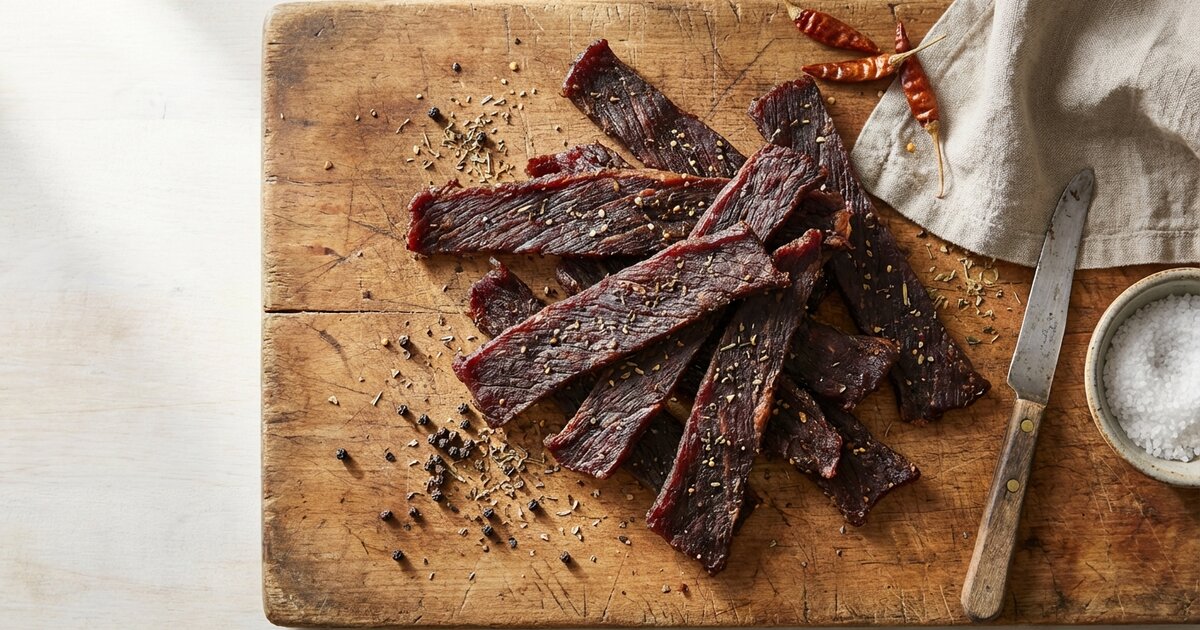
Beef jerky is the ultimate portable protein. It’s shelf-stable, doesn’t need refrigeration, and packs serious protein into a small package. For macro trackers, it’s a convenient way to hit protein goals when whole food options aren’t available.
But beef jerky isn’t all upside. The sodium content is significant, the carbs from added sugars can surprise you, and premium brands are expensive. Understanding the full macro picture helps you use jerky strategically rather than mindlessly.
This guide breaks down everything: exact macros by brand and type, how to find the best options for your diet, and when jerky makes sense in your nutrition plan.
Beef Jerky Macros: Quick Reference
Here’s the standard macro breakdown for commercial beef jerky. Values vary by brand, but these represent typical averages.
| Serving Size | Calories | Protein | Carbs | Fat | Sodium |
|---|---|---|---|---|---|
| 1 oz (28g) | 116 | 9.4g | 3.1g | 7.3g | 506mg |
| 50g | 207 | 17g | 5.5g | 13g | 903mg |
| 100g | 410 | 33g | 11g | 26g | 1,800mg |
| 1 piece (~14g) | 58 | 4.7g | 1.5g | 3.6g | 253mg |
Key insight: Beef jerky is protein-dense but not protein-exclusive. A typical serving delivers about 33% of calories from protein, 27% from carbs, and 40% from fat—not the pure protein bomb many assume.
Beef Jerky Macros by Brand
Brand differences are substantial. Here’s how popular options compare per 1 oz (28g) serving:
| Brand | Calories | Protein | Carbs | Fat | Sodium |
|---|---|---|---|---|---|
| Jack Link’s Original | 80 | 11g | 5g | 1.5g | 520mg |
| Tillamook Country Smoker | 70 | 12g | 3g | 1g | 430mg |
| Epic Beef | 90 | 10g | 3g | 4g | 320mg |
| Chomps Grass-Fed | 100 | 10g | 1g | 6g | 390mg |
| Country Archer | 70 | 10g | 5g | 1g | 390mg |
| Old Trapper | 80 | 10g | 4g | 2g | 520mg |
| Krave | 90 | 10g | 6g | 2g | 310mg |
| Oberto | 80 | 12g | 3g | 2g | 580mg |
Highest protein: Tillamook and Oberto lead with 12g per ounce.
Lowest carbs: Chomps at 1g—ideal for keto.
Lowest sodium: Krave and Epic around 310-320mg.
Best all-around for macros: Tillamook offers the best protein-to-everything-else ratio.
Understanding Beef Jerky Nutrition Labels
Reading jerky labels requires attention because serving sizes vary wildly between brands.
Serving Size Variations
- Jack Link’s: 1 oz (28g)
- Chomps: 1 stick (1.15 oz/32g)
- Epic: 1 strip (0.8 oz/23g)
- Bag servings: Some list “about 3 servings” per bag
Always check the serving size. A bag that looks single-serving might technically be 2-3 servings according to the label.
What’s Actually in Beef Jerky?
Typical ingredients:
- Beef (quality varies: conventional, grass-fed, organic)
- Sugar or sweeteners (brown sugar, cane sugar, honey)
- Salt and soy sauce (sodium sources)
- Spices and flavorings
- Preservatives (sodium nitrite in some brands)
The sugar question: Most commercial jerky contains 2-5g sugar per ounce from marinades. This is where the carbs come from—beef itself has zero carbs.
Beef Jerky for Different Diets
Beef Jerky for High-Protein Diets
Verdict: Good but not optimal as a primary protein source.
The math: To get 30g protein from jerky, you’d need about 3 oz, which delivers:
- 348 calories
- 30g protein
- 9g carbs
- 22g fat
- 1,518mg sodium
Compare to 6 oz chicken breast for the same 30g protein:
- 281 calories
- 53g protein (actually more)
- 0g carbs
- 6g fat
- 130mg sodium
Best use: Supplement your protein intake between meals, not as a meal replacement.
Beef Jerky for Keto
Verdict: Possible but choose carefully.
Standard jerky’s 3-5g carbs per ounce can add up on strict keto (20g daily limit). Two ounces of regular jerky could eat 30-50% of your carb budget.
Keto-friendly options:
- Chomps (1g carbs per stick)
- Epic Venison (2g carbs per bar)
- People’s Choice Zero Sugar (0g carbs)
- Cattaneo Bros Traditional (1g carbs)
These use minimal or no sugar in their marinades, keeping carbs negligible.
Beef Jerky for Weight Loss
Verdict: Can help, with caveats.
Pros:
- High protein increases satiety
- Requires chewing (slows eating)
- Portion-controlled packages
- No prep required
Cons:
- Calorie-dense for the volume
- High sodium may cause water retention
- Easy to overeat from the bag
- Expensive per calorie
Strategy: Use jerky as a protein-boosting snack between meals, not as a volume food. Pre-portion servings rather than eating from the bag.
Beef Jerky for Flexible Dieting/IIFYM
Verdict: Fits easily when you track accurately.
For flexible dieters, jerky is just another protein source to fit into your macros. The main consideration is sodium—if you’re eating jerky regularly, balance with lower-sodium foods at other meals.
Typical fit: 1 oz jerky as an afternoon snack adds 80-100 calories and 9-12g protein. Easy to work into most macro targets.
Use our Macro Calculator to determine your daily targets and see how jerky fits.
Beef Jerky vs Other Protein Snacks
How does jerky compare to other portable protein options?
| Snack | Calories | Protein | Carbs | Fat | Portability |
|---|---|---|---|---|---|
| Beef jerky (1 oz) | 116 | 9g | 3g | 7g | Excellent |
| String cheese (1 stick) | 80 | 7g | 1g | 6g | Excellent |
| Hard-boiled egg (1 large) | 78 | 6g | 0.5g | 5g | Good |
| Greek yogurt (5.3 oz) | 100 | 17g | 6g | 0g | Needs cold |
| Protein bar | 200 | 20g | 20g | 8g | Excellent |
| Deli turkey (2 oz) | 60 | 12g | 2g | 1g | Needs cold |
| Cottage cheese (1/2 cup) | 110 | 14g | 5g | 5g | Needs cold |
Jerky’s advantage: True shelf-stability. Unlike eggs, yogurt, or deli meat, jerky needs no refrigeration.
Jerky’s disadvantage: Protein-to-calorie ratio is mediocre compared to Greek yogurt or deli meat.
Types of Jerky Compared
Not all jerky is beef. Here’s how different meats compare:
| Type (1 oz) | Calories | Protein | Carbs | Fat |
|---|---|---|---|---|
| Beef jerky | 116 | 9g | 3g | 7g |
| Turkey jerky | 70 | 13g | 3g | 1g |
| Chicken jerky | 75 | 12g | 4g | 1g |
| Venison jerky | 80 | 14g | 4g | 1g |
| Bison jerky | 90 | 12g | 3g | 3g |
| Salmon jerky | 70 | 12g | 2g | 1g |
| Pork jerky | 100 | 10g | 4g | 5g |
For maximum protein per calorie: Turkey, chicken, and venison jerky beat beef significantly.
For lowest fat: Turkey and chicken jerky run under 2g fat per ounce.
For lowest carbs: Salmon jerky typically has the least added sugar.
Learn more about protein options in our Protein: The Complete Guide.
The Sodium Question
Let’s address the elephant in the room. Beef jerky is high in sodium—unavoidably so.
Why So Much Sodium?
Sodium serves multiple purposes in jerky:
- Preservation: Salt inhibits bacterial growth
- Moisture control: Draws out water for shelf stability
- Flavor: Enhances taste of dried meat
- Texture: Affects the chew and mouthfeel
You can’t make traditional jerky without significant sodium. It’s fundamental to the product.
How Much Sodium Is in Beef Jerky?
- Per ounce: 400-600mg (typical range)
- Per 100g: 1,500-2,000mg
- Daily recommendation: 2,300mg (max for most adults)
One ounce of jerky = 20-25% of your daily sodium limit.
Who Should Limit Beef Jerky?
- People with hypertension
- Those on sodium-restricted diets
- Anyone with kidney issues
- People prone to water retention
Managing Sodium If You Eat Jerky
- Limit to 1 oz per day most days
- Drink extra water to help process sodium
- Choose lower-sodium brands (Krave, Epic)
- Balance with low-sodium meals
- Avoid jerky on days you’re eating other high-sodium foods
Making Beef Jerky Fit Your Macros
Scenario 1: Cutting Phase (1,800 calories, 180g protein)
You’re in a caloric deficit and protein is priority. Where does jerky fit?
Daily protein target: 180g From whole foods (meals): ~140g Gap to fill with snacks: 40g
Option A: 2 oz beef jerky
- 232 calories
- 19g protein
- Still need 21g more from other sources
Option B: 1 oz beef jerky + Greek yogurt
- 116 + 100 = 216 calories
- 9g + 17g = 26g protein
- Better protein per calorie
Recommendation: Use jerky as ONE of your protein snacks, not the only one.
Scenario 2: Road Trip / Travel Day
Limited food options, need portable nutrition.
Smart jerky strategy:
- Bring 2-3 oz jerky (pre-portioned)
- Pair with nuts for fat and satiety
- Add an apple or banana for fiber and carbs
- Drink extra water (sodium + dehydration from travel)
Travel snack pack example:
- 1.5 oz beef jerky: 174 cal, 14g protein
- 1 oz almonds: 164 cal, 6g protein, 14g fat
- 1 medium apple: 95 cal, 25g carbs
- Total: 433 cal, 20g protein, 14g fat, 30g carbs
Scenario 3: Pre/Post Workout Snack
Is jerky good around training?
Pre-workout: Not ideal. Takes time to digest, and the sodium may cause discomfort during intense exercise.
Post-workout: Decent option. Protein helps recovery, but you’d benefit from faster-digesting protein and some carbs. Pair jerky with fruit or crackers.
Better post-workout choices: Protein shake, Greek yogurt, chocolate milk.
Best Beef Jerky for Specific Goals
Best for Maximum Protein
- Tillamook Country Smoker - 12g protein per oz
- Oberto All Natural - 12g protein per oz
- Jack Link’s - 11g protein per oz
Best for Keto/Low-Carb
- Chomps - 1g carbs per stick
- People’s Choice Zero Sugar - 0g carbs
- Epic Beef - 3g carbs with no added sugar
Best for Clean Ingredients
- Chomps - Grass-fed, Whole30 approved, no sugar
- Epic - Grass-fed, minimal ingredients
- Country Archer - No added nitrates, simple ingredients
Best Budget Option
- Jack Link’s - Widely available, reasonable price
- Old Trapper - Good value for quality
- Store brands (Costco Kirkland) - Best price per ounce
How to Read Beef Jerky Labels Like a Pro
Red Flags to Watch For
- High fructose corn syrup - Unnecessary sugar
- Excessive serving sizes - Bag may be 4+ servings
- “Made with beef” - May contain fillers
- Very low price - Quality concerns
Green Flags
- Grass-fed beef - Better fatty acid profile
- No added sugar - Lower carbs
- Simple ingredient list - Beef, salt, spices
- Whole30/Keto certified - Third-party verification
Beef Jerky Meal Ideas
Snack Combinations
Protein power snack:
- 1 oz beef jerky (9g protein)
- 1 string cheese (7g protein)
- Total: 16g protein, 196 calories
Balanced travel snack:
- 1 oz beef jerky
- Small handful almonds (1/4 cup)
- 1 small apple
- Total: 15g protein, 380 calories, good fat, fiber
Quick desk lunch addition:
- Salad with vegetables
- Add 1.5 oz jerky for protein
- Dress with olive oil
- Turns a sad salad into a meal
Using Jerky in Cooking
Jerky isn’t just a snack—it can add protein and flavor to meals:
- Scrambled eggs: Chop jerky into eggs
- Fried rice: Use jerky as the protein
- Trail mix: Combine with nuts and dark chocolate
- Salads: Crumble as a bacon alternative
- Wraps: Layer in lettuce wraps with veggies
Making Your Own Beef Jerky
Homemade jerky lets you control ingredients, reduce sodium (somewhat), and save money long-term.
Basic Homemade Jerky Macros
With lean beef and minimal marinade:
- Per oz: 70 calories, 11g protein, 1g carbs, 2g fat
- Sodium: Can reduce to 300-400mg per oz
Simple Marinade Recipe
- 1/4 cup low-sodium soy sauce
- 1 tbsp Worcestershire sauce
- 1 tsp black pepper
- 1 tsp garlic powder
- 1 tsp onion powder
- Optional: 1 tbsp honey (adds ~2g carbs per oz)
Dehydrator Method
- Slice lean beef (eye of round, top round) into 1/4” strips
- Marinate 4-24 hours
- Dehydrate at 160°F for 4-6 hours
- Store in airtight container
Cost comparison: Homemade runs $8-10/lb vs $20-30/lb for premium commercial brands.
For more protein-rich foods, check out Chicken Breast Macros and Eggs Macros.
Common Questions About Beef Jerky Macros
Does Beef Jerky Spike Blood Sugar?
Minimally for most people. The protein and fat slow glucose absorption, even with the small amount of sugar present. However, highly sweetened varieties (teriyaki, sweet flavors) will have more impact.
Is Gas Station Jerky the Same Quality?
Nutritionally similar to brand-name jerky, but quality varies. Check the label—some gas station brands are surprisingly good (Tillamook is often available), while others are loaded with fillers.
Can I Eat Beef Jerky Every Day?
You can, but moderation is wise due to sodium content. Daily intake of 1 oz is generally fine for healthy adults. More than that regularly may contribute to excessive sodium intake.
Does Beef Jerky Have Complete Protein?
Yes. As an animal protein, beef jerky contains all essential amino acids in appropriate ratios. It’s a complete protein source.
Why Does Beef Jerky Have Carbs If Beef Has None?
The carbs come entirely from marinades and seasonings—sugars, teriyaki sauce, honey, etc. Plain dried beef with just salt would have zero carbs.
The Bottom Line on Beef Jerky Macros
The good:
- Excellent portable protein source
- Shelf-stable and convenient
- Satisfying texture that slows eating
- Complete protein with all amino acids
The not-so-good:
- High sodium content
- Moderate carbs from added sugars
- Expensive per gram of protein
- Not the most efficient protein-to-calorie ratio
Best use case: Beef jerky shines as a supplemental protein source for travel, emergencies, and between-meal snacks. It’s not optimal as a primary protein source, but it fills a unique niche that other proteins can’t.
Smart strategy: Keep jerky in your desk, car, or bag for situations where whole food protein isn’t available. Choose brands that match your priorities (low-carb, low-sodium, high-protein, or clean ingredients), and track your intake accurately.
For calculating how beef jerky fits your personal macro targets, use our Macro Calculator to dial in your daily needs.
Understanding What Are Macronutrients helps you see how beef jerky’s protein, carbs, and fats contribute to your overall nutrition picture.
Related Articles

Dragonfruit Macros: Complete Nutrition Guide for Pitaya
Complete macro breakdown of dragonfruit (pitaya). Learn the calories, protein, carbs, and...
Read guide →
Bulgur Macros: Complete Nutritional Guide & Health Benefits
Discover bulgur's complete macro breakdown, nutritional benefits, and how to incorporate...
Read guide →
Radish Macros: Nutrition Facts and Health Benefits
Complete guide to radish macros and nutrition. Learn calories, protein, carbs, and health...
Read guide →Note: Nutrition values are approximate and may vary based on preparation method and source.