Celery Macros: Complete Nutrition Guide for This Ultra-Low-Calorie Vegetable
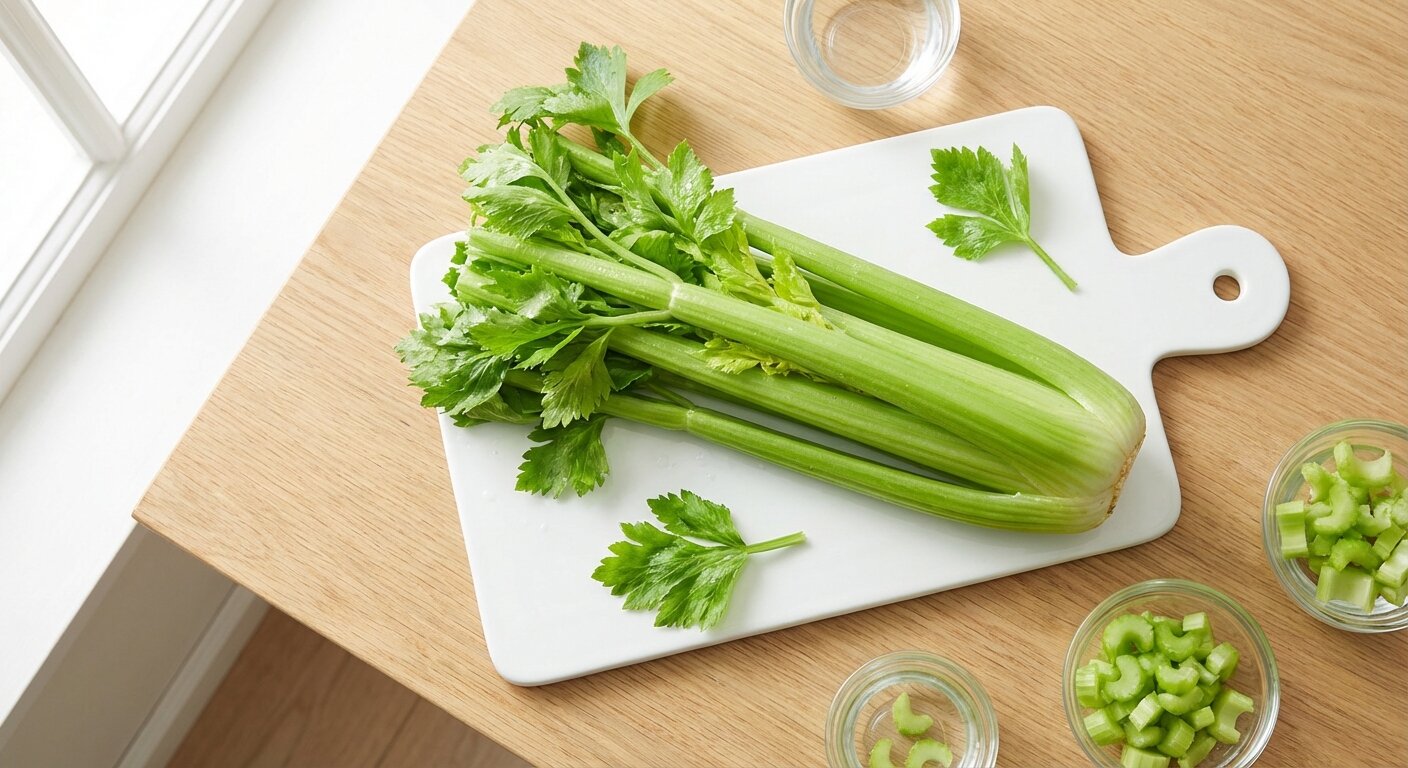
Celery might be the ultimate diet food—crunchy, hydrating, and so low in calories you can practically eat it with reckless abandon. But what exactly are you getting when you munch on those green stalks? Whether you’re tracking macros for weight loss, curious about the “negative calorie” myth, or just want to understand how celery fits into your nutrition plan, this guide breaks down everything you need to know.
We’ll cover celery’s complete macro profile, compare raw vs cooked vs juiced, explore why it’s a dieter’s dream, and share creative ways to incorporate it beyond just peanut butter vessels and Bloody Mary garnishes.
Ready to track your celery intake? Use our free macro calculator to see how celery fits into your personalized nutrition plan.
Related: Learn more about what macros are and how they impact your diet.
Celery Macros Breakdown
Raw Celery (Medium Stalk, 40g)
Basic Macros:
- Calories: 6 kcal
- Protein: 0.3g
- Carbohydrates: 1.2g
- Fiber: 0.6g
- Sugar: 0.5g
- Net Carbs: 0.6g (total carbs minus fiber)
- Fat: 0.1g
- Water: ~38g (95% water content)
Per 100g (about 2.5 medium stalks):
- Calories: 14 kcal
- Protein: 0.7g
- Carbohydrates: 3g
- Fiber: 1.6g
- Sugar: 1.3g
- Fat: 0.2g
Common Serving Sizes
1 Cup Chopped Celery (101g):
- Calories: 14 kcal
- Protein: 0.7g
- Carbs: 3g (1.6g fiber)
- Fat: 0.2g
Large Stalk (64g):
- Calories: 9 kcal
- Protein: 0.4g
- Carbs: 1.9g (1g fiber)
- Fat: 0.1g
Small Stalk (17g):
- Calories: 2 kcal
- Protein: 0.1g
- Carbs: 0.5g (0.3g fiber)
- Fat: 0g
Celery Variations
Cooked Celery (Boiled, 1 cup, 150g):
- Calories: 27 kcal
- Protein: 1.2g
- Carbs: 6g (2.4g fiber)
- Fat: 0.3g
Cooking celery increases the serving size per cup due to water absorption, slightly raising calories per volume but not significantly changing the macro profile.
Celery Juice (1 cup, 240ml):
- Calories: 16-20 kcal
- Protein: 0.9g
- Carbs: 3.8g (0.2g fiber) ← Most fiber removed
- Fat: 0.2g
Note: Juicing removes most fiber, reducing satiety despite similar calories.
Celery Root/Celeriac (1 cup raw, 156g):
- Calories: 66 kcal
- Protein: 2.3g
- Carbs: 14.4g (2.8g fiber)
- Fat: 0.5g
Celery root is a different vegetable entirely, despite the name—much higher in calories and carbs than celery stalks.
Micronutrients in Celery
While celery is nearly all water and provides minimal macros, it does offer several micronutrients:
Per 1 cup chopped celery (101g):
- Vitamin K: 29.3μg (29% DV) - Important for blood clotting and bone health
- Potassium: 263mg (6% DV) - Electrolyte balance and blood pressure
- Folate: 36μg (9% DV) - Cell growth and DNA synthesis
- Vitamin A: 453 IU (9% DV) - Vision and immune function
- Vitamin C: 3.1mg (5% DV) - Antioxidant and immune support
- Manganese: 0.1mg (5% DV) - Bone health and metabolism
Antioxidants:
- Apigenin: Anti-inflammatory flavonoid linked to reduced cancer risk
- Luteolin: Antioxidant that may have neuroprotective effects
- Phenolic acids: Caffeic acid, ferulic acid, and others with antioxidant properties
The Negative-Calorie Food Myth
You’ve probably heard celery called a “negative-calorie food”—meaning you supposedly burn more calories digesting it than it contains. This isn’t technically accurate, but there’s a kernel of truth.
The Reality:
- Celery contains ~6 calories per stalk
- Your body uses about 10-30% of consumed calories for digestion (thermic effect of food)
- For celery, that’s roughly 0.6-1.8 calories burned during digestion
- Net result: You still absorb about 4-5 calories per stalk
Why the myth persists:
- Celery is so low in calories that the metabolic cost of digestion is unusually high relative to its calorie content
- The fiber and high water content require more mechanical digestion than many foods
- Psychologically, eating celery “feels” like free food because the calorie impact is negligible
Bottom line: While not truly negative-calorie, celery is close enough to zero that it’s functionally irrelevant for macro tracking unless you’re eating pounds of it.
Why Celery Is Perfect for Cutting
Celery is a bodybuilder and dieter’s secret weapon for several reasons:
1. Extreme Volume-to-Calorie Ratio
- You can eat an entire cup of chopped celery for just 14 calories
- Compare that to 1 tablespoon of peanut butter (94 calories) often paired with celery
- Perfect for high-volume eating to feel full while maintaining a calorie deficit
2. High Water Content (95%)
- Helps with hydration
- Contributes to satiety
- Adds bulk to meals without adding calories
3. Decent Fiber (1.6g per cup)
- Slows digestion and increases fullness
- Supports gut health
- Helps regulate blood sugar
4. Satisfying Crunch
- Provides texture and satisfaction when you want to munch on something
- Natural appetite suppressant—the act of chewing signals satiety
5. Minimal Impact on Macros
- Won’t interfere with hitting protein, carb, or fat targets
- Easy to fit into any diet (keto, low-carb, balanced macros, etc.)
6. Naturally Low in Sugar
- Only 0.5g sugar per stalk
- Won’t spike blood sugar or insulin
How to Track Celery Macros
For most people: You can track celery as “0 calories” unless you’re eating massive quantities.
If you want precision:
- Count stalks: 1 medium stalk = 6 calories, 0.3g protein, 1.2g carbs, 0.1g fat
- Weigh if needed: Most food scales can handle celery—1g = 0.14 calories
- Round up with dips: If eating celery with peanut butter, hummus, or ranch, focus on tracking the dip—that’s where the calories are
MyFitnessPal tips:
- Search “celery raw” for the most accurate generic entry
- Use “1 medium stalk (40g)” or “1 cup chopped (101g)” for consistency
- Avoid entries that include added butter, salt, or dressings
Meal prep consideration: Celery doesn’t add meaningful macros to recipes. If you’re making a chicken salad with celery, track the chicken, mayo, and bread—the celery is nutritionally negligible.
Celery in Different Diet Approaches
Keto Diet
Verdict: Excellent
- Net carbs: 0.6g per stalk (1.2g total - 0.6g fiber)
- 3g total carbs per cup (1.6g fiber = 1.4g net)
- Perfect low-carb vehicle for high-fat dips like cream cheese or blue cheese dressing
Low-Carb
Verdict: Perfect
- One of the lowest-carb vegetables available
- Can eat liberally without worrying about carb limits
High-Protein
Verdict: Neutral
- Celery won’t help you hit protein goals (0.7g per cup)
- But it’s a great low-cal side to high-protein meals
IIFYM/Flexible Dieting
Verdict: Ideal filler food
- Helps create volume and satisfaction without using up macro budget
- Pairs well with macro-dense foods (nut butters, cheese, meats)
Whole30/Paleo
Verdict: Compliant
- Whole, unprocessed vegetable
- Natural and nutrient-dense
Vegan/Vegetarian
Verdict: Staple
- Adds crunch and freshness to plant-based meals
- Good source of potassium and vitamin K
Creative Ways to Eat Celery
Beyond Peanut Butter:
-
Tuna Salad Boats
- Hollow out celery stalks
- Fill with tuna salad (tuna, Greek yogurt, mustard, dill)
- High protein, low carb, crunchy
-
Buffalo Celery Sticks
- Toss celery sticks in buffalo sauce
- Serve with blue cheese or ranch
- All the flavor, fraction of the calories of wings
-
Celery Slaw
- Thinly slice celery
- Mix with apple cider vinegar, olive oil, salt, pepper
- Crunchy, refreshing, nearly zero-calorie side
-
Braised Celery
- Cut into 3-inch pieces
- Braise in chicken stock with garlic and herbs
- Surprisingly elegant side dish
-
Celery Leaf Pesto
- Don’t toss those leaves! Blend with garlic, parmesan, olive oil, nuts
- Use as sauce for pasta or chicken
-
Crudité Platter
- Pair with hummus, tzatziki, or Greek yogurt dip
- Track the dip, not the celery
-
Juicing/Smoothies
- Adds freshness without many calories
- Pairs well with apple, cucumber, lemon
-
Soups and Stews
- Classic mirepoix base (celery, carrot, onion)
- Adds flavor and texture for almost no calories
Celery vs Other Low-Calorie Vegetables
Calories per 100g (raw):
- Celery: 14 calories
- Cucumber: 15 calories
- Lettuce (iceberg): 14 calories
- Lettuce (romaine): 17 calories
- Radishes: 16 calories
- Zucchini: 17 calories
- Bell peppers: 26 calories
- Broccoli: 34 calories
- Carrots: 41 calories
Celery is tied with iceberg lettuce as the lowest-calorie common vegetable, making it a top choice for volume eating.
Common Questions About Celery Macros
Does cooking celery change its macros?
Slightly. Cooked celery absorbs water during boiling, increasing the weight per cup and therefore the calories per cup (27 vs 14). However, the actual macronutrient density doesn’t change much—you’re just eating more celery per volume.
Is celery juice healthier than whole celery?
Not really. Celery juice removes most of the fiber, which is one of celery’s main benefits. You get similar vitamins and minerals, but you lose satiety and gut health benefits. Whole celery is generally better.
Can you eat too much celery?
Technically yes, but it’s very difficult. Excessive celery consumption could lead to digestive issues due to fiber, or in extreme cases, photosensitivity due to psoralens (compounds that make skin sensitive to UV light). You’d have to eat pounds daily for this to be a concern.
Does celery interact with medications?
Celery contains natural compounds that may have mild blood-thinning effects and could theoretically interact with anticoagulants like warfarin. If you’re on blood thinners, consult your doctor, but normal dietary amounts are generally fine.
Is organic celery worth it?
Celery consistently ranks on the EWG’s “Dirty Dozen” list for pesticide residues. If budget allows, organic celery may reduce exposure to pesticides. Washing thoroughly helps with conventional celery.
How long does celery stay fresh?
Store celery in the crisper drawer, ideally wrapped in aluminum foil (surprisingly, this keeps it crisp longer than plastic). Properly stored, it lasts 1-2 weeks. If celery gets limp, you can revive it by cutting the ends and placing in ice water for 30 minutes.
Can I meal prep celery?
Yes, but it loses crunch over time. For best results, cut celery just before eating. If meal prepping, store in water in an airtight container and change water daily.
Does celery have any protein?
Minimal—0.7g per cup. You’d need to eat 71 cups of celery to get 50g of protein (and you’d be eating 994 calories of celery, which sounds like a challenge video).
Sample Macro Calculations
Example 1: Celery with Peanut Butter Snack
- 3 medium celery stalks (120g): 18 calories, 0.9g protein, 3.6g carbs, 0.3g fat
- 2 tablespoons peanut butter (32g): 188 calories, 8g protein, 6g carbs, 16g fat
- Total: 206 calories, 8.9g protein, 9.6g carbs, 16.3g fat
The peanut butter is 91% of the calories.
Example 2: Chicken Salad with Celery (1 cup)
- 4oz grilled chicken breast: 187 calories, 35g protein, 0g carbs, 4g fat
- 1 cup chopped celery: 14 calories, 0.7g protein, 3g carbs, 0.2g fat
- 2 tablespoons mayo: 188 calories, 0.3g protein, 0.1g carbs, 21g fat
- Total: 389 calories, 36g protein, 3.1g carbs, 25.2g fat
The celery is 3.6% of the total calories.
Example 3: Celery Juice (16oz)
- 16oz celery juice: 32-40 calories, 1.8g protein, 7.6g carbs, 0.4g fat
- Negligible impact on macros, similar to drinking water with slight carbs
How Celery Fits Your Goals
Weight Loss:
- Perfect. Eat as much as you want. The volume and crunch help satisfy hunger without meaningfully impacting calorie deficit.
Muscle Gain:
- Neutral. Celery won’t help you hit protein or calorie surplus goals, but it’s a healthy addition to meals. Pair with protein-rich dips or use in meals alongside calorie-dense foods.
Maintenance:
- Great for snacking. Keeps you full between meals without adding calories. Helps maintain weight by preventing overeating of more calorie-dense foods.
Keto:
- Excellent. Extremely low net carbs. Use as a crunchy vehicle for high-fat dips like cream cheese, blue cheese, or guacamole.
Performance/Athletes:
- Hydration aid. The 95% water content and potassium make celery a good hydrating snack post-workout. Pair with protein for recovery.
The Bottom Line on Celery Macros
Celery is about as close to “free food” as you’ll find in the macro tracking world. With just 6 calories per stalk, 95% water content, and enough fiber to provide satiety, it’s the ultimate low-calorie, high-volume vegetable.
Key takeaways:
- 6 calories per medium stalk (14 per cup)
- Minimal macros: 0.7g protein, 3g carbs, 0.2g fat per cup
- Not truly negative-calorie, but close enough to be functionally irrelevant
- Perfect for cutting: High volume, low calories, satisfying crunch
- Keto-friendly: Only 1.4g net carbs per cup
- Nutrient bonuses: Vitamin K, potassium, antioxidants
Whether you’re tracking every macro or just trying to eat more veggies, celery is a no-brainer addition to your diet. It won’t make or break your macros—but it might just keep you sane during a cut.
Want to see how celery fits into your personalized macro plan? Try our free macro calculator and build a nutrition plan that works for you.
Frequently Asked Questions
How many calories are in a celery stalk?
One medium celery stalk (about 40g or 7-8 inches long) contains approximately 6 calories. This makes celery one of the lowest-calorie vegetables you can eat. A large stalk (64g) has about 9 calories, while a small stalk (17g) has just 2 calories.
The reason celery is so low in calories is its composition—it’s 95% water with minimal macronutrients. The remaining 5% consists primarily of fiber (about 0.6g per stalk) and trace amounts of carbohydrates (1.2g), protein (0.3g), and fat (0.1g).
This ultra-low calorie density makes celery perfect for volume eating during a cut. You can munch on several stalks while barely impacting your daily calorie budget.
Does celery really have negative calories?
No, celery does not have negative calories—that’s a persistent myth. While celery is extremely low in calories (6 per stalk), your body still absorbs a net positive amount of energy from it.
Here’s the math: Celery contains about 6 calories per stalk. Your body uses approximately 10-30% of consumed calories for digestion, absorption, and processing (called the thermic effect of food or TEF). For celery, that’s roughly 0.6-1.8 calories burned during digestion.
The net result is you still absorb about 4-5 calories per stalk—not negative, but close to zero.
The myth likely persists because celery’s calorie content is so low that the metabolic cost of digestion is unusually high relative to what you’re eating. Plus, the high water and fiber content require more mechanical digestion than many foods, giving celery a “free food” feel.
Bottom line: while not technically negative-calorie, celery is so low in calories that it’s functionally irrelevant for macro tracking unless you’re eating pounds of it daily.
What are the complete macros for celery?
Here are the complete macronutrient breakdowns for celery in common serving sizes:
Per medium stalk (40g):
- Calories: 6 kcal
- Protein: 0.3g
- Carbohydrates: 1.2g (Fiber: 0.6g, Sugar: 0.5g, Net carbs: 0.6g)
- Fat: 0.1g
- Water: ~38g (95%)
Per cup chopped (101g):
- Calories: 14 kcal
- Protein: 0.7g
- Carbohydrates: 3g (Fiber: 1.6g, Sugar: 1.3g, Net carbs: 1.4g)
- Fat: 0.2g
Per 100g (about 2.5 stalks):
- Calories: 14 kcal
- Protein: 0.7g
- Carbohydrates: 3g (Fiber: 1.6g)
- Fat: 0.2g
Celery is almost entirely water (95%), with minimal macronutrients. The small amount of carbohydrates comes primarily from fiber and natural sugars. Protein and fat are nearly negligible.
This macro profile makes celery perfect for adding volume and crunch to meals without significantly impacting your daily macro targets.
Is celery good for weight loss?
Yes, celery is excellent for weight loss and is considered one of the best “diet foods” for several reasons:
1. Extreme calorie density: At just 14 calories per cup, you can eat large quantities of celery to feel full without consuming many calories. This high-volume, low-calorie ratio is perfect for maintaining a calorie deficit.
2. High water content: Celery is 95% water, which contributes to hydration and satiety. Water-rich foods help you feel fuller longer.
3. Fiber content: With 1.6g of fiber per cup, celery slows digestion, increases fullness, and helps regulate blood sugar—all beneficial for appetite control.
4. Satisfying crunch: The mechanical act of chewing celery signals satiety to your brain, making it a good snack when you want to munch on something without blowing your calorie budget.
5. Minimal macro impact: Celery won’t interfere with hitting your protein, carb, or fat targets, making it easy to fit into any diet plan.
6. Low sugar: Only 0.5g of sugar per stalk means celery won’t spike blood sugar or trigger cravings.
While celery alone won’t cause weight loss (calorie deficit is still required), it’s an extremely useful tool for managing hunger and creating filling, low-calorie meals during a cut.
Does celery juice have the same macros as whole celery?
No, celery juice has similar calories but significantly less fiber than whole celery—and that difference matters for nutrition and satiety.
Whole celery (1 cup chopped, 101g):
- Calories: 14 kcal
- Fiber: 1.6g
- Protein: 0.7g
- Carbs: 3g
Celery juice (1 cup, 240ml):
- Calories: 16-20 kcal (similar)
- Fiber: 0.2g ← Most fiber removed
- Protein: 0.9g
- Carbs: 3.8g
The juicing process removes most of the insoluble fiber, which is one of celery’s main nutritional benefits. Fiber slows digestion, promotes fullness, supports gut health, and helps regulate blood sugar.
Without fiber, celery juice is essentially flavored water with micronutrients. You’ll get similar vitamins (vitamin K, potassium) and antioxidants (apigenin, luteolin), but you lose the satiety and digestive benefits of whole celery.
Bottom line: Whole celery is generally better for nutrition and weight management. If you enjoy celery juice, it’s fine as a hydrating beverage, but don’t consider it a replacement for eating whole vegetables with fiber intact.
Can I eat celery on a keto diet?
Yes, celery is excellent for keto and is one of the most keto-friendly vegetables available.
Net carbs per serving:
- 1 medium stalk: 0.6g net carbs (1.2g total carbs - 0.6g fiber)
- 1 cup chopped: 1.4g net carbs (3g total carbs - 1.6g fiber)
With such low net carb counts, you can eat celery liberally on keto without worrying about going over your daily carb limit (typically 20-50g net carbs for ketosis).
Keto-friendly uses:
- Dipping vehicle: Use celery sticks with high-fat dips like cream cheese, blue cheese dressing, guacamole, or ranch
- Crunch factor: Adds texture to keto meals without adding carbs
- Hydration: The 95% water content helps with electrolyte balance and hydration on keto
- Meal filler: Adds volume to salads, soups, and stir-fries without impacting carb macros
Celery also provides potassium (263mg per cup), which is important on keto since the diet can be naturally lower in this electrolyte.
Just be mindful of what you pair celery with—high-fat dips can be calorie-dense, so track those if you’re also watching calories for weight loss.
How much protein is in celery?
Celery contains very little protein—approximately 0.3g per medium stalk or 0.7g per cup of chopped celery.
To put this in perspective: if you were trying to get 50g of protein from celery alone, you’d need to eat about 71 cups of chopped celery, which would total 994 calories. This is obviously impractical (and would be a wild YouTube challenge).
Protein content by serving size:
- 1 medium stalk (40g): 0.3g protein
- 1 cup chopped (101g): 0.7g protein
- 1 large stalk (64g): 0.4g protein
- 100g (about 2.5 stalks): 0.7g protein
Celery should not be relied upon as a protein source. Instead, pair it with high-protein foods like:
- Peanut butter or almond butter (2 tbsp = 8g protein)
- Hummus (¼ cup = 5g protein)
- Tuna salad (4oz tuna = 28g protein)
- Greek yogurt dip (½ cup = 10g protein)
- Cream cheese and smoked salmon (2oz salmon = 11g protein)
Celery’s role in your diet is volume, crunch, hydration, and fiber—not protein contribution.
What nutrients does celery provide besides macros?
While celery is low in macronutrients, it does provide several important micronutrients and beneficial compounds:
Vitamins (per 1 cup chopped, 101g):
- Vitamin K: 29.3μg (29% Daily Value) - Essential for blood clotting and bone health
- Folate: 36μg (9% DV) - Important for cell growth, DNA synthesis, and pregnancy health
- Vitamin A: 453 IU (9% DV) - Supports vision, immune function, and skin health
- Vitamin C: 3.1mg (5% DV) - Antioxidant that supports immune health and collagen production
- Manganese: 0.1mg (5% DV) - Plays a role in bone health, metabolism, and antioxidant function
Minerals:
- Potassium: 263mg (6% DV) - Electrolyte important for blood pressure regulation, heart function, and muscle contractions
- Small amounts of calcium, magnesium, and phosphorus
Antioxidants and phytonutrients:
- Apigenin: A flavonoid with anti-inflammatory properties and potential anti-cancer effects
- Luteolin: An antioxidant that may have neuroprotective and anti-inflammatory benefits
- Phenolic acids: Including caffeic acid and ferulic acid, which have antioxidant properties
- Phthalides: Compounds that give celery its distinctive smell and may help lower blood pressure
While you shouldn’t eat celery specifically for micronutrients (other vegetables are more nutrient-dense), these bonuses make celery more than just crunchy water—it’s a legitimate addition to a healthy diet.
Related Articles

Dragonfruit Macros: Complete Nutrition Guide for Pitaya
Complete macro breakdown of dragonfruit (pitaya). Learn the calories, protein, carbs, and...
Read guide →
Bulgur Macros: Complete Nutritional Guide & Health Benefits
Discover bulgur's complete macro breakdown, nutritional benefits, and how to incorporate...
Read guide →
Radish Macros: Nutrition Facts and Health Benefits
Complete guide to radish macros and nutrition. Learn calories, protein, carbs, and health...
Read guide →Note: Nutrition values are approximate and may vary based on preparation method and source.