Monster Energy Macros: Complete Nutrition Guide
Reviewed by Dr. Michael Torres, PhD
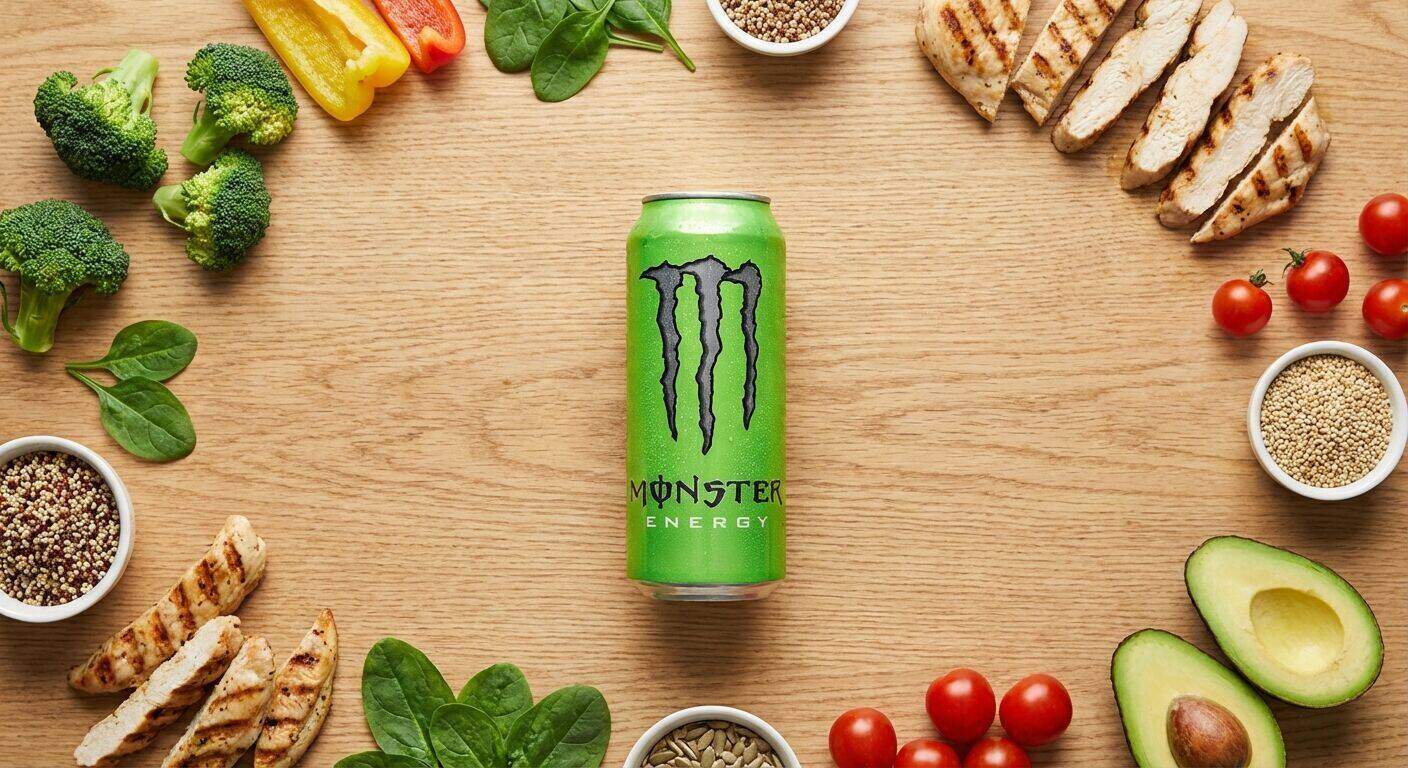
Monster Energy Macros: Complete Nutrition Guide
Monster Energy is one of the world’s most popular energy drinks, with its iconic green claw logo recognized across gyms, offices, and gas stations everywhere. But if you’re tracking macros—whether for fat loss, muscle building, or athletic performance—you need to understand exactly what you’re drinking.
The reality: A standard 16 oz can of Monster Energy contains 210 calories, 0g protein, 54g carbs (all from sugar), and 0g fat. That’s more sugar than two Krispy Kreme donuts, with zero nutritional value beyond caffeine.
But Monster Energy isn’t just one product. The brand offers dozens of varieties—from high-sugar originals to zero-calorie Ultra editions—each with dramatically different macro profiles. This guide breaks down every option so you can make informed decisions that align with your nutrition goals.
Whether you’re wondering if Monster fits your cutting phase, comparing it to other energy drinks, or deciding between original and zero-sugar varieties, you’ll find comprehensive macro breakdowns, flavor comparisons, and practical advice for fitting (or avoiding) Monster Energy in your diet.
Ready to calculate your macros? Try our Macro Calculator to determine your optimal protein, carb, and fat targets.
Related: Learn more about what macros are and how they impact your diet.
Monster Energy Macros: Quick Reference
Here’s what you’re drinking when you crack open a Monster Energy can:
Standard Monster Energy (16 oz can)
| Macro | Amount | % of 2,000 cal diet |
|---|---|---|
| Calories | 210 | 11% |
| Protein | 0g | 0% |
| Carbohydrates | 54g | 18% |
| - Sugars | 54g | 108% DV |
| Fat | 0g | 0% |
| Caffeine | 160mg | - |
| Sodium | 180mg | 8% DV |
Key nutrients:
- B-Vitamins: High doses of B2 (riboflavin), B3 (niacin), B6, and B12 - often 100-200% of daily values
- Taurine: 2,000mg per can (amino acid, not a macro)
- Ginseng: Various amounts depending on formula
- L-Carnitine: Present in some varieties
Monster Energy Zero Sugar (16 oz can)
| Macro | Amount | % of 2,000 cal diet |
|---|---|---|
| Calories | 10 | <1% |
| Protein | 0g | 0% |
| Carbohydrates | 2g | <1% |
| - Sugars | 0g | 0% |
| Fat | 0g | 0% |
| Caffeine | 140-160mg | - |
| Sodium | 180-200mg | 8-9% DV |
Sweeteners used: Sucralose, acesulfame potassium, erythritol (depending on variety)
The macro truth: Standard Monster is a pure carbohydrate bomb with no protein or fat. Zero Sugar varieties eliminate the caloric impact but replace sugar with artificial sweeteners that some people prefer to avoid.
Understanding Monster Energy Serving Sizes
Unlike many beverages that list “per serving” nutrition, Monster Energy typically displays information per can—but can sizes vary significantly:
Standard Can Sizes
16 oz (473 mL) - Most common
- What you get: 210 calories, 54g carbs (standard)
- Caffeine: 160mg
- Found in: Original Monster, most flavors
- Tracking tip: One can = one serving, log as is
24 oz (710 mL) - “Mega Monster”
- What you get: 310 calories, 81g carbs (standard)
- Caffeine: 240mg
- Found in: Larger gas station sizes
- Tracking tip: 1.5x the macros of a standard can
12 oz (355 mL) - Import/Java varieties
- What you get: 160 calories, 40g carbs
- Caffeine: 120mg
- Found in: Monster Java, some import flavors
- Tracking tip: 0.75x the macros of standard can
8.4 oz (250 mL) - Mini cans
- What you get: 110 calories, 27g carbs
- Caffeine: 80mg
- Found in: Import Original, some specialty stores
- Tracking tip: Exactly half the standard can
Common Serving Size Mistakes
Mistake #1: Drinking half, logging a full can If you drink half a 16 oz Monster throughout the day, you still consumed 105 calories and 27g carbs. Half-consumed cans still count.
Solution: Pour into a measured glass if you want partial servings, or commit to tracking the full can when you open it.
Mistake #2: Assuming “energy drink” = one serving Some people treat all energy drinks as “one serving” regardless of size. A 24 oz Monster has 50% more caffeine and macros than standard.
Solution: Always check the can size. Log by volume, not by “one can.”
Mistake #3: Forgetting opened cans from earlier Energy drinks go flat but don’t go away. That half-flat Monster from this morning still counts toward your daily macros.
Solution: Log it when you open it, not when you finish it.
Monster Energy Varieties: Complete Macro Comparison
Monster has expanded far beyond the original green can. Here’s every major variety with complete macro breakdowns:
Original/Classic Line (Full Sugar)
Monster Energy Original (Green)
- Size: 16 oz
- Calories: 210
- Protein: 0g
- Carbs: 54g (54g sugar)
- Fat: 0g
- Caffeine: 160mg
- Flavor profile: Citrus-berry, slightly medicinal
- Best for: Post-workout carb spike, emergency energy
Monster Energy Lo-Carb
- Size: 16 oz
- Calories: 40
- Protein: 0g
- Carbs: 8g (6g sugar)
- Fat: 0g
- Caffeine: 140mg
- Flavor profile: Lighter citrus
- Best for: Transitioning from full-sugar to zero-sugar
Monster Energy Assault (Red)
- Size: 16 oz
- Calories: 200
- Protein: 0g
- Carbs: 52g (51g sugar)
- Fat: 0g
- Caffeine: 160mg
- Flavor profile: Cherry-berry
- Best for: Flavor variety with similar macros
Monster Ultra Line (Zero Sugar)
The Ultra line uses artificial sweeteners (sucralose, ace-K, erythritol) for flavor without sugar:
Monster Ultra Zero (White)
- Calories: 10
- Protein: 0g
- Carbs: 2g (0g sugar)
- Fat: 0g
- Caffeine: 140mg
- Sweetness level: Moderate
- Flavor: Light citrus, refreshing
Monster Ultra Blue
- Calories: 10
- Protein: 0g
- Carbs: 2g (0g sugar)
- Fat: 0g
- Caffeine: 140mg
- Flavor: Blue raspberry
Monster Ultra Red
- Calories: 10
- Protein: 0g
- Carbs: 2g (0g sugar)
- Fat: 0g
- Caffeine: 140mg
- Flavor: Cranberry-berry
Monster Ultra Sunrise (Orange)
- Calories: 10
- Protein: 0g
- Carbs: 2g (0g sugar)
- Fat: 0g
- Caffeine: 140mg
- Flavor: Orange citrus
Monster Ultra Paradise (Green)
- Calories: 10
- Protein: 0g
- Carbs: 2g (0g sugar)
- Fat: 0g
- Caffeine: 140mg
- Flavor: Kiwi-lime-cucumber
Monster Ultra Violet (Purple)
- Calories: 10
- Protein: 0g
- Carbs: 2g (0g sugar)
- Fat: 0g
- Caffeine: 140mg
- Flavor: Grape-citrus
Monster Ultra Peachy Keen (Peach)
- Calories: 10
- Protein: 0g
- Carbs: 2g (0g sugar)
- Fat: 0g
- Caffeine: 140mg
- Flavor: Peach tea
Monster Ultra Watermelon
- Calories: 10
- Protein: 0g
- Carbs: 2g (0g sugar)
- Fat: 0g
- Caffeine: 140mg
- Flavor: Watermelon
Monster Ultra Fiesta (Mango)
- Calories: 10
- Protein: 0g
- Carbs: 2g (0g sugar)
- Fat: 0g
- Caffeine: 140mg
- Flavor: Mango-tropical
Monster Ultra Rosa (Pink)
- Calories: 0
- Protein: 0g
- Carbs: 0g
- Fat: 0g
- Caffeine: 140mg
- Flavor: Floral-berry
Monster Ultra Gold (Pineapple)
- Calories: 10
- Protein: 0g
- Carbs: 2g (0g sugar)
- Fat: 0g
- Caffeine: 140mg
- Flavor: Pineapple
Ultra Line Macro Summary: All Ultra varieties contain 0-10 calories, 0-2g carbs, 0g sugar, 140mg caffeine. The only macro-relevant difference is flavor preference.
Monster Rehab Line (Recovery Blend)
Monster Rehab combines energy drink ingredients with tea, lemonade, and electrolytes:
Monster Rehab Tea + Lemonade
- Size: 16 oz
- Calories: 20
- Protein: 0g
- Carbs: 5g (5g sugar)
- Fat: 0g
- Caffeine: 160mg
- Unique: Contains real brewed tea
Monster Rehab Peach Tea
- Size: 16 oz
- Calories: 25
- Protein: 0g
- Carbs: 6g (6g sugar)
- Fat: 0g
- Caffeine: 160mg
Monster Rehab Raspberry Tea
- Size: 16 oz
- Calories: 25
- Protein: 0g
- Carbs: 6g (6g sugar)
- Fat: 0g
- Caffeine: 160mg
Monster Rehab Pink Lemonade
- Size: 16 oz
- Calories: 20
- Protein: 0g
- Carbs: 5g (5g sugar)
- Fat: 0g
- Caffeine: 160mg
Rehab Line Macro Summary: Lowest-calorie options with sugar (20-25 cal, 5-6g carbs). Better than original Monster but still contains some sugar. Not truly “zero” like Ultra.
Monster Java Line (Coffee + Energy)
Monster Java blends coffee with energy drink ingredients and cream/milk:
Monster Java Mean Bean
- Size: 15 oz
- Calories: 200
- Protein: 4g
- Carbs: 33g (30g sugar)
- Fat: 6g (3g saturated)
- Caffeine: 188mg
- Unique: Contains actual protein and fat from milk/cream
Monster Java Salted Caramel
- Size: 15 oz
- Calories: 200
- Protein: 4g
- Carbs: 32g (29g sugar)
- Fat: 6g (3g saturated)
- Caffeine: 188mg
Monster Java Swiss Chocolate
- Size: 15 oz
- Calories: 200
- Protein: 4g
- Carbs: 32g (29g sugar)
- Fat: 6g (3g saturated)
- Caffeine: 188mg
Monster Java Vanilla Light
- Size: 15 oz
- Calories: 100
- Protein: 4g
- Carbs: 16g (14g sugar)
- Fat: 2g (1g saturated)
- Caffeine: 188mg
- Best for: Lower-calorie coffee option
Java Line Macro Summary: The only Monster products with protein and fat due to coffee and dairy. Still high in sugar, but more balanced macros than standard Monster. Higher caffeine content (188mg vs 160mg).
Monster Juice Line
Monster Pipeline Punch
- Size: 16 oz
- Calories: 210
- Protein: 0g
- Carbs: 52g (50g sugar)
- Fat: 0g
- Caffeine: 160mg
- Contains: 10% real juice
Monster Papillon (Peach)
- Size: 16 oz
- Calories: 200
- Protein: 0g
- Carbs: 50g (49g sugar)
- Fat: 0g
- Caffeine: 160mg
- Contains: 10% real juice
Monster Mango Loco
- Size: 16 oz
- Calories: 210
- Protein: 0g
- Carbs: 52g (51g sugar)
- Fat: 0g
- Caffeine: 160mg
- Contains: 10% real juice
Monster Pacific Punch
- Size: 16 oz
- Calories: 210
- Protein: 0g
- Carbs: 52g (51g sugar)
- Fat: 0g
- Caffeine: 160mg
- Contains: 10% real juice
Juice Line Macro Summary: Virtually identical to original Monster (200-210 cal, 50-54g sugar) despite “juice” branding. The 10% juice content doesn’t meaningfully change macros.
Monster Reign Line (Performance)
Monster’s “performance” sub-brand marketed toward fitness:
Monster Reign (various flavors)
- Size: 16 oz
- Calories: 10
- Protein: 0g
- Carbs: 1g (0g sugar)
- Fat: 0g
- Caffeine: 300mg (!)
- Added: BCAAs (3g), CoQ10, electrolytes
- Best for: High-caffeine pre-workout alternative
Reign Macro Reality: Despite fitness marketing, Reign provides no protein and the 3g BCAAs are insufficient for muscle building. The 300mg caffeine is the main functional ingredient—equivalent to 3 cups of coffee.
How Monster Energy Flavor Affects Macros
Unlike food where “flavor” often means different ingredients and macros, Monster Energy flavors within the same line have virtually identical nutritional profiles.
Within Original Line: Negligible Differences
Compare these “different” flavors:
- Original (Green): 210 cal, 54g carbs
- Assault (Red): 200 cal, 52g carbs
- Khaos (Orange): 210 cal, 52g carbs
- Pipeline Punch (Pink): 210 cal, 52g carbs
Macro difference: ±10 calories, ±2g carbs—essentially rounding error. Flavor extracts and colorings add negligible macros.
Within Ultra Line: Effectively Identical
All Ultra flavors (White, Blue, Red, Orange, Paradise, Violet, Peachy Keen, Watermelon, Fiesta, Gold) contain:
- 10 calories
- 2g carbs
- 0g sugar
- 140mg caffeine
The only exception is Ultra Rosa (Pink) with 0 calories, 0g carbs—likely due to different sweetener ratios.
Why Flavor Doesn’t Change Macros
Flavor compounds are macro-free:
- Natural and artificial flavors are used in tiny amounts (milligrams)
- Citric acid, preservatives, and colorings add negligible calories
- The sweetness comes from sugar (original line) or artificial sweeteners (Ultra line), not the “flavor”
The real macro determinants:
- Sugar vs no sugar (Original vs Ultra)
- Coffee/dairy addition (Java line adds protein/fat)
- Can size (24 oz has 1.5x macros of 16 oz)
Bottom line for tracking: Within the same Monster line, choose flavors based on taste preference—macros will be nearly identical.
Monster Energy vs Other Energy Drinks: Macro Comparison
How does Monster stack up against competitors? Here’s the truth:
Standard Energy Drinks (Full Sugar)
| Drink | Size | Calories | Protein | Carbs | Sugar | Fat | Caffeine |
|---|---|---|---|---|---|---|---|
| Monster Original | 16 oz | 210 | 0g | 54g | 54g | 0g | 160mg |
| Red Bull | 8.4 oz | 110 | 1g | 27g | 27g | 0g | 80mg |
| Red Bull (16 oz) | 16 oz | 210 | 2g | 52g | 52g | 0g | 152mg |
| Rockstar | 16 oz | 260 | 0g | 63g | 63g | 0g | 160mg |
| NOS | 16 oz | 210 | 0g | 54g | 54g | 0g | 160mg |
| Bang | 16 oz | 0 | 0g | 0g | 0g | 0g | 300mg |
| Celsius | 12 oz | 10 | 0g | 2g | 0g | 0g | 200mg |
Key insights:
- Monster vs Red Bull (same volume): Nearly identical macros. Red Bull has 2g protein from taurine; Monster has 0g.
- Monster vs Rockstar: Rockstar has MORE sugar (63g vs 54g) despite similar marketing
- Monster vs Bang/Celsius: Bang and Celsius are zero-sugar with higher caffeine—better macro profiles for cutting
Zero-Sugar Energy Drinks
| Drink | Size | Calories | Carbs | Caffeine |
|---|---|---|---|---|
| Monster Ultra | 16 oz | 10 | 2g | 140mg |
| Red Bull Zero | 8.4 oz | 5 | 1g | 80mg |
| Rockstar Zero | 16 oz | 20 | 4g | 160mg |
| Bang | 16 oz | 0 | 0g | 300mg |
| Celsius | 12 oz | 10 | 2g | 200mg |
| C4 Energy | 16 oz | 5 | 1g | 200mg |
| Reign | 16 oz | 10 | 1g | 300mg |
Key insights:
- Monster Ultra (10 cal, 140mg caffeine) is middle-of-the-pack for zero-sugar options
- Bang and Celsius offer higher caffeine with zero calories
- C4 Energy has more caffeine (200mg) with fewer calories (5 vs 10)
- Reign (Monster’s own performance line) has double the caffeine (300mg) for same calories (10)
Coffee vs Monster Energy
For pure caffeine delivery, how does Monster compare to coffee?
| Beverage | Size | Calories | Carbs | Caffeine | Cost |
|---|---|---|---|---|---|
| Black coffee | 16 oz | 5 | 0g | 180-200mg | $0.10-0.50 |
| Monster Original | 16 oz | 210 | 54g | 160mg | $2-3 |
| Monster Ultra | 16 oz | 10 | 2g | 140mg | $2-3 |
| Cold brew | 16 oz | 5 | 0g | 200-300mg | $0.20-0.60 |
Coffee wins on:
- ✅ Caffeine per calorie (black coffee: 40mg per calorie vs Monster Original: 0.76mg per calorie)
- ✅ Cost (1/5 to 1/10 the price)
- ✅ No added sugar
- ✅ Natural caffeine source
Monster wins on:
- ✅ Taste (if you dislike coffee)
- ✅ Added B-vitamins and taurine
- ✅ Convenience (no brewing)
- ✅ Variety (30+ flavors vs coffee’s limited range)
The macro verdict: If you’re tracking macros strictly, black coffee or Monster Ultra are your best options for caffeine. Standard Monster’s 210 calories of pure sugar are inefficient unless you specifically need quick carbs post-workout.
Pre-Workout Supplements vs Monster
Monster is often used as a pre-workout. How does it compare to dedicated supplements?
| Product | Calories | Carbs | Protein | Caffeine | Cost per serving |
|---|---|---|---|---|---|
| Monster Original | 210 | 54g | 0g | 160mg | $2-3 |
| Monster Ultra | 10 | 2g | 0g | 140mg | $2-3 |
| C4 Pre-Workout | 5 | 1g | 0g | 150mg | $0.70-1.00 |
| Legion Pulse | 5 | 0g | 0g | 350mg | $1.80-2.20 |
| Cellucor C4 Ultimate | 10 | 1g | 0g | 300mg | $1.50-2.00 |
Pre-workout supplements win on:
- ✅ Additional ergogenic ingredients (beta-alanine, citrulline, betaine)
- ✅ Higher caffeine options (300-350mg vs 160mg)
- ✅ Customizable dosing (scoop sizes)
- ✅ More cost-effective per serving
Monster wins on:
- ✅ No prep required (grab and go)
- ✅ Tastes better (subjective)
- ✅ Available everywhere
The fitness verdict: Dedicated pre-workouts provide more performance benefits with similar or better macro profiles. Monster is convenient but not optimized for training.
Monster Energy and Different Macro Goals
How does Monster Energy fit (or not fit) specific nutritional strategies?
Monster Energy for Fat Loss / Cutting
Standard Monster (210 cal, 54g sugar):
- ❌ Inefficient calorie use: 210 calories with zero protein, fiber, or micronutrients
- ❌ Blood sugar spike: 54g sugar causes insulin spike followed by crash and increased hunger
- ❌ Crowds out nutritious foods: 210 calories = 6 oz chicken breast OR 2 cups blueberries OR 2 tbsp almond butter with apple
Typical cutting macros (example: 1,800 cal, 140g protein, 180g carbs, 60g fat):
- One Monster = 12% of daily calories, 30% of daily carbs
- Leaves only 150g carbs for actual food
- Zero contribution to protein target
Better alternatives for cutting:
- Monster Ultra (10 cal): Negligible macro impact, provides caffeine for energy and appetite suppression
- Black coffee: 5 calories, 180-200mg caffeine, no sugar
- Green tea: 0 calories, 25-50mg caffeine, antioxidants
When standard Monster makes sense on a cut:
- Post-workout carb refeed: If you’re doing one high-carb meal per week, Monster can be part of that
- Pre-planned treat: If it fits your daily carbs and you genuinely enjoy it, one planned Monster won’t derail fat loss
- Emergency low blood sugar: If you’re diabetic or experiencing hypoglycemia, fast-acting sugar is appropriate
Verdict: Monster Ultra is acceptable for cutting. Standard Monster should be rare and intentional.
Monster Energy for Muscle Building / Bulking
Standard Monster (210 cal, 54g sugar):
- ✅ Quick carbs: 54g fast-digesting carbs can spike insulin and drive nutrients into muscles post-workout
- ✅ Calorie contribution: On a 3,500 cal bulk, 210 calories is manageable
- ❌ No protein: Doesn’t contribute to the ~180-220g daily protein target most bodybuilders need
- ❌ Not optimal: Better carb sources (rice, oats, fruit) come with fiber and micronutrients
Typical bulking macros (example: 3,500 cal, 200g protein, 450g carbs, 110g fat):
- One Monster = 6% of daily calories, 12% of daily carbs
- Still leaves 396g carbs and all protein/fat targets intact
When standard Monster makes sense for bulking:
- Post-workout with protein: Monster + whey protein shake = 210 cal, 54g carbs, 25g protein (from shake)
- Intra-workout carbs: Sipping during long training sessions for sustained energy
- Convenience calories: On busy days when hitting calorie targets is difficult
Monster Java (200 cal, 4g protein, 33g carbs, 6g fat):
- ✅ Actually contains protein: 4g protein is minimal but better than zero
- ✅ Balanced macros: Includes fat from cream/milk, making it more filling
- ❌ Still suboptimal: A protein shake with real food (banana, oats) is superior
Better bulking alternatives:
- Protein shake + banana: 300 cal, 30g protein, 45g carbs, 2g fat
- Monster + PB&J: 210 (Monster) + 350 (sandwich) = 560 cal, 15g protein, 85g carbs, 16g fat
- Mass gainer shake: 400-600 cal, 40-50g protein, 60-80g carbs, customizable
Verdict: Standard Monster can fit a bulk as a carb source, but should be paired with protein. Not optimal, but not prohibitive.
Monster Energy for Keto
Standard Monster (54g carbs, 54g sugar):
- ❌ Instantly kicks you out of ketosis: 54g carbs exceeds most people’s daily keto limit (20-50g total)
- ❌ Pure glucose: Spikes blood sugar and insulin, halting ketone production
- ❌ Wasted carb budget: If you have 25g daily carbs, Monster consumes them all
Monster Ultra (10 cal, 2g carbs, 0g sugar):
- ✅ Fits strict keto: 2g carbs is negligible in a 20-50g daily limit
- ✅ No sugar: Artificial sweeteners don’t spike blood glucose
- ⚠️ Sweetener debate: Some argue artificial sweeteners trigger insulin response or increase sweet cravings
Monster Zero Sugar debate for keto:
- Sweeteners used: Sucralose, acesulfame potassium, erythritol
- Erythritol: Sugar alcohol that doesn’t raise blood glucose, technically “keto-friendly”
- Sucralose/Ace-K: Artificial sweeteners with mixed research on insulin response
- Anecdotal reports: Some keto dieters report stalls or increased cravings from artificial sweeteners
Strict keto approach:
- Avoid all sweeteners (water, black coffee, unsweetened tea only)
- Monster Ultra permitted only occasionally
Flexible keto approach:
- Monster Ultra daily or several times per week is fine if it doesn’t trigger cravings or stall weight loss
Verdict: Monster Ultra is technically keto-compliant at 2g carbs. Standard Monster is absolutely not.
Monster Energy for Athletes / Performance
Pre-workout use:
- Standard Monster: 54g carbs provide quick energy, but sugar crash can occur mid-workout
- Monster Ultra: Caffeine for energy and focus without carb load (suitable for fasted training)
- Optimal timing: 30-60 minutes before training for peak caffeine levels
Intra-workout use:
- Standard Monster: Can be sipped during long endurance sessions (2+ hours) for sustained carbs
- Monster Ultra: Not ideal intra-workout—no carbs to fuel performance
- Better alternatives: Sports drinks with electrolytes, dextrose, and sodium
Post-workout use:
- Standard Monster: 54g fast-acting carbs can help replenish glycogen, but lacks protein
- Monster Java: 4g protein is minimal but better than zero; 33g carbs for glycogen
- Better alternatives: Real food (rice, chicken) or protein shake with carbs
Caffeine timing for athletes:
- Endurance athletes: 3-6mg caffeine per kg bodyweight 60 min pre-race improves performance
- 160mg Monster: Effective for athletes under 200 lbs
- Issue: Monster’s sugar may cause GI distress during competition
Verdict: Monster can work as a pre-workout caffeine source, but dedicated sports nutrition (electrolyte drinks, gels, protein shakes) is more effective.
Monster Energy for Intermittent Fasting
Standard Monster (210 cal, 54g carbs):
- ❌ Breaks your fast immediately: 210 calories with 54g sugar stops autophagy and ketone production
- ❌ Insulin spike: Halts fat burning and triggers fed state
- ❌ Not suitable: Cannot be consumed during fasting window
Monster Ultra (10 cal, 0g sugar):
- ⚠️ Technically breaks fast: Most fasting protocols allow <10-50 calories during fasting window
- ⚠️ Sweetener effects: Artificial sweeteners may trigger insulin response in some individuals
- ✅ Widely accepted: Many intermittent fasters drink zero-calorie energy drinks without issue
Fasting approaches and Monster Ultra:
- Strict fasting (water only): Monster Ultra not allowed
- “Dirty fasting” (<50 cal): Monster Ultra permitted
- Time-restricted eating: Monster Ultra fine during eating window, debated during fasting window
Real-world fasting use:
- Many people drink Monster Ultra during fasting windows for appetite suppression and energy
- Anecdotal reports suggest it doesn’t noticeably impact fat loss results
- If you’re fasting for autophagy or longevity (not weight loss), artificial sweeteners may interfere
Best practice for fasting:
- During fasting window: Water, black coffee, plain tea only (purist approach)
- If you need caffeine: Black coffee (0 cal) or plain green tea (0 cal) are safest
- If you must have flavor: Monster Ultra (10 cal) is unlikely to ruin fat loss results, but may reduce autophagy benefits
- During eating window: Any Monster variety fits your macros
Verdict: Monster Ultra is in a gray area for fasting—technically breaks strict fast, but unlikely to prevent fat loss in time-restricted eating.
Common Monster Energy Macro Tracking Mistakes
Even experienced trackers make these errors:
Mistake #1: Logging “Energy Drink” Generically
The problem: Many food tracking apps have a generic “energy drink” entry averaging all brands.
Why it matters:
- Red Bull (8.4 oz) has 110 calories
- Monster (16 oz) has 210 calories
- Logging generic “energy drink” may underestimate by 50-100 calories
Solution: Search specifically for “Monster Energy 16 oz” or create a custom food with exact macros from the can.
Mistake #2: Not Tracking Zero-Sugar Varieties
The problem: “It’s zero calories, so it doesn’t matter.”
Why it matters:
- Monster Ultra has 10 calories and 2g carbs, not zero
- Over a week (7 cans), that’s 70 calories and 14g carbs
- For strict macro tracking (bodybuilding prep, precise deficits), this adds up
Solution: Log all beverages except water, black coffee, and plain tea.
Mistake #3: Forgetting the Can Size
The problem: Assuming all Monster cans are the same size.
Why it matters:
- 16 oz (standard) = 210 calories
- 24 oz (Mega) = 310 calories
- 12 oz (Java) = 200 calories
- Logging wrong size creates 100+ calorie errors
Solution: Check the can size (printed on front) before logging.
Mistake #4: Not Accounting for Multiple Cans
The problem: Drinking 2-3 Monsters throughout the day without tracking.
Why it matters:
- 3 standard Monsters = 630 calories, 162g carbs
- That’s a full meal’s worth of macros (or more)
- Easy to exceed carb targets without realizing
Solution: Log each can as you open it, not at the end of the day.
Mistake #5: Drinking While “Fasting”
The problem: Consuming Monster Ultra during a fasting window and claiming “it doesn’t count.”
Why it matters:
- Monster Ultra has 10 calories—technically breaks a fast
- If you’re doing multiple fasts per week with Monster Ultra, you’re consuming an extra 50-70 calories weekly
- May prevent deeper autophagy benefits
Solution: Decide if you’re doing strict fasting (water only) or flexible fasting (allows <50 cal). Track accordingly.
Mistake #6: Pairing with Other High-Sugar Items
The problem: Monster (54g sugar) + donut (25g sugar) + energy bar (20g sugar) = 99g sugar in one sitting.
Why it matters:
- Exceeds WHO recommendation of <50g daily added sugar
- Massive insulin spike can lead to fat storage and energy crash
- Creates a blood sugar rollercoaster
Solution: If drinking standard Monster, pair with protein and whole foods—not additional simple carbs.
Mistake #7: Assuming Java = Healthy Because Protein
The problem: “Monster Java has 4g protein, so it’s a good recovery drink.”
Why it matters:
- 4g protein is minimal (1/5 of a chicken breast)
- Still contains 30g sugar and 200 calories
- Real recovery drinks have 20-40g protein
Solution: Monster Java is a flavored coffee drink with caffeine, not a protein shake. Track it as dessert/treat, not nutrition.
The Bottom Line on Monster Energy Macros
Monster Energy isn’t one product—it’s a lineup with dramatically different nutritional profiles. Here’s what you need to remember:
Standard Monster (Original, Juice line):
- 210 calories, 0g protein, 54g carbs (all sugar), 0g fat
- Pure carbohydrate source with no nutritional value beyond caffeine
- Useful post-workout for quick glycogen replenishment
- Inefficient for fat loss (empty calories)
- Can fit a bulk if paired with protein
Monster Ultra (Zero Sugar line):
- 10 calories, 0g protein, 2g carbs, 0g sugar
- Fits cutting, keto, and low-calorie diets
- Provides 140mg caffeine for energy and focus
- Artificial sweeteners may not suit everyone
Monster Java (Coffee line):
- 200 calories, 4g protein, 33g carbs, 6g fat
- Only Monster variety with protein and fat
- More balanced macro profile but still high in sugar
- Best used as a coffee replacement, not a meal
Monster Rehab (Tea + energy):
- 20-25 calories, 5-6g carbs
- Lowest-calorie option with real sugar
- Middle ground between original and ultra
Monster Reign (Performance):
- 10 calories, 1g carbs, 300mg caffeine
- Highest caffeine option (double standard Monster)
- Contains BCAAs but insufficient for muscle building
When to Choose Monster
Choose standard Monster when:
- You need fast-acting carbs post-workout
- You’re bulking and want convenient carbs
- You genuinely enjoy the taste and it fits your daily macros
- You’re not tracking macros and just want energy
Choose Monster Ultra when:
- You’re cutting and want caffeine without calories
- You’re on keto and need <5g carb beverages
- You’re intermittent fasting (flexible approach)
- You want Monster flavor without the sugar
Choose Monster Java when:
- You want a coffee drink with energy boost
- You’re okay with 200 calories for convenience
- You’re bulking and want variety in carb sources
Skip Monster entirely when:
- You’re on a strict cut with limited carbs
- You’re pursuing whole-food nutrition exclusively
- You have blood sugar regulation issues (diabetes, hypoglycemia)
- You’re sensitive to artificial sweeteners (if choosing Ultra)
- You’re doing strict water-only fasting
Better Alternatives
For most macro goals, these beat Monster:
For energy/caffeine:
- Black coffee (0 cal, 180mg caffeine)
- Green tea (0 cal, 25-50mg caffeine, antioxidants)
- Pre-workout supplement (5-10 cal, 150-350mg caffeine, performance ingredients)
For post-workout carbs:
- White rice + protein (400 cal, 40g protein, 60g carbs, balanced meal)
- Banana + protein shake (300 cal, 30g protein, 45g carbs, fiber)
- Sports drink + chicken (350 cal, 35g protein, 40g carbs, real food)
For convenience:
- Cold brew coffee (5 cal, 200mg caffeine, no sugar)
- Sparkling water with flavor (0 cal, hydration)
- Tea with lemon (0 cal, antioxidants)
Final Recommendations
If you love Monster and track macros:
- Choose Ultra varieties for cutting/keto
- Limit standard Monster to 1-2 times per week as a planned treat
- Always pair standard Monster with protein (shake, meal)
- Log it accurately—don’t pretend 210 calories doesn’t count
- Consider the opportunity cost: what nutritious food are you displacing?
If you’re serious about body composition:
- Transition to coffee, tea, or pre-workout for caffeine
- Reserve standard Monster for rare occasions (post-workout refeed, social setting)
- If you need zero-calorie caffeine, Ultra is acceptable but not optimal
- Prioritize whole foods for 90%+ of your carb intake
If you’re just getting started with macro tracking:
- Standard Monster isn’t the enemy, but it’s not helping your goals
- One switch (Monster → Monster Ultra) saves 200 calories daily = 1,400 weekly
- That’s nearly half a pound of fat loss per week from one beverage change
- Small swaps create big results over months
Monster Energy has a place in modern life—convenience, taste, and energy are valuable. But the standard varieties offer poor macro efficiency: 210 calories of pure sugar with no protein, fiber, or meaningful nutrition. For anyone tracking macros seriously, Monster Ultra is the only daily-viable option. Standard Monster should be occasional and intentional, not a default choice.
Want to see how Monster fits your specific macro targets? Use our Macro Calculator to determine your ideal protein, carb, and fat intake based on your goals, then decide if 210 calories of pure carbs aligns with your priorities.
Frequently Asked Questions
How many calories are in a Monster Energy drink?
A standard 16 oz Monster Energy contains 210 calories, all derived from 54 grams of sugar (carbohydrates). There is no protein or fat. Zero Sugar Monster varieties (Ultra line) contain only 10 calories with 2g carbs from non-nutritive sweeteners like erythritol, sucralose, and acesulfame potassium.
The calorie content varies by size: 24 oz cans have 310 calories, while 12 oz Monster Java varieties contain 200 calories (but include 4g protein and 6g fat from dairy/cream). The Rehab line sits in the middle with 20-25 calories from minimal sugar.
If you’re tracking macros strictly, remember that those 210 calories in standard Monster represent roughly 10-15% of a typical cutting diet (1,500-2,000 calories daily), with zero contribution to your protein requirements. For most people, this represents a poor use of limited daily calories unless consumed strategically post-workout for glycogen replenishment.
What are the macros in Monster Energy?
Standard Monster Energy (16 oz green can) contains:
- Protein: 0g
- Carbohydrates: 54g (100% from sugar)
- Fat: 0g
- Calories: 210 (all from carbs)
Monster Ultra Zero Sugar varieties contain:
- Protein: 0g
- Carbohydrates: 2g (0g sugar, from erythritol)
- Fat: 0g
- Calories: 10
Monster Java (coffee varieties) are the only products with balanced macros:
- Protein: 4g
- Carbohydrates: 33g (30g sugar)
- Fat: 6g (3g saturated)
- Calories: 200
The standard Monster is a pure carbohydrate source—functionally equivalent to drinking 3.5 tablespoons of sugar dissolved in water with caffeine added. It provides no protein for muscle building, no fat for hormone production, and no fiber for satiety. This makes it macro-inefficient for most nutrition goals outside of immediate post-workout carb replenishment.
Is Monster Energy good for pre-workout?
Monster Energy can provide a pre-workout energy boost from its 160mg of caffeine (equivalent to 1.5 cups of coffee), but it’s not optimal for most training goals.
Standard Monster (210 cal, 54g sugar):
- ✅ Quick energy from fast-digesting carbs
- ✅ Caffeine improves focus, endurance, and power output
- ❌ Blood sugar spike followed by potential crash mid-workout
- ❌ High sugar may cause GI distress during intense training
- ❌ No performance-enhancing ingredients (beta-alanine, citrulline, betaine)
Monster Ultra (10 cal, 0g sugar):
- ✅ Caffeine without carb load (suitable for fasted training)
- ✅ Won’t cause blood sugar spikes or crashes
- ❌ Still lacks ergogenic ingredients found in dedicated pre-workouts
- ❌ No carbs for fuel during high-intensity sessions
Better alternatives:
- Dedicated pre-workout supplements: 150-350mg caffeine plus beta-alanine, citrulline, and betaine for improved performance (5-10 calories)
- Black coffee + carb source: 180mg caffeine from coffee plus banana or oatmeal for sustained energy
- DIY approach: Coffee + creatine + salt (electrolytes) for pennies per serving
When Monster works pre-workout:
- Convenience (gas station stop before gym)
- You prefer ready-to-drink over mixing powder
- You’re training fasted and want caffeine only (Monster Ultra)
Bottom line: Monster provides caffeine, but dedicated pre-workouts offer better performance enhancement per dollar and per serving. If you’re already using Monster, it’s not hurting your training—but it’s not optimized for it either.
Can I drink Monster Energy on a cut?
Standard Monster (210 calories, 54g sugar): Generally not recommended for cutting.
Those 210 calories provide zero protein, zero fiber, and zero micronutrients—just pure sugar. On a typical cutting diet of 1,500-1,800 calories, one Monster consumes 12-14% of your daily intake without contributing to satiety or muscle preservation.
The math on a 1,700-calorie cut:
- Target macros: 150g protein, 150g carbs, 50g fat
- One Monster: 0g protein, 54g carbs, 0g fat
- Remaining budget: 150g protein, 96g carbs, 50g fat
- Problem: You’ve used 36% of daily carbs on liquid sugar, leaving minimal room for filling, nutritious carbs like oats, rice, fruit, or vegetables
Monster Ultra (10 calories, 0g sugar): Perfectly acceptable for cutting.
With only 10 calories and 2g carbs, Monster Ultra fits any cutting phase without displacing valuable macros. The 140mg caffeine can even help by:
- Suppressing appetite during calorie restriction
- Providing energy for training despite lower food intake
- Slightly increasing metabolic rate through thermogenesis
When standard Monster fits a cut:
- Rare refeed meal: Once per week high-carb day, Monster can be part of your 200+ carb intake
- Post-workout glycogen replenishment: If you train fasted and want fast carbs immediately after
- It fits your macros: If you’ve planned for it and genuinely enjoy it, one Monster won’t ruin progress—but ask yourself if 210 calories of sugar is really the best use of your limited carb budget
Better cutting alternatives:
- Monster Ultra: Same caffeine, 200 fewer calories
- Black coffee: 0 calories, more caffeine (180mg per 16 oz)
- Diet soda: 0 calories if you just want carbonated sweetness
- Sparkling water with flavor: 0 calories, hydrating
Verdict: Skip standard Monster while cutting unless it’s a rare, planned indulgence. Monster Ultra is fine for daily use.
Does Monster Energy break a fast?
Standard Monster Energy (210 calories, 54g sugar): Yes, absolutely breaks a fast.
The 54 grams of sugar immediately spike insulin, halt autophagy, stop ketone production, and shift your body into fed state. There is no fasting protocol where 210 calories of pure glucose is acceptable during the fasting window.
Monster Ultra (10 calories, 0g sugar): Depends on your fasting approach.
Strict water fasting:
- Breaks the fast. Any calories or artificial sweeteners are prohibited.
- Allowed: Water, black coffee, plain tea only.
Flexible/“dirty” fasting (<50 calorie rule):
- Permitted. Many intermittent fasting protocols allow up to 50 calories during the fasting window without significantly impacting results.
- Monster Ultra’s 10 calories fall well below this threshold.
Time-restricted eating (16:8, 18:6):
- Gray area. The goal is limiting eating hours, not strict fasting. Many practitioners drink zero-calorie beverages (including Monster Ultra) during fasting windows without issue.
- Anecdotal reports suggest Monster Ultra doesn’t prevent fat loss in time-restricted eating.
Fasting for autophagy/longevity:
- Potentially interferes. Artificial sweeteners may trigger insulin responses in some individuals, reducing autophagy benefits even without calories.
- Research is mixed, but purists avoid all sweeteners.
Practical recommendation:
- During fasting window: Water, black coffee, or plain tea (purist approach for maximum autophagy and simplicity)
- If you need caffeine + flavor: Monster Ultra is unlikely to ruin fat loss results in time-restricted eating, though it may reduce autophagy depth
- During eating window: Any Monster variety fits if it aligns with your macros
Real-world use: Many successful intermittent fasters drink Monster Ultra during fasting windows without noticeable negative effects on body composition. If your primary goal is fat loss (not autophagy or longevity), Monster Ultra is probably fine. If you’re fasting for deeper health benefits, stick to water and black coffee.
How does Monster compare to Red Bull nutritionally?
Per equal volume (16 oz), Monster and Red Bull are nearly identical:
| Nutrient | Monster (16 oz) | Red Bull (16 oz) | Difference |
|---|---|---|---|
| Calories | 210 | 210 | Tied |
| Protein | 0g | 2g | Red Bull +2g |
| Carbs | 54g | 52g | Monster +2g |
| Sugar | 54g | 52g | Monster +2g |
| Fat | 0g | 0g | Tied |
| Caffeine | 160mg | 152mg | Monster +8mg |
| Sodium | 180mg | 200mg | Red Bull +20mg |
Key differences:
- Red Bull has 2g protein from added taurine and amino acids; Monster has 0g
- Red Bull has slightly less sugar (52g vs 54g)—functionally irrelevant
- Monster has slightly more caffeine (160mg vs 152mg)—also negligible
But here’s the catch: Red Bull’s standard size is 8.4 oz, while Monster’s is 16 oz. Most people compare these mismatched sizes:
| Nutrient | Monster (16 oz) | Red Bull (8.4 oz) |
|---|---|---|
| Calories | 210 | 110 |
| Carbs/Sugar | 54g | 27g |
| Caffeine | 160mg | 80mg |
Monster appears “worse” because you’re drinking twice as much.
Zero-sugar comparison:
| Nutrient | Monster Ultra (16 oz) | Red Bull Zero (8.4 oz) |
|---|---|---|
| Calories | 10 | 5 |
| Carbs | 2g | 1g |
| Caffeine | 140mg | 80mg |
Again, Monster appears higher, but that’s due to larger volume. Per ounce, they’re nearly identical.
Bottom line: Monster and Red Bull are nutritionally equivalent per ounce. Monster cans are larger, so you consume more total sugar and caffeine. If comparing 16 oz to 16 oz, they’re virtually the same. Neither is “healthier”—both are sugar water with caffeine unless you choose zero-sugar versions.
What’s the best Monster Energy flavor for tracking macros?
For macro tracking, flavor is largely irrelevant—line matters.
Within the same Monster product line, flavors have virtually identical macros:
Original Line (all ~210 calories, ~54g sugar):
- Original Green, Assault Red, Pipeline Punch, Mango Loco, Pacific Punch, Khaos Orange
- Macro difference: ±2g carbs, ±10 calories—essentially rounding error
- Choose by taste preference, not macros
Ultra Zero Sugar Line (all 10 calories, 2g carbs):
- White, Blue, Red, Sunrise, Paradise, Violet, Peachy Keen, Watermelon, Fiesta, Gold
- Macro difference: None (except Ultra Rosa at 0 cal, 0g carbs)
- Choose by taste preference, not macros
Java Coffee Line (all ~200 calories, ~30g sugar, 4g protein, 6g fat):
- Mean Bean, Salted Caramel, Swiss Chocolate
- Macro difference: ±2g carbs, ±10 calories
- Choose by taste preference, not macros
Rehab Line (all 20-25 calories, 5-6g sugar):
- Tea + Lemonade, Peach Tea, Raspberry Tea, Pink Lemonade
- Macro difference: ±5 calories, ±1g carbs
- Choose by taste preference, not macros
If you’re strictly optimizing macros:
- Best choice: Monster Ultra Rosa (0 cal, 0g carbs)—the only truly zero-calorie Monster
- Second best: Any other Monster Ultra (10 cal, 2g carbs)
- Third best: Monster Rehab (20-25 cal, 5-6g sugar)—lowest sugar option with real sugar
- Avoid for strict tracking: Original line (210 cal, 54g sugar)—poor macro efficiency
Flavor recommendations for Ultra line:
- Most popular: Ultra White (original zero-sugar), Ultra Sunrise (orange)
- Best tasting (subjective): Ultra Peachy Keen, Ultra Paradise
- Least sweet: Ultra White, Ultra Blue
Bottom line: Within each line, choose the flavor you enjoy most—macros are virtually identical. The line you choose (Original vs Ultra vs Java) determines your macros, not the flavor.
Can Monster Energy fit into a bodybuilding diet?
Yes, but it’s not optimal.
Monster Energy can technically fit a bodybuilding diet, but it offers little nutritional value compared to whole foods or sports nutrition products.
Standard Monster (210 cal, 54g carbs, 0g protein):
Pros for bodybuilding:
- ✅ Fast-acting carbs: 54g simple sugar can spike insulin post-workout, driving nutrients into muscles
- ✅ Glycogen replenishment: Quick carbs restore muscle glycogen after intense training
- ✅ Caffeine: 160mg improves training performance (strength, endurance, focus)
- ✅ Calorie contribution: On a 3,500+ calorie bulk, 210 calories is manageable
Cons for bodybuilding:
- ❌ Zero protein: Doesn’t contribute to daily protein requirements (typically 1.6-2.2g per kg bodyweight)
- ❌ No amino acids: Unlike sports drinks with BCAAs or EAAs, Monster offers nothing for muscle protein synthesis
- ❌ Suboptimal nutrient timing: Better post-workout options exist (whey + dextrose, rice + chicken)
- ❌ No micronutrients: Displaces calories from nutrient-dense foods (sweet potatoes, oats, fruit)
When standard Monster makes sense for bodybuilders:
- Post-workout with protein shake: Monster (54g carbs) + whey protein (25g protein) = quick recovery drink
- Intra-workout carbs: Sipping during 2+ hour training sessions for sustained energy
- Bulking convenience: On high-calorie days (4,000+), Monster is an easy 210 calories
Monster Ultra (10 cal, 0g sugar):
Pros for bodybuilding:
- ✅ Pre-workout caffeine: 140mg without calorie load, suitable for cutting or fasted training
- ✅ Appetite control: Helps manage hunger during prep or mini-cut phases
- ✅ No macro impact: Fits any phase (bulking, cutting, maintenance) without displacing food
Cons:
- ❌ No performance benefit beyond caffeine: Dedicated pre-workouts (with beta-alanine, citrulline) are superior
- ❌ Artificial sweeteners: Some bodybuilders avoid them due to potential water retention or GI issues
Monster Java (200 cal, 4g protein, 33g carbs, 6g fat):
Pros:
- ✅ Only Monster with protein: 4g protein is minimal but better than zero
- ✅ Balanced macros: Includes fat, making it more filling than pure-sugar versions
- ✅ Coffee lover’s option: Combines energy drink + coffee in one
Cons:
- ❌ Insufficient protein: 4g is 1/5 of a chicken breast—not meaningful for muscle building
- ❌ Still high in sugar: 30g sugar without substantial nutritional benefit
Better bodybuilding alternatives:
Instead of standard Monster (210 cal, 0g protein, 54g carbs):
- Protein shake + banana: 300 cal, 30g protein, 45g carbs, 2g fat (more balanced recovery)
- Rice + chicken: 350 cal, 35g protein, 50g carbs, 5g fat (whole food option)
- Intra-workout carbs: Highly branched cyclic dextrin or Gatorade (designed for performance)
Instead of Monster Ultra (10 cal, 140mg caffeine):
- Pre-workout supplement: 5-10 cal, 150-350mg caffeine, plus beta-alanine, citrulline, betaine (better performance boost)
- Black coffee + creatine: 0 cal, 180mg caffeine, 5g creatine (effective and cheap)
Verdict: Monster can fit a bodybuilding diet if you account for its macros, but it’s never the optimal choice. Standard Monster works as a post-workout carb source if paired with protein. Monster Ultra works as a pre-workout caffeine source if you don’t want to mix powder. But dedicated sports nutrition products (whey, dextrose, pre-workout) deliver better results for body composition goals.
If you’re a competitive bodybuilder in prep, standard Monster is a waste of limited carbs. If you’re a casual lifter who enjoys Monster, fit it in occasionally post-workout with a protein shake—it won’t ruin your gains, but it won’t optimize them either.
Related Articles
Dragonfruit Macros: Complete Nutrition Guide for Pitaya
Complete macro breakdown of dragonfruit (pitaya). Learn the calories, protein, carbs, and...
Read guide →
Bulgur Macros: Complete Nutritional Guide & Health Benefits
Discover bulgur's complete macro breakdown, nutritional benefits, and how to incorporate...
Read guide →
Radish Macros: Nutrition Facts and Health Benefits
Complete guide to radish macros and nutrition. Learn calories, protein, carbs, and health...
Read guide →Note: Nutrition values are approximate and may vary based on preparation method and source.