Mustard Macros: Complete Nutrition Guide for Every Type
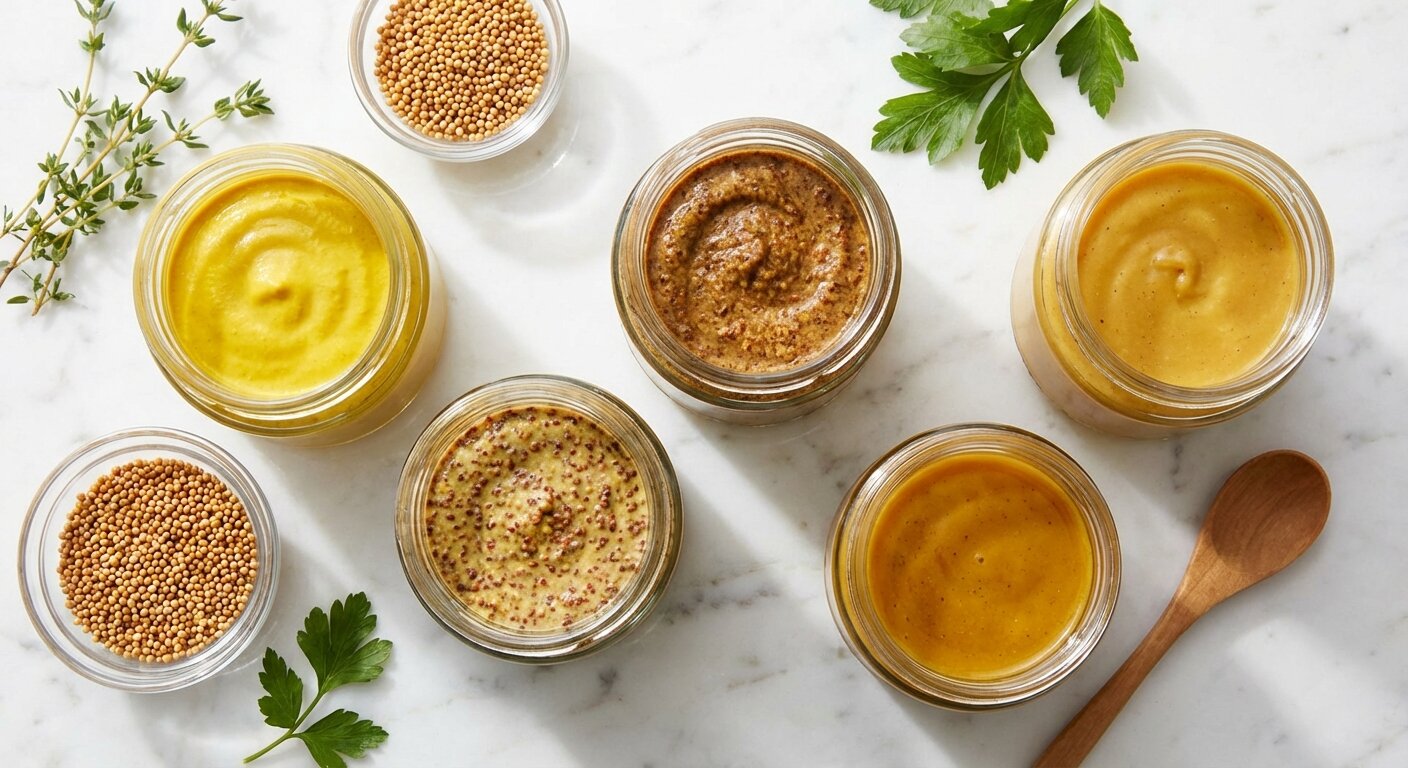
Mustard is one of the most macro-friendly condiments available, offering bold flavor with virtually zero caloric impact on your diet. Whether you’re tracking macros for fat loss, muscle building, or general health, understanding mustard’s nutritional profile helps you make informed decisions about which varieties fit your goals.
This guide breaks down the complete macro profile of every common mustard type, from classic yellow to gourmet Dijon, so you can track with precision and add flavor without derailing your targets.
Want to calculate your personalized macro targets? Use our free macro calculator to determine your optimal protein, carbs, and fat based on your goals, activity level, and body composition.
Related: Learn more about what macros are and how they impact your diet.
Mustard Macros by Type
Yellow Mustard Macros
Per 1 tablespoon (15g):
- Calories: 5
- Protein: 0g
- Carbohydrates: 1g
- Fat: 0g
- Fiber: 0g
- Sodium: 55-120mg (brand dependent)
Yellow mustard is the most common variety in America, made from ground yellow/white mustard seeds, vinegar, turmeric (for color), and salt. It’s the most macro-friendly condiment available with only 5 calories per serving.
Key nutrients:
- Turmeric provides curcumin, a potent anti-inflammatory compound
- Trace amounts of selenium, magnesium, and phosphorus
- No added sugars in traditional formulations
- Vinegar adds acetic acid which may aid digestion
Best for: Any diet goal, especially calorie restriction, keto, or macro tracking where condiments can add hidden calories.
Dijon Mustard Macros
Per 1 tablespoon (15g):
- Calories: 5
- Protein: 0g
- Carbohydrates: 1g
- Fat: 0g
- Fiber: 0g
- Sodium: 120-200mg
Dijon mustard originates from Dijon, France and is made with brown or black mustard seeds, white wine or wine vinegar, and salt. It’s sharper and more pungent than yellow mustard but nutritionally identical.
Key characteristics:
- Higher sodium than yellow mustard (120-200mg vs 55-120mg)
- No added sugars
- Same 5 calories per tablespoon as yellow mustard
- Contains small amounts of omega-3 fatty acids from mustard seeds
Best for: Keto, low-calorie diets, adding flavor to proteins without adding macros.
Spicy Brown Mustard Macros
Per 1 tablespoon (15g):
- Calories: 5-10
- Protein: 0g
- Carbohydrates: 1-2g
- Fat: 0-1g
- Fiber: 0-1g
- Sodium: 100-180mg
Spicy brown mustard (also called deli mustard) is made from coarsely ground brown mustard seeds with less vinegar, giving it a thicker texture and spicier kick.
Key nutrients:
- Higher fiber from less-refined seed particles
- May contain small amounts of added sugar (check labels)
- Contains more intact mustard seed oils
- Slight variations between brands (5-10 calorie range)
Best for: Adding texture and heat to sandwiches without significant macro impact.
Honey Mustard Macros
Per 1 tablespoon (15g):
- Calories: 30-60
- Protein: 0g
- Carbohydrates: 4-6g
- Fat: 1-5g (depending on oil/mayo content)
- Fiber: 0g
- Sodium: 50-150mg
- Sugar: 3-5g
Honey mustard is a sweetened variety made by mixing mustard with honey and often mayonnaise or oil. It’s significantly higher in both carbs and calories than traditional mustard.
Macro breakdown:
- 6-12x the calories of yellow mustard
- Contains 3-5g added sugars
- Fat content varies dramatically by brand (1-5g per tbsp)
- Not keto-friendly due to sugar content
Best for: Moderate use in balanced diets when you need a sweet condiment. Measure carefully as portion sizes dramatically affect macros.
Stone-Ground Mustard Macros
Per 1 tablespoon (15g):
- Calories: 10-15
- Protein: 0-1g
- Carbohydrates: 1-2g
- Fat: 1g
- Fiber: 1g
- Sodium: 120-200mg
Stone-ground mustard is made from whole, minimally processed mustard seeds that are crushed (not finely ground), giving it a chunky texture and robust flavor.
Key characteristics:
- Higher fiber from intact seed fragments (1g per tbsp)
- Contains more natural mustard seed oils (1g fat)
- Retains more micronutrients than refined varieties
- Slightly higher in calories but still very low (10-15 per tbsp)
Best for: Adding texture and flavor while getting slightly more fiber and micronutrients than smooth varieties.
Whole Grain Mustard Macros
Per 1 tablespoon (15g):
- Calories: 10-15
- Protein: 1g
- Carbohydrates: 1g
- Fat: 1g
- Fiber: 1g
- Sodium: 120-180mg
Whole grain mustard (also called grainy mustard) contains partially ground and whole mustard seeds suspended in a vinegar base.
Nutritional benefits:
- Contains 1g protein per tablespoon (more than any other variety)
- 1g fiber from intact seed coats
- Provides plant-based omega-3 ALA from mustard seed oil
- Higher in selenium and magnesium than refined mustards
Best for: Getting the most nutrition from your condiment while keeping calories low.
Mustard Macros Comparison Chart
| Mustard Type | Calories | Protein | Carbs | Fat | Fiber | Sodium |
|---|---|---|---|---|---|---|
| Yellow | 5 | 0g | 1g | 0g | 0g | 55-120mg |
| Dijon | 5 | 0g | 1g | 0g | 0g | 120-200mg |
| Spicy Brown | 5-10 | 0g | 1-2g | 0-1g | 0-1g | 100-180mg |
| Honey Mustard | 30-60 | 0g | 4-6g | 1-5g | 0g | 50-150mg |
| Stone-Ground | 10-15 | 0-1g | 1-2g | 1g | 1g | 120-200mg |
| Whole Grain | 10-15 | 1g | 1g | 1g | 1g | 120-180mg |
Key takeaways:
- Traditional mustards (yellow, Dijon) are virtually calorie-free
- Honey mustard contains 6-12x more calories than yellow mustard
- Stone-ground and whole grain varieties provide more fiber and micronutrients
- All mustards are low-carb except honey mustard
- Sodium varies significantly by brand and type
How to Track Mustard Macros
Standard Serving Sizes
Tablespoon measures:
- 1 tablespoon = 15g (standard nutrition label serving)
- 1 teaspoon = 5g (⅓ of tablespoon macros)
- 2 tablespoons = 30g (typical sandwich portion)
Visual references:
- 1 tablespoon ≈ size of a poker chip
- 2 tablespoons ≈ fills a standard condiment cup
- 1 teaspoon ≈ one pump from most squeeze bottles
Tracking by Diet Goal
Fat Loss (calorie deficit):
- Yellow or Dijon mustard: Track as 5 cal per tbsp (minimal macro impact)
- Honey mustard: ALWAYS measure—easy to use 2-3 tbsp (60-180 calories)
- Stone-ground: 10-15 cal per tbsp (still very low impact)
Muscle Building (calorie surplus):
- Mustard adds flavor without taking up macro budget
- Can use liberally (2-4 tbsp still only 10-20 calories for yellow/Dijon)
- Honey mustard can add carbs if needed for energy
Keto (low-carb high-fat):
- Yellow, Dijon, spicy brown: Fully keto-friendly (1g net carbs per tbsp)
- Avoid honey mustard (4-6g carbs, 3-5g sugar per tbsp)
- Stone-ground/whole grain: 1g net carbs (fiber partially offsets)
Maintenance:
- Track if you’re precise, or estimate
- Yellow/Dijon have negligible impact even at 3-4 tbsp
- Honey mustard still requires tracking at 30-60 cal per tbsp
Mustard in Macro-Friendly Recipes
High-Protein Dijon Chicken
Ingredients:
- 6 oz chicken breast (180 cal, 40g protein, 0g carbs, 3g fat)
- 2 tbsp Dijon mustard (10 cal, 0g protein, 2g carbs, 0g fat)
- 1 tsp olive oil (40 cal, 0g protein, 0g carbs, 4.5g fat)
- Garlic, herbs, lemon juice (negligible macros)
Total macros: 230 calories | 40g protein | 2g carbs | 7.5g fat
Instructions:
- Mix Dijon, olive oil, minced garlic, herbs, and lemon juice
- Coat chicken breast in mixture
- Bake at 400°F for 20-25 minutes until internal temp reaches 165°F
- Dijon adds tangy flavor with virtually no caloric cost
Macro-Friendly Honey Mustard Dressing
Ingredients (makes 4 servings):
- 2 tbsp yellow mustard (10 cal, 0g protein, 2g carbs, 0g fat)
- 1 tbsp honey (64 cal, 0g protein, 17g carbs, 0g fat)
- 2 tbsp nonfat Greek yogurt (18 cal, 3g protein, 2g carbs, 0g fat)
- 1 tsp lemon juice (negligible)
Per serving: 23 calories | 0.75g protein | 5.25g carbs | 0g fat
Instructions:
- Whisk all ingredients together
- Adjust honey for desired sweetness
- Use on salads, chicken, or as veggie dip
- 4x lower in calories than store-bought honey mustard (23 vs 90-120 cal per 2 tbsp)
Spicy Brown Mustard Burger Topping
Ingredients (per burger):
- 1 tbsp spicy brown mustard (10 cal, 0g protein, 1g carbs, 0g fat)
- 1 slice tomato (5 cal, 0g protein, 1g carbs, 0g fat)
- 1 leaf lettuce (2 cal, 0g protein, 0g carbs, 0g fat)
- 1 slice red onion (4 cal, 0g protein, 1g carbs, 0g fat)
Total toppings: 21 calories | 0g protein | 3g carbs | 0g fat
Compare to:
- Mayo (1 tbsp): 94 calories, 10g fat
- Ketchup (1 tbsp): 17 calories, 4g carbs, 4g sugar
- BBQ sauce (1 tbsp): 29 calories, 7g carbs, 6g sugar
Mustard-based toppings save 70-100+ calories per burger while adding more flavor complexity.
Mustard for Different Macro Targets
Aggressive Fat Loss (Deficit of 500+ Calories)
Why mustard is essential:
- Adds flavor to plain proteins without adding calories
- Makes vegetables more palatable (improving adherence)
- Zero-fat option when every calorie matters
- Vinegar content may slightly boost satiety
Best varieties:
- Yellow mustard (5 cal per tbsp)
- Dijon (5 cal per tbsp)
- Spicy brown (5-10 cal per tbsp)
Daily usage: Unlimited—even 10 tablespoons only adds 50 calories
Lean Bulking (Surplus of 200-300 Calories)
Role in bulking:
- Enhances meal enjoyment without filling you up with fats
- Adds variety to repetitive high-protein meals
- Sodium can help with muscle pumps and hydration
Best varieties:
- Any variety (calories are insignificant in surplus)
- Stone-ground for added fiber (aids digestion of large meals)
- Honey mustard if you need extra carbs to hit targets
Maintenance (Eating at TDEE)
Strategic use:
- Replace higher-calorie condiments to keep meals balanced
- Use liberally on proteins, vegetables, sandwiches
- Track honey mustard but not yellow/Dijon (unless being very precise)
Mustard vs Other Condiments
Mustard vs Mayonnaise
Per 1 tablespoon:
- Yellow mustard: 5 cal | 0g protein | 1g carbs | 0g fat
- Mayo: 94 cal | 0g protein | 0g carbs | 10g fat
Macro impact: Mayo has 19x more calories, all from fat. Mustard is the clear winner for fat loss.
When to use mayo: When you need to add calories/fats (bulking, keto if fat target is low).
Mustard vs Ketchup
Per 1 tablespoon:
- Yellow mustard: 5 cal | 0g protein | 1g carbs | 0g fat | 0g sugar
- Ketchup: 17 cal | 0g protein | 4g carbs | 0g fat | 4g sugar
Macro impact: Ketchup has 3.4x more calories, all from sugar. Mustard is better for blood sugar control and fat loss.
When to use ketchup: When you specifically want sweetness or are in a surplus and not tracking closely.
Mustard vs BBQ Sauce
Per 1 tablespoon:
- Yellow mustard: 5 cal | 0g protein | 1g carbs | 0g fat | 0g sugar
- BBQ sauce: 29 cal | 0g protein | 7g carbs | 0g fat | 6g sugar
Macro impact: BBQ sauce has 6x more calories, mostly from added sugars. Mustard is superior for macro tracking.
When to use BBQ sauce: When flavor justifies the carb cost, or when bulking and needing extra carbs.
Mustard vs Honey Mustard
Per 1 tablespoon:
- Yellow mustard: 5 cal | 0g protein | 1g carbs | 0g fat
- Honey mustard: 30-60 cal | 0g protein | 4-6g carbs | 1-5g fat
Macro impact: Honey mustard has 6-12x more calories from added sugars and fats.
When to use honey mustard: When you want sweetness and can afford the macros (or make the lighter version from recipe above).
Tracking Mustard: When It Matters
Track Always:
- Honey mustard: Significant calories and carbs, especially if used liberally (60-180 cal for 2-4 tbsp)
- When in aggressive deficit: Every 50-100 calories matters, so log everything
- If tracking sodium: Mustard ranges from 50-200mg per tbsp, which adds up with multiple servings
Track Sometimes:
- Stone-ground or whole grain mustard: 10-15 cal per tbsp—not significant unless using 4+ tbsp
- When learning portions: Track initially to understand how much you’re using
Track Never (or estimate):
- Yellow or Dijon mustard: 5 cal per tbsp is so minimal it won’t impact goals unless you’re using ½ cup+ daily
- When in surplus: Mustard’s calorie contribution is negligible compared to total intake
Health Benefits of Mustard Beyond Macros
Antioxidants and Phytonutrients
Mustard seeds are rich in glucosinolates, which break down into isothiocyanates—compounds with anti-inflammatory and potential anticancer properties. While prepared mustard contains far less than whole seeds, you still get trace amounts.
Key compounds:
- Sinigrin (in black mustard seeds)
- Glucoraphanin (similar to broccoli’s sulforaphane precursor)
- Sinapic acid (potent antioxidant)
Turmeric Content (Yellow Mustard)
Yellow mustard gets its bright color from turmeric, which contains curcumin—a powerful anti-inflammatory compound studied for joint health, brain function, and chronic disease prevention.
Realistic impact: One tablespoon of yellow mustard contains approximately 20-40mg turmeric (about 1-2mg curcumin). This is far below supplemental doses (500-2000mg curcumin), but regular consumption provides cumulative benefits.
Digestive Support
The vinegar in mustard provides acetic acid, which may:
- Support stomach acid production for better protein digestion
- Help stabilize blood sugar when consumed with meals
- Promote gut health through prebiotic effects
Anti-Inflammatory Effects
Studies on mustard seed compounds show potential for:
- Reducing inflammatory markers (CRP, IL-6)
- Supporting joint health (traditional use for arthritis)
- Protecting against oxidative stress
Important: These benefits come primarily from mustard seeds. Prepared mustard is diluted but still provides trace amounts with regular consumption.
Sodium in Mustard: What You Need to Know
Sodium Content by Type
Per 1 tablespoon:
- Yellow mustard: 55-120mg (varies by brand)
- Dijon: 120-200mg
- Spicy brown: 100-180mg
- Honey mustard: 50-150mg
- Stone-ground: 120-200mg
- Whole grain: 120-180mg
Daily Sodium Context
Dietary guidelines:
- General population: <2,300mg/day (about 1 teaspoon salt)
- High blood pressure: <1,500mg/day
- Athletes/heavy sweaters: May need 3,000-5,000mg/day
Mustard’s sodium impact:
- 1 tbsp: 50-200mg (2-9% of 2,300mg target)
- 4 tbsp: 200-800mg (9-35% of 2,300mg target)
Should You Worry About Mustard’s Sodium?
Track if:
- You have high blood pressure or heart disease
- Your doctor has you on a low-sodium diet (<1,500mg/day)
- You’re using 4+ tablespoons per day
Don’t worry if:
- You have normal blood pressure
- You exercise regularly and sweat heavily
- You’re eating mostly whole foods (low processed food = room for condiment sodium)
- You’re using 1-2 tablespoons per day
Tip: If reducing sodium, look for “low-sodium” mustard varieties (30-40mg per tbsp vs 120mg).
Brand Comparisons: Macro Differences
Yellow Mustard Brands
| Brand | Calories | Carbs | Sodium |
|---|---|---|---|
| French’s Classic Yellow | 0 | 0g | 55mg |
| Heinz Yellow Mustard | 5 | 1g | 65mg |
| Gulden’s Spicy Brown | 5 | 1g | 120mg |
| Stadium Mustard | 0 | 0g | 80mg |
Key differences: Minimal macro variation, but sodium ranges from 55-120mg per tablespoon.
Dijon Mustard Brands
| Brand | Calories | Carbs | Sodium |
|---|---|---|---|
| Grey Poupon Dijon | 5 | 0g | 120mg |
| Maille Dijon Originale | 5 | 0g | 190mg |
| Annie’s Organic Dijon | 5 | 1g | 160mg |
| Sir Kensington’s Dijon | 5 | 0g | 105mg |
Key differences: Sodium is the main variable, ranging from 105-190mg per tablespoon.
Honey Mustard Brands
| Brand | Calories | Carbs | Fat | Sodium |
|---|---|---|---|---|
| Gulden’s Honey Mustard | 30 | 7g | 0g | 80mg |
| French’s Honey Mustard | 35 | 4g | 2g | 50mg |
| Ken’s Steakhouse Honey Mustard | 60 | 3g | 5g | 120mg |
| Grey Poupon Honey Dijon | 30 | 4g | 2g | 90mg |
Key differences: Massive variation in fat content (0-5g) depending on mayo/oil content. Some brands prioritize sugar (7g carbs, 0g fat) while others use fat for texture (3g carbs, 5g fat).
Whole Grain Mustard Brands
| Brand | Calories | Protein | Carbs | Fat | Sodium |
|---|---|---|---|---|---|
| Maille Old Style Mustard | 10 | 0g | 1g | 1g | 140mg |
| Grey Poupon Stone Ground | 10 | 0g | 1g | 0g | 120mg |
| Inglehoffer Stone Ground | 15 | 1g | 1g | 1g | 120mg |
| Sir Kensington’s Whole Grain | 10 | 0g | 1g | 0g | 105mg |
Key differences: Some brands retain slightly more protein and fat from less-refined seeds.
Common Questions About Mustard Macros
Can I use mustard on a cut without tracking it?
Answer: Yes, for yellow and Dijon mustard (5 calories per tablespoon). Even if you use 4 tablespoons per day, that’s only 20 calories—insignificant in a cutting diet. However, ALWAYS track honey mustard, which can add 60-180 calories if you use 2-3 tablespoons.
Does mustard break a fast?
Answer: It depends on your fasting protocol:
- Strict water fast: Yes, mustard breaks the fast (contains calories, small amounts of carbs)
- Modified fasting (<50 calories): 1-2 tablespoons of yellow/Dijon is acceptable (5-10 calories)
- Fat fasting: Yellow/Dijon is fine (0g fat, minimal calories)
- Protein sparing: Yellow/Dijon is acceptable (0g protein, minimal calories)
For most intermittent fasting protocols (16:8, 20:4), 1-2 tablespoons of yellow or Dijon mustard is unlikely to meaningfully impact ketone production or autophagy.
Is mustard considered a carbohydrate?
Answer: While mustard contains 1-2g carbs per tablespoon, it’s better categorized as a condiment/flavor agent rather than a carb source. The carbohydrate content is minimal and shouldn’t be treated the same as bread, rice, or fruit. Exception: Honey mustard contains 4-6g carbs per tablespoon and should be tracked as a carb source.
Can you have too much mustard on keto?
Answer: It’s difficult to have “too much” yellow or Dijon mustard on keto (only 1g net carbs per tablespoon). Even 5 tablespoons would only be 5g net carbs—well within a 20-50g daily keto limit. However, watch sodium intake if you’re consuming large amounts (200mg+ per tablespoon), as excess sodium can cause water retention that masks fat loss.
Does the type of mustard seed matter for macros?
Answer: Not significantly in prepared mustard. Yellow, brown, and black mustard seeds have similar macronutrient profiles when made into condiments. The processing (grinding, dilution with vinegar) eliminates most nutritional differences. However, stone-ground and whole grain varieties retain slightly more fiber, protein, and fat because the seeds are less refined.
Is mustard a good protein source?
Answer: No, mustard is not a meaningful protein source. Even whole grain varieties only provide about 1g protein per tablespoon. You’d need to consume over 2 cups (32 tablespoons) to get 30g protein, which would also give you 6,400mg+ sodium. Use mustard for flavor, not protein.
Why does some mustard say 0 calories but others say 5?
Answer: FDA rounding rules allow foods with <5 calories per serving to be labeled as 0 calories. Yellow mustard typically has 3-5 calories per tablespoon, so brands round differently:
- 5 calories: Accurate measurement or rounding up
- 0 calories: Legal rounding (technically 0-4.9 calories)
For macro tracking purposes, assume 5 calories per tablespoon to be safe.
Can mustard cause bloating or water retention?
Answer: The sodium in mustard (50-200mg per tablespoon) can cause temporary water retention, especially if you’re sodium-sensitive or consume large amounts (4+ tablespoons). However, this is water weight, not fat gain, and will normalize within 24-48 hours. If you notice bloating, try low-sodium varieties (30-40mg per tablespoon) or limit serving size.
Is organic mustard different nutritionally?
Answer: No, organic mustard has the same macros as conventional mustard. The difference is in production methods (no synthetic pesticides), not nutritional content. If you prioritize organic food, buy organic mustard, but don’t expect any macro or calorie difference.
Does mustard expire or lose nutritional value?
Answer: Mustard is highly shelf-stable due to its acidity (vinegar) and doesn’t lose significant nutritional value over time. However:
- Unopened: 2-3 years at room temperature
- Opened: 1-2 years in refrigerator
- Nutritional degradation: Minimal—vinegar preserves most compounds
The main risk is flavor degradation (less tangy, less sharp) rather than nutrient loss. If mustard looks/smells fine, it’s safe to eat even past the “best by” date.
Frequently Asked Questions
What are the macros in yellow mustard?
One tablespoon (15g) of yellow mustard contains 0-5 calories, 0g protein, 1g carbohydrates, and 0g fat. The exact calorie count varies by brand due to FDA rounding rules—some label it as 0 calories (legally allowed for foods with <5 calories), while others list it as 5 calories for accuracy.
From a macro tracking perspective, yellow mustard has essentially zero impact on your daily targets. Even if you use 5 tablespoons per day, you’re only adding 25 calories and 5g carbs—a negligible amount for any diet goal.
The sodium content is more variable, ranging from 55-120mg per tablespoon depending on the brand. If you’re tracking sodium due to blood pressure concerns, check the nutrition label of your specific brand.
Yellow mustard also provides a small amount of turmeric (which gives it the bright yellow color), delivering trace amounts of curcumin—an anti-inflammatory compound. While you won’t get therapeutic doses from condiment use, regular consumption may provide cumulative health benefits.
Does mustard have protein?
Traditional prepared mustard (yellow, Dijon, spicy brown) contains negligible protein—less than 0.5g per tablespoon, which nutrition labels round down to 0g. Mustard seeds themselves are protein-rich at about 25g protein per 100g, but prepared mustard is heavily diluted with vinegar, water, and spices, eliminating most of the protein content.
Whole grain and stone-ground mustards retain slightly more protein because they contain partially intact or coarsely ground mustard seeds. These varieties may provide up to 1g protein per tablespoon, but this is still insignificant from a dietary perspective—you’d need to consume 30+ tablespoons to get a meaningful amount of protein.
If you’re looking to boost protein intake, focus on animal proteins, legumes, dairy, or protein powders rather than relying on condiments. Use mustard for what it does best: adding flavor with virtually no macro impact.
Is honey mustard high in carbs?
Yes, honey mustard is significantly higher in carbs than regular mustard due to added honey or sugar. One tablespoon of honey mustard typically contains 4-6g carbohydrates compared to 1g in yellow or Dijon mustard—a 4-6x difference.
The carb content varies by brand and formulation:
- Lower carb versions (4g per tbsp): Use less honey, more mustard base
- Higher carb versions (6-7g per tbsp): Contain more honey or corn syrup
Additionally, nearly all of honey mustard’s carbs come from sugar:
- 1 tablespoon = 3-5g sugar (vs 0g in yellow mustard)
- Using 3 tablespoons = 9-15g sugar, equivalent to eating 1-2 packets of sugar
For ketogenic diets, honey mustard is not ideal. With 4-6g net carbs per tablespoon, just 2 tablespoons could use up 20-40% of a 20-25g daily carb limit. Stick to yellow, Dijon, or spicy brown mustard on keto (1g carbs per tablespoon).
For general macro tracking, honey mustard is fine in moderation, but measure carefully—it’s easy to use 2-3 tablespoons (8-18g carbs) without realizing, which can significantly impact your daily carb target.
Can I eat mustard on a keto diet?
Yes, yellow, Dijon, and spicy brown mustard are all keto-friendly with only 1g net carbohydrates per tablespoon. You can use these varieties liberally without worrying about being kicked out of ketosis—even 5 tablespoons would only contribute 5g net carbs, well within most keto practitioners’ daily limits of 20-50g.
Keto-friendly mustard types:
- Yellow mustard: 1g net carbs per tbsp
- Dijon: 1g net carbs per tbsp
- Spicy brown: 1-2g net carbs per tbsp
- Stone-ground: 1g net carbs per tbsp (fiber partially offsets)
- Whole grain: 1g net carbs per tbsp
Avoid on keto:
- Honey mustard: 4-6g net carbs per tbsp (mostly sugar)
- Honey Dijon: 3-5g net carbs per tbsp
- Sweet and spicy varieties: Often 3-4g+ net carbs per tbsp
Beyond carbs, mustard is also zero-fat, which means it doesn’t help you hit your fat macro targets on keto. If you’re struggling to reach your fat goals, consider pairing mustard with higher-fat foods or using it as a flavor enhancer for fatty proteins like pork, salmon, or duck.
One minor consideration: some people find that the vinegar in mustard can temporarily halt ketone production or cause a small insulin response. However, this effect is minimal and short-lived—it won’t meaningfully impact fat burning or ketosis for the vast majority of people.
What is the healthiest type of mustard?
From a pure nutritional standpoint, whole grain and stone-ground mustards are the healthiest options because they retain more of the mustard seed’s natural nutrients:
Whole grain mustard benefits:
- 1g fiber per tablespoon (vs 0g in smooth varieties)
- 1g protein per tablespoon (vs 0g in smooth varieties)
- Higher in selenium, magnesium, and omega-3 fatty acids
- Contains more intact glucosinolates (anti-inflammatory compounds)
- Only 10-15 calories per tablespoon (still very low)
Stone-ground mustard benefits:
- Similar fiber and micronutrient profile to whole grain
- Less processed than smooth mustards
- Retains more natural mustard seed oils
- Contains higher levels of isothiocyanates (studied for cancer prevention)
However, the practical difference between yellow/Dijon and whole grain/stone-ground mustard is minimal because serving sizes are small. One tablespoon of whole grain mustard provides 1g fiber—helpful but not transformative when you need 25-35g daily.
For most people, the “healthiest” mustard is the one they’ll actually use to make healthy foods more enjoyable. If you prefer yellow mustard and it helps you eat more grilled chicken, vegetables, and salads, it’s healthier for YOU than whole grain mustard you won’t use.
If you want to maximize micronutrient intake from mustard, choose:
- Stone-ground or whole grain for extra fiber and omega-3s
- Yellow mustard for turmeric/curcumin content
- Any variety except honey mustard to avoid added sugars
All traditional mustards (yellow, Dijon, spicy brown, stone-ground, whole grain) are health-promoting condiments with virtually no downside. The “unhealthiest” option is honey mustard due to added sugars, but even that can fit a balanced diet in moderation.
Does Dijon mustard have more calories than yellow mustard?
No, Dijon mustard has virtually the same calorie content as yellow mustard—both contain approximately 5 calories per tablespoon. The slight variation between brands (some list 0 calories, others list 5) is due to FDA rounding rules, not actual nutritional differences.
Macro comparison (per 1 tablespoon):
- Yellow mustard: 5 calories | 0g protein | 1g carbs | 0g fat
- Dijon mustard: 5 calories | 0g protein | 1g carbs | 0g fat
The main differences between yellow and Dijon mustard are:
- Flavor: Dijon is sharper and more pungent due to brown/black mustard seeds and white wine
- Sodium: Dijon typically has slightly more sodium (120-200mg vs 55-120mg per tablespoon)
- Color: Yellow mustard gets its bright color from turmeric; Dijon is pale yellow-brown
From a macro tracking perspective, you can treat yellow and Dijon mustard as nutritionally identical. Both are excellent choices for adding flavor with minimal caloric impact, and both are keto-friendly, fat-loss-friendly, and muscle-building-friendly.
How much sodium is in mustard?
Sodium content in mustard varies significantly by type and brand, ranging from 50-200mg per tablespoon:
Sodium by mustard type (per 1 tablespoon):
- Yellow mustard: 55-120mg (brand dependent)
- Dijon mustard: 120-200mg
- Spicy brown mustard: 100-180mg
- Honey mustard: 50-150mg
- Stone-ground mustard: 120-200mg
- Whole grain mustard: 120-180mg
In context of daily sodium intake:
- General population guideline: <2,300mg/day
- High blood pressure guideline: <1,500mg/day
- 1 tablespoon mustard: 2-9% of daily limit
- 4 tablespoons mustard: 9-35% of daily limit
Should you worry about mustard’s sodium?
For most healthy adults, mustard’s sodium content is not a concern. If you’re eating a whole-foods-based diet low in processed foods, you have plenty of room in your sodium budget for condiments.
Track sodium from mustard if:
- You have high blood pressure or heart disease
- Your doctor has you on a sodium-restricted diet (<1,500mg/day)
- You’re eating 4+ tablespoons per day
- You’re experiencing unexplained water retention
Don’t worry about sodium if:
- You have normal blood pressure
- You exercise regularly and sweat heavily (you need more sodium)
- You’re eating mostly whole foods with minimal processed food
- You’re using 1-2 tablespoons per day
Low-sodium alternatives: If you need to reduce sodium, look for “low-sodium” mustard varieties available from brands like French’s and Gulden’s (30-40mg per tablespoon vs 120mg in regular versions).
Is mustard good for weight loss?
Yes, mustard is one of the best condiments for weight loss because it adds significant flavor with virtually no caloric impact. One tablespoon of yellow or Dijon mustard contains only 5 calories—you’d need to eat 20 tablespoons to equal the calories in a single tablespoon of mayonnaise (94 calories).
Why mustard supports weight loss:
-
Negligible calories: Even if you use 5 tablespoons per day, you’re only adding 25 calories (vs 470 calories for 5 tablespoons of mayo)
-
Enhances food enjoyment: Plain grilled chicken, vegetables, and salads become more enjoyable with mustard, improving adherence to your diet
-
Zero fat: Unlike mayo, ranch, or other creamy dressings, mustard adds no fat—important when managing total calorie intake
-
Low glycemic impact: With only 1g carbs and 0g sugar (except honey mustard), mustard won’t spike blood sugar or insulin
-
May boost metabolism: Some research suggests compounds in mustard seeds (isothiocyanates) may temporarily increase metabolic rate by 5-10%, though the effect from condiment-level consumption is likely minimal
-
Improves satiety: The vinegar content (acetic acid) in mustard has been shown in studies to increase feelings of fullness and reduce blood sugar spikes when consumed with meals
Best mustards for fat loss:
- Yellow mustard: 5 cal per tbsp
- Dijon: 5 cal per tbsp
- Spicy brown: 5-10 cal per tbsp
Avoid or limit for fat loss:
- Honey mustard: 30-60 cal per tbsp (6-12x more than yellow mustard)
Strategic use: Replace higher-calorie condiments with mustard to create a larger calorie deficit without sacrificing flavor:
- Mayo → Yellow mustard: Saves 89 calories per tablespoon
- Ranch dressing → Dijon: Saves 68-73 calories per tablespoon
- BBQ sauce → Spicy brown mustard: Saves 20-24 calories per tablespoon
Over time, these swaps create meaningful calorie deficits. Replacing 2 tablespoons of mayo with 2 tablespoons of mustard daily saves 178 calories per day, which translates to approximately 1.8 pounds of fat loss over a month.
Conclusion
Mustard is one of the most macro-friendly condiments available, providing bold flavor with minimal caloric impact on your diet. Whether you’re tracking macros for fat loss, muscle building, or general health, understanding the nutritional differences between mustard varieties allows you to make strategic choices that align with your goals.
Key takeaways:
- Yellow, Dijon, and spicy brown mustard are virtually calorie-free at 5-10 calories per tablespoon
- Honey mustard contains 6-12x more calories than yellow mustard due to added sugars and fats
- Stone-ground and whole grain varieties provide slightly more fiber, protein, and micronutrients
- All traditional mustards are keto-friendly (1g net carbs per tablespoon) except honey mustard
- Sodium content varies from 50-200mg per tablespoon—track if you have blood pressure concerns
- Mustard is an excellent substitute for higher-calorie condiments like mayonnaise, ranch, and BBQ sauce
By incorporating mustard strategically into your meal plan, you can enhance food enjoyment without derailing your macro targets—whether you’re in an aggressive deficit, lean bulk, or maintenance phase.
Ready to dial in your personalized macro targets? Use our free macro calculator to determine your optimal protein, carbs, and fat intake based on your goals, activity level, and body composition.
Related Articles

Dragonfruit Macros: Complete Nutrition Guide for Pitaya
Complete macro breakdown of dragonfruit (pitaya). Learn the calories, protein, carbs, and...
Read guide →
Bulgur Macros: Complete Nutritional Guide & Health Benefits
Discover bulgur's complete macro breakdown, nutritional benefits, and how to incorporate...
Read guide →
Radish Macros: Nutrition Facts and Health Benefits
Complete guide to radish macros and nutrition. Learn calories, protein, carbs, and health...
Read guide →Note: Nutrition values are approximate and may vary based on preparation method and source.