Carbohydrates Explained: Simple vs Complex, How Much You Need
Reviewed by Sarah Chen, MS, RD

No macronutrient has been more vilified, debated, and misunderstood than carbohydrates. As one of the three essential macronutrients alongside protein and fats, carbs play a crucial role in your body’s energy system. Depending on who you ask, carbs are either the key to athletic performance or the root cause of the obesity epidemic. Low-carb evangelists say cut them entirely. Sports nutritionists say you can’t train without them.
So what’s the truth?
Here it is: carbs are a tool. They’re not inherently good or bad—they’re useful in the right context, problematic when misused, and absolutely not the enemy you’ve been told they are. The confusion comes from treating all carbs the same when they’re incredibly varied.
This guide cuts through the noise. You’ll learn what carbohydrates actually are, why the simple vs. complex distinction matters, how many carbs YOU need based on your goals, and which sources deserve a place on your plate. No dogma, no agenda—just practical guidance you can apply today.
Want to know your ideal carb intake? Use our Macro Calculator to get personalized numbers in under a minute.
What Are Carbohydrates?
Carbs Defined
Carbohydrates are one of the three macronutrients, alongside protein and fat. They’re your body’s preferred and fastest source of energy, providing 4 calories per gram—the same as protein.
Carbs are found in a huge variety of foods: grains, fruits, vegetables, legumes, dairy, and yes, sugar and processed foods. The diversity of carb sources is exactly why blanket statements about carbs being “good” or “bad” are useless.
When you eat carbohydrates, your digestive system breaks them down into glucose—the simplest form of sugar. Glucose enters your bloodstream (this is your “blood sugar”) and is either:
- Used immediately for energy
- Stored in your muscles and liver as glycogen for later
- Converted to fat if glycogen stores are full AND you’re in a calorie surplus
That third point is key: carbs only turn to fat when you’re overeating overall. In a calorie deficit or at maintenance, your body uses carbs for energy, not storage.
How Your Body Uses Carbs
Your body loves carbohydrates for one simple reason: they convert to energy faster than any other fuel source. This is why athletes “carb load” before events—glycogen is readily available energy.
Your brain is especially carb-hungry. It runs primarily on glucose, consuming roughly 120g per day. This is why very low-carb diets often cause brain fog initially—your brain is adapting to using ketones instead.
Here’s the practical takeaway: carbs aren’t just empty fuel. They power your workouts, your mental focus, and your recovery. The question isn’t whether to eat carbs—it’s how much and from what sources.

Simple vs Complex Carbs
You’ve probably heard this distinction before. It’s the most useful way to think about carb quality.
Simple Carbohydrates
Simple carbs are short-chain sugars—molecules of just one or two sugar units. They digest quickly, enter your bloodstream fast, and spike your blood sugar rapidly.
Common sources:
- Table sugar
- Candy and sweets
- Soda and fruit juice
- Honey and maple syrup
- White bread and pastries
Simple carbs aren’t inherently evil. They have their place—quick energy around workouts, for example. But they provide little nutritional value beyond calories, don’t keep you full, and are easy to overeat. This is what gives carbs a bad reputation.
Complex Carbohydrates
Complex carbs are long-chain sugars—many sugar units linked together. They take longer to break down, release energy gradually, and don’t spike blood sugar as dramatically.
Common sources:
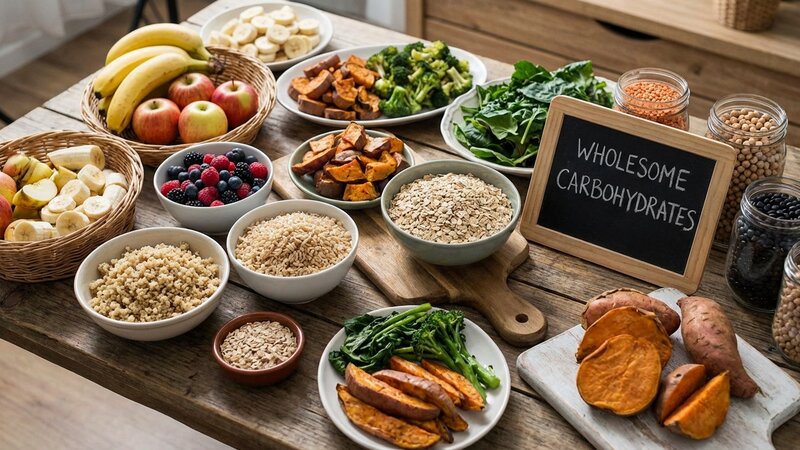
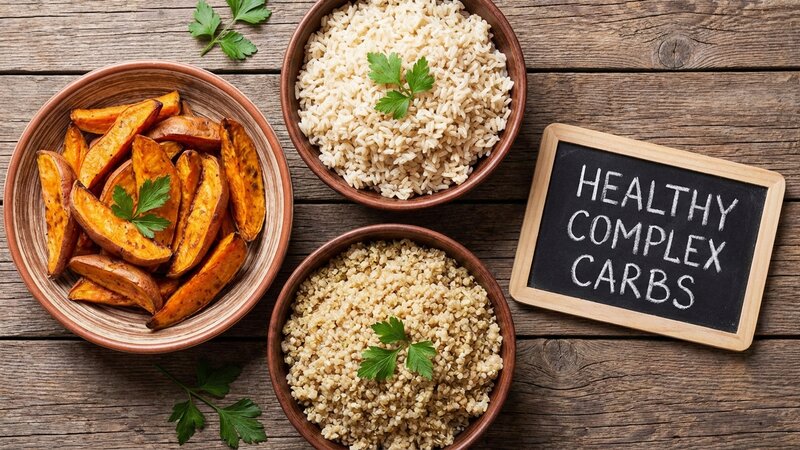
- Oats and whole grains
- Sweet potatoes and potatoes
- Brown rice and quinoa
- Beans and lentils
- Vegetables
- Most fruits (fiber slows sugar absorption)
Complex carbs come “packaged” with fiber, vitamins, and minerals. They keep you fuller longer, provide sustained energy, and support gut health. This is what carbs should look like in most of your diet.
The Real Difference: Fiber and Nutrients
Here’s the practical distinction: complex carbs come with fiber and micronutrients attached. Simple carbs are often “naked calories”—energy without nutrition.
A sweet potato and a handful of candy might have similar carb grams, but the sweet potato brings fiber, potassium, vitamin A, and sustained energy. The candy brings… a sugar rush and a crash.
Your guideline: Get 80%+ of your carbs from complex, whole-food sources. Simple carbs can fit in moderation—especially around training—but shouldn’t be the foundation of your intake.
Are Carbs Bad for You? (Myth Busting)
Let’s address the elephant in the room. For decades, carbs have been blamed for weight gain, diabetes, and metabolic dysfunction. Let’s separate fact from fiction.
The Anti-Carb Movement
Low-carb and ketogenic diets exploded in popularity because they work for weight loss. This led many people to conclude that carbs themselves cause weight gain.
Here’s the reality: low-carb diets work because they create a calorie deficit, not because carbs are inherently fattening. When you eliminate an entire macronutrient group, you naturally eat fewer calories. You’re also cutting out hyperpalatable processed foods that are easy to overeat.
Carbs don’t make you fat. Eating more calories than you burn makes you fat—and that can happen with any macronutrient.
What Science Actually Says
In controlled studies where calories and protein are matched, the carb-to-fat ratio makes minimal difference for weight loss. People lose similar amounts of weight whether their diet is 20% carbs or 60% carbs—as long as total calories are equal.
Where carbs do matter:
- Athletes and regular exercisers perform better with adequate carbs
- Very high carb + very high fat together is problematic (the typical junk food combo)
- Highly processed carbs are easy to overeat and provide little satiety
- Individual response varies—some people genuinely feel better on lower carbs
When Carbs CAN Be a Problem
Carbs aren’t universally problematic, but there are situations where moderating intake makes sense:
When they lead to overeating. Processed carbs (chips, cookies, pastries) are engineered to be hyperpalatable. They override satiety signals and make it easy to eat thousands of calories without feeling full.
For insulin-resistant individuals. People with prediabetes, type 2 diabetes, or significant insulin resistance may benefit from moderating carbs and choosing lower glycemic options.
When they displace protein. A common beginner mistake is filling up on carbs while neglecting protein. Both macros have distinct roles—carbs can’t substitute for protein’s muscle-building function.
For sedentary lifestyles. If you’re not exercising and barely moving, your carb needs are lower. You don’t need to fuel activity that isn’t happening.

How Many Carbs Do You Need?
There’s no single answer here—carb needs vary based on activity level, goals, and individual preference.
It Depends on Your Activity Level
| Activity Level | Daily Carb Range |
|---|---|
| Sedentary (desk job, little exercise) | 100-150g |
| Moderately active (exercise 3-4x/week) | 150-250g |
| Very active (exercise 5-6x/week, intense) | 250-400g |
| Athlete/endurance training | 400g+ |
| Low-carb preference | 50-100g |
| Keto | Under 50g (often under 20g) |
The theme: more activity = more carbs needed. Less activity = more flexibility to go lower.
Calculating Your Carb Target
Here’s the practical approach:
- Set protein first (0.8-1.0g per pound bodyweight)
- Set fat minimum (0.3-0.4g per pound bodyweight)
- Remaining calories go to carbs
Carbs are the flexible macro. Once protein and fat minimums are covered, carbs fill the rest based on your calorie target.
Example: 150lb person, 1,800 calorie target
- Protein: 150g (600 calories)
- Fat: 55g (495 calories)
- Remaining: 705 calories = 176g carbs
Use our Macro Calculator to run these numbers for your specific situation.
Signs You Need More Carbs
- Low energy, especially during or after workouts
- Brain fog and difficulty concentrating
- Irritability and mood swings
- Poor sleep quality
- Constant hunger despite adequate calories
- Declining workout performance
If you’re experiencing these while eating low carb, try increasing carbs for 1-2 weeks and see if symptoms improve.
Signs You Could Reduce Carbs
- Blood sugar issues or insulin resistance
- Feeling sluggish and bloated after carb-heavy meals
- Very sedentary lifestyle with minimal activity
- Personal preference for higher-fat foods
- Better mental clarity on lower carbs
Neither high nor low carb is objectively “better.” The right amount is the one that supports your energy, performance, and adherence.
Best Sources of Carbohydrates
Complex Carb Sources (Prioritize These)
These should form the foundation of your carb intake:
| Food | Carbs (per serving) | Notes |
|---|---|---|
| Oats | 27g (1/2 cup dry) | High fiber, filling, versatile |
| Brown rice | 45g (1 cup cooked) | Whole grain staple |
| White rice | 45g (1 cup cooked) | Lower fiber but still fine |
| Sweet potato | 26g (medium) | Vitamin A powerhouse |
| Quinoa | 39g (1 cup cooked) | Complete protein bonus |
| Black beans | 41g (1 cup cooked) | Fiber + protein combo |
| Lentils | 40g (1 cup cooked) | High fiber, high protein |
| Whole wheat bread | 15g (1 slice) | Choose 100% whole grain |
| Fruit (varies) | 15-30g (1 medium piece) | Fiber + vitamins + natural sugars |
| Vegetables | 5-20g (1 cup) | Nutrient dense, high volume |
Simple Carb Sources (Use Strategically)
These have their place, especially around training:
| Food | Carbs (per serving) | Best Use |
|---|---|---|
| White rice | 45g (1 cup cooked) | Post-workout, quick digestion |
| Banana | 27g (medium) | Pre or post-workout |
| White bread | 15g (1 slice) | Around training |
| Sports drinks | Varies | During endurance exercise |
| Honey | 17g (1 tbsp) | Quick energy, natural |
Carbs to Limit
Not forbidden, but these offer little nutrition and are easy to overeat:
- Sugary drinks (soda, juice, sweetened coffee)
- Candy, cookies, pastries
- Chips and highly processed snacks
- Sweetened cereals
- Foods with added sugars as primary ingredients
The issue isn’t the carbs—it’s the lack of fiber, the hyperpalatability, and the ease of overconsumption.

Carb Timing: When to Eat Carbs
Does Timing Matter?
For most people, total daily carb intake matters far more than when you eat them. The “don’t eat carbs after 6pm” rule is a myth—your body doesn’t gain fat based on the clock.
That said, strategic timing can optimize performance and recovery for those who train regularly.
Practical Timing Guidelines
Pre-workout (1-2 hours before): Complex carbs + protein. This tops off glycogen stores and provides energy for training. Examples: oatmeal with protein, rice with chicken, toast with eggs.
Post-workout (within 2 hours): Carbs + protein to replenish glycogen and support recovery. This is when faster-digesting carbs are most useful. Examples: rice with lean meat, banana with protein shake, sweet potato with fish.
Evening carbs: Don’t fear them. There’s no metabolic reason to avoid carbs at night. In fact, carbs before bed may improve sleep quality by boosting serotonin. If you train in the evening, post-workout carbs at dinner make perfect sense.
Morning carbs: Fine if they fit your macros. Some people feel more energized starting with carbs; others prefer protein-focused mornings. Experiment and see what works for you.
Carb Cycling (Advanced)
Carb cycling means eating more carbs on training days and fewer on rest days. The logic: match fuel intake to fuel needs.
Example approach:
- Training days: 200-250g carbs
- Rest days: 100-150g carbs
- Weekly average stays the same
This can optimize performance and body composition for advanced dieters. But it adds complexity—if you’re new to tracking, master consistent daily targets first before experimenting with cycling.
Fiber: The Overlooked Part of Carbs
What is Fiber?
Fiber is a type of carbohydrate your body can’t digest. Instead of being absorbed, it passes through your digestive system, providing benefits along the way.
Soluble fiber (oats, beans, apples) absorbs water and forms a gel, slowing digestion and helping regulate blood sugar and cholesterol.
Insoluble fiber (vegetables, whole grains, nuts) adds bulk, helping food move through your digestive tract and promoting regularity.
Why Fiber Matters
- Keeps you full: Fiber adds volume without calories, stretching your stomach and signaling satiety
- Supports gut health: Feeds beneficial gut bacteria, supporting your microbiome
- Regulates blood sugar: Slows carb absorption, preventing spikes
- Reduces disease risk: Associated with lower rates of heart disease, diabetes, and certain cancers
How Much Fiber Do You Need?
| Group | Daily Target |
|---|---|
| Women | 25g minimum |
| Men | 38g minimum |
Most people get far less—typically 10-15g per day. If you’re low, increase gradually. Going from 10g to 40g overnight will cause digestive distress. Add 5g per week until you reach your target.
Fiber-rich foods: Beans, lentils, vegetables, berries, oats, whole grains, nuts, seeds.

Common Questions About Carbs
Do Carbs Make You Gain Weight?
No—excess calories cause weight gain, regardless of the source. Carbs can contribute to overeating when they come from highly processed, hyperpalatable foods that don’t satisfy. But within your calorie target, carbs don’t cause fat gain.
Should I Go Low-Carb or Keto?
It depends on your goals, lifestyle, and preferences.
Consider low-carb if: You’re sedentary, insulin resistant, or simply prefer higher-fat foods. Some people genuinely feel better with fewer carbs.
Consider moderate carbs if: You exercise regularly, want dietary flexibility, or struggle with the restrictions of very low-carb eating.
Consider keto if: You’ve researched it thoroughly, are prepared for the adaptation period, and believe it aligns with your lifestyle. Keto works but isn’t necessary for fat loss—it’s one tool among many.
For most people, moderate carbs (150-250g) combined with adequate protein is sustainable, flexible, and effective.
What About Fruit? Too Much Sugar?
Fruit contains natural sugar—but it also contains fiber, vitamins, antioxidants, and water. The fiber slows absorption, preventing the blood sugar spikes you’d get from pure sugar.
Eating 2-4 servings of whole fruit per day is associated with better health outcomes, not worse. Don’t fear fruit—fear fruit juice, which strips the fiber and concentrates the sugar.
Fruit is not the same as candy. Treat it accordingly.
Are Carbs Addictive?
“Carb addiction” is overstated. What people experience is the overconsumption of hyper-processed foods engineered to be irresistible—combining sugar, fat, and salt in combinations that override satiety signals.
Whole-food carbs (oats, potatoes, fruit) don’t trigger this response. Nobody binges on plain rice. If you struggle with carb cravings, the issue is likely processed foods, not carbohydrates as a category.
Frequently Asked Questions
What are carbohydrates and why do I need them?
Carbohydrates are one of three macronutrients your body uses for energy. They’re made of sugar molecules that your digestive system breaks down into glucose—your body’s preferred fuel source, especially for your brain and muscles during exercise. Every gram of carbohydrates provides 4 calories.
You don’t strictly “need” carbs to survive (your body can make glucose from protein through gluconeogenesis), but carbs are the most efficient energy source. They fuel high-intensity exercise, support hormone production, and spare protein from being burned for energy. Unless you’re following a ketogenic diet, carbs should be a significant part of your nutrition.
What’s the difference between simple and complex carbs?
Simple carbs have one or two sugar molecules and digest quickly—think table sugar, honey, fruit, and candy. Complex carbs have longer chains of sugar molecules and digest more slowly—think rice, oats, potatoes, and whole grains. Both provide the same energy (4 cal/g), but complex carbs provide more sustained energy and usually come with more fiber and nutrients.
Neither is inherently “bad”—context matters. Simple carbs from fruit provide vitamins and fiber. Complex carbs from white rice fuel workouts effectively despite being “refined.” Focus on whole food sources most of the time, and use simple carbs strategically around training for quick energy.
How many carbs should I eat per day?
Carb needs vary widely based on activity level, goals, and personal preference. Sedentary people may do well on 100-150g per day, while athletes training intensely may need 300-400g+ to fuel performance and recovery. As a starting point, aim for 30-40% of your total calories from carbs.
For fat loss, carbs are often reduced to create a calorie deficit—but don’t eliminate them entirely unless you’re intentionally doing keto. Carbs support training intensity, mood, and hormone health. Use our Carb Calculator to find your personalized target based on your goals and activity level.
Are carbs bad for weight loss?
No—carbs themselves don’t prevent fat loss. A calorie deficit causes fat loss, regardless of carb intake. Low-carb diets work for many people because reducing carbs naturally reduces calories, not because carbs are inherently fattening. High-carb diets can also produce fat loss when calories are controlled.
That said, lower-carb approaches (100-150g/day) can help manage hunger and stabilize blood sugar for some people. Others perform and feel better with higher carbs (200-300g/day). Test what works for you—there’s no universal “best” carb level. See our Macros for Weight Loss guide for more.
What are “good carbs” vs “bad carbs”?
“Good” carbs typically refer to minimally processed, fiber-rich sources: oats, quinoa, sweet potatoes, brown rice, fruits, and vegetables. These provide sustained energy, vitamins, minerals, and fiber that supports digestion and satiety. “Bad” carbs usually mean refined, low-fiber sources: white bread, pastries, sugary cereals, and candy.
However, context matters. White rice is a “refined” carb but an excellent workout fuel. A banana is “simple sugar” but packed with potassium. Don’t get dogmatic—prioritize whole food carbs 80% of the time, and don’t stress about occasional processed sources, especially around training.
Should I eat carbs before or after a workout?
Both—ideally. Eating carbs 1-3 hours before training provides readily available fuel for high-intensity work. Eating carbs after training replenishes muscle glycogen (stored carbohydrate) and supports recovery. For most people, having carbs at both pre- and post-workout meals optimizes performance and results.
If you train fasted, prioritize post-workout carbs even more. If you only strength train moderately, carb timing matters less—focus on hitting your daily total across all meals. Endurance athletes and high-frequency trainers benefit most from strategic carb timing.
Do carbs make you bloated?
Carbs cause temporary water retention because every gram of stored carbohydrate (glycogen) holds 3-4 grams of water. When you increase carb intake, you’ll gain 2-5 lbs of water weight within a day or two—this is normal and not fat gain. When you cut carbs, you’ll lose this water weight quickly (which is why low-carb diets show rapid initial weight loss).
True bloating from carbs usually comes from rapid increases in fiber (if your gut isn’t adapted) or food intolerances (like gluten or FODMAPs). If you feel genuinely uncomfortable, not just heavier, investigate specific trigger foods rather than blaming all carbs.
Can I eat fruit while cutting?
Yes—fruit is an excellent carb source even during fat loss. Fruits provide vitamins, minerals, fiber, and antioxidants in a relatively low-calorie package. A medium apple has 25g of carbs and 95 calories—far less energy-dense than bread, pasta, or rice, making fruit a smart choice when calories are limited.
The “fruit has too much sugar” myth is outdated. Fructose (fruit sugar) is processed differently than added sugar, and the fiber in whole fruit slows absorption and supports satiety. Berries, apples, and citrus fruits are especially low in calories while high in nutrients. See our Low Carb Foods guide for more options.
The Bottom Line on Carbs
Carbohydrates are your body’s preferred energy source—not the enemy. The quality and quantity of carbs you eat matters far more than avoiding them entirely.
Your action plan:
- Prioritize complex carbs from whole foods: oats, rice, potatoes, beans, vegetables, fruit
- Adjust carb intake based on activity level—more activity means more carbs needed
- Don’t fear carbs at any time of day—total intake matters more than timing
- Limit processed carbs that are easy to overeat and provide little nutrition
- Get enough fiber (25-38g daily) from whole food sources
Ready to find your ideal carb target? Macro Calculator gives you personalized macros based on your goals and activity level.
For more on building your complete nutrition foundation:
- What Are Macronutrients — The complete macro overview
- Protein: The Complete Guide — The muscle-building essential
- Healthy Fats Guide — Understanding dietary fat
- Macros vs Calories — Which matters more?
Related Articles

Travel Macros: How to Track Nutrition While Traveling
Complete guide to managing macros while traveling. Learn meal planning strategies,...
Read guide →
Macros for Shift Workers: Complete Guide to Nutrition on Rotating Schedules
Master macro tracking on night shifts and rotating schedules. Learn meal timing, sleep...
Read guide →
Macros During Ramadan: Complete Nutrition Guide for Fasting
Learn how to track macros during Ramadan fasting. Expert guide covering meal timing,...
Read guide →Disclaimer: This content is for informational purposes only. Consult a healthcare provider before making changes to your diet.