Dirty Bulk vs Clean Bulk: Which Mass Gain Strategy Is Right for You?
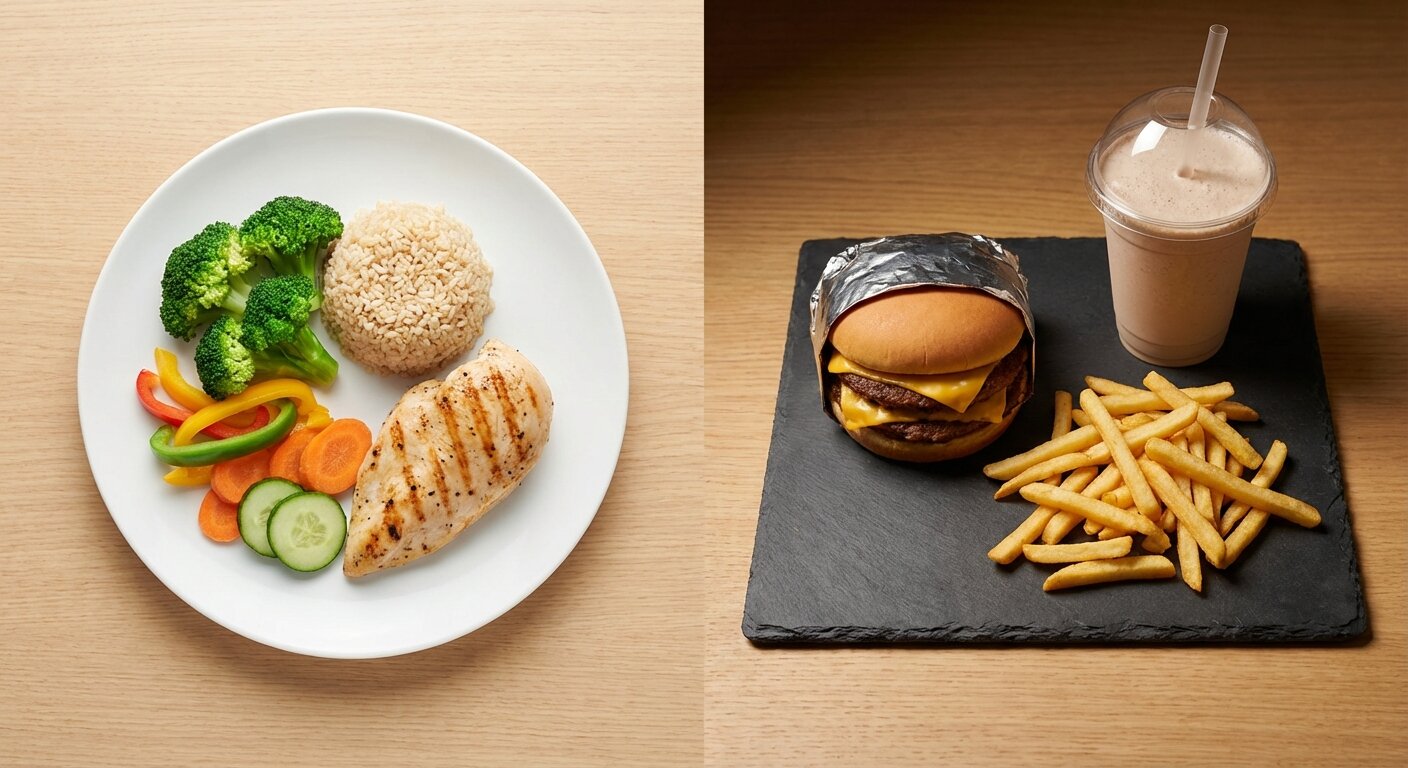
If you’re trying to build muscle, you’ve likely encountered two competing philosophies: the dirty bulk and the clean bulk. One promises rapid weight gain by eating everything in sight. The other takes a more measured approach, prioritizing food quality alongside quantity.
But which strategy actually works better? Does it matter what you eat as long as you’re in a calorie surplus? And can you really build muscle eating pizza and ice cream daily?
This guide breaks down the science, benefits, and drawbacks of both approaches to help you choose the bulking strategy that matches your goals, lifestyle, and tolerance for body fat gain. Whether you’re a competitive bodybuilder, recreational lifter, or someone trying to pack on mass for the first time, you’ll learn exactly how to structure your bulk for maximum muscle with minimum regret.
Let’s start with the calculator. Use our macro calculator to determine your ideal calorie surplus and macronutrient targets based on your current stats and bulking goals.
Related: Learn the optimal macros for muscle gain and flexible dieting principles.
What Is a Dirty Bulk?
A dirty bulk is an aggressive muscle-building approach that prioritizes calorie quantity over food quality. The philosophy is simple: eat in a massive surplus (often 500-1,500+ calories above maintenance) with minimal restrictions on food choices.
Dirty Bulk Characteristics
High calorie surplus: Typically 1,000+ calories above maintenance daily, sometimes significantly more
Minimal food restrictions: Fast food, processed snacks, sugary treats, and calorie-dense “junk” foods are not only allowed but often encouraged
Rapid weight gain: Target weight gain of 2-4+ pounds per week
Macro flexibility: Protein targets are maintained, but carbs and fats often come from whatever’s convenient and calorie-dense
Time efficiency: Less meal prep, less food tracking precision, more eating out
The Dirty Bulk Mindset
The dirty bulk philosophy emerged from old-school bodybuilding culture, popularized by the idea that you need to “eat big to get big.” The approach assumes that maximizing calorie intake will maximize muscle growth, and that some fat gain is not just acceptable but inevitable during mass-building phases.
Proponents argue that worrying about food quality is overthinking—what matters is hitting calorie and protein targets by any means necessary. The extra fat can always be cut later.
Common Dirty Bulk Foods
- Fast food burgers and fries
- Pizza, wings, nachos
- Ice cream, donuts, pastries
- Sugary cereals and snack foods
- Processed meats
- Calorie-dense shakes with whole milk, peanut butter, ice cream
- Essentially anything that packs maximum calories with minimum volume
The appeal is obvious: dirty bulking is easy, convenient, and psychologically satisfying. You’re not restricting anything. Every meal feels like a cheat meal. For hardgainers who struggle to eat enough, it removes barriers to calorie consumption.
But convenience and enjoyment don’t necessarily translate to optimal muscle building—or good health.
What Is a Clean Bulk?
A clean bulk is a controlled muscle-building approach that emphasizes strategic calorie surplus from nutrient-dense whole foods. The goal is maximizing muscle gain while minimizing fat accumulation and supporting overall health.
Clean Bulk Characteristics
Moderate calorie surplus: Typically 300-500 calories above maintenance daily
Whole food emphasis: Diet built around lean proteins, complex carbs, healthy fats, fruits, vegetables, and minimally processed foods
Controlled weight gain: Target weight gain of 0.5-1 pound per week (beginners may aim for 1-2 pounds weekly due to newbie gains)
Precise macro tracking: Careful monitoring of protein (0.8-1g per pound bodyweight), carbs, and fats to optimize body composition
Meal preparation: More planning, cooking, and tracking required compared to dirty bulking
The Clean Bulk Philosophy
Clean bulking is rooted in the understanding that muscle protein synthesis has limits. Research shows that muscle growth maxes out at relatively modest calorie surpluses—eating 3,000 calories above maintenance doesn’t build muscle 6x faster than eating 500 above.
The clean bulk approach recognizes that:
- Excess calories beyond what muscle synthesis requires get stored as fat
- Food quality impacts recovery, performance, inflammation, and health markers
- Minimizing fat gain makes cutting phases shorter and preserves muscle better
- Sustainable nutrition habits matter for long-term progress
Clean bulking isn’t about deprivation—it’s about efficiency. Every calorie is working toward your goal rather than being wasted on unnecessary fat storage.
Common Clean Bulk Foods
Lean proteins:
- Chicken breast, turkey breast
- Lean beef (93/7 or leaner)
- Fish (salmon, tuna, tilapia, cod)
- Egg whites with some whole eggs
- Greek yogurt, cottage cheese
- Protein powder
Complex carbohydrates:
- Oats, quinoa, brown rice
- Sweet potatoes, regular potatoes
- Whole grain bread and pasta
- Fruits (bananas, berries, apples)
Healthy fats:
- Nuts and nut butters (measured portions)
- Avocado
- Olive oil, coconut oil
- Fatty fish (salmon, mackerel)
- Whole eggs
Vegetables:
- Broccoli, spinach, kale
- Bell peppers, carrots, tomatoes
- Mixed greens salads
- Essentially unlimited volume of non-starchy vegetables
Strategic treats:
- Dark chocolate (85%+)
- Homemade protein treats
- Occasional restaurant meals with controlled portions
Clean bulking requires more discipline, planning, and cooking, but delivers cleaner gains and better health outcomes throughout the process.
Dirty Bulk vs Clean Bulk: Key Differences
| Factor | Dirty Bulk | Clean Bulk |
|---|---|---|
| Calorie Surplus | 1,000+ calories/day | 300-500 calories/day |
| Weight Gain Rate | 2-4+ lbs/week | 0.5-1 lb/week |
| Food Quality | Unrestricted, heavy on processed foods | Prioritizes whole, nutrient-dense foods |
| Muscle Gain Rate | No faster than clean bulk (muscle synthesis limited) | Optimal for muscle protein synthesis |
| Fat Gain | Significant and rapid | Minimal and controlled |
| Energy Levels | Variable, often blood sugar crashes | Stable throughout day |
| Digestion | Often poor (bloating, discomfort) | Generally good with fiber intake |
| Health Markers | Can worsen (cholesterol, inflammation) | Usually stable or improve |
| Cutting Phase Required | Longer, more aggressive | Shorter, less aggressive |
| Ease/Convenience | Very easy, no restrictions | Requires meal prep and tracking |
| Cost | Often more expensive (eating out) | Generally cheaper (home cooking) |
| Sustainability | Hard to maintain long-term | Sustainable as lifestyle approach |
| Best For | Extreme hardgainers, short-term aggressive phases | Most lifters, long-term muscle building |
The fundamental difference isn’t just what you eat—it’s the philosophy behind surplus management. Dirty bulking treats surplus as unlimited, while clean bulking recognizes that muscle building has a ceiling that more calories can’t break through.
The Science of Muscle Growth and Calorie Surplus
Understanding the physiology of muscle building reveals why clean bulking is more efficient for most people.
Muscle Protein Synthesis Has Limits
When you resistance train and consume adequate protein in a calorie surplus, you trigger muscle protein synthesis (MPS)—the process of building new muscle tissue. But MPS doesn’t scale infinitely with calorie intake.
Research shows that muscle protein synthesis maxes out at relatively modest surpluses:
- Beginners: Can build 1-1.5 pounds of muscle per month in small surpluses
- Intermediates: ~0.5-1 pound of muscle monthly
- Advanced lifters: ~0.25-0.5 pounds monthly
These rates don’t significantly increase by eating thousands of extra calories. Once you’ve provided enough calories and protein to maximize MPS, additional calories get stored as fat, not muscle.
The 3,500-Calorie “Rule”
A pound of fat contains approximately 3,500 calories. A pound of muscle contains roughly 600-700 calories worth of tissue (mostly water and protein).
If you’re eating 1,000 calories above maintenance daily:
- Weekly surplus: 7,000 calories
- Potential muscle gain: 0.5-1 pound (~350-700 calories worth)
- Remaining surplus: 6,300-6,650 calories
- Fat gain: ~1.8-1.9 pounds weekly
In contrast, a 300-500 calorie daily surplus:
- Weekly surplus: 2,100-3,500 calories
- Potential muscle gain: 0.5-1 pound (~350-700 calories worth)
- Remaining surplus: 1,400-3,150 calories
- Fat gain: ~0.4-0.9 pounds weekly
The muscle gained is essentially identical between approaches, but fat accumulation differs dramatically.
Nutrient Partitioning
Your body’s ability to direct nutrients toward muscle vs. fat storage (nutrient partitioning) is influenced by:
- Training status: Beginners partition nutrients better toward muscle
- Body fat percentage: Leaner individuals partition better (another reason to start bulks lean)
- Insulin sensitivity: Better insulin sensitivity improves partitioning
- Genetics: Some people build muscle more efficiently than others
Dirty bulking often worsens insulin sensitivity through processed foods, high sugar intake, and rapid fat gain—actually making nutrient partitioning worse over time.
Clean bulking supports better nutrient partitioning by maintaining insulin sensitivity and minimizing body fat accumulation.
Hormonal Impacts
Excessive fat gain from dirty bulking affects hormone profiles:
- Testosterone: Can decrease as body fat rises significantly
- Estrogen: Increases with higher body fat
- Cortisol: Chronic overeating can elevate stress hormones
- Leptin/Ghrelin: Appetite regulation becomes dysregulated
These hormonal shifts can actually impair muscle building and worsen fat storage as a dirty bulk progresses.
The Cutting Phase Reality
Many dirty bulkers underestimate the cost of aggressive cutting required after months of excessive eating:
- Longer cutting phases (3-6+ months vs. 8-12 weeks)
- More muscle loss during aggressive deficits
- Metabolic adaptation requiring increasingly low calories
- Worse gym performance throughout prolonged cuts
- Psychological difficulty of extended restriction after months of unrestricted eating
By the time you finish cutting from a dirty bulk, you may have similar or less muscle than someone who clean bulked and cut for half the time.
Pros and Cons of Dirty Bulking
Advantages of Dirty Bulk
1. Easiest to execute
No meal prep, no food restrictions, minimal tracking required. Convenient for people with limited cooking skills or time constraints.
2. Psychologically satisfying
You’re never hungry. Every meal can be whatever you want. Great for people coming off restrictive diets or cutting phases.
3. Works for extreme hardgainers
If you genuinely struggle to gain weight eating clean foods due to very high TDEE or poor appetite, dirty bulking removes barriers to calorie consumption.
4. Maximizes strength gains short-term
The massive calorie surplus can support maximal strength performance in the gym, especially for powerlifters prioritizing absolute strength over aesthetics.
5. Simple for beginners
No need to learn meal prep or macro tracking immediately—just eat more of everything.
Disadvantages of Dirty Bulk
1. Excessive fat gain
The primary downside. You’ll gain 2-3+ pounds of fat for every pound of muscle, sometimes worse. This fat must be cut later, extending your time to reach physique goals.
2. Worse health markers
Blood work often shows elevated cholesterol, triglycerides, fasting glucose, and inflammatory markers. Blood pressure may increase. These impacts are usually reversible but represent months of suboptimal health.
3. Digestive issues
Constant high-calorie processed food consumption commonly causes bloating, constipation or diarrhea, acid reflux, and general gut discomfort.
4. Energy instability
Blood sugar spikes and crashes from high-sugar, high-processed-food intake lead to energy roller coasters, afternoon crashes, and poor sleep quality.
5. Difficult reverse diet
After months of eating 4,000-5,000+ calories, reducing to maintenance or deficit requires aggressive cuts that often result in rebound weight gain and yo-yo dieting.
6. More expensive
Eating out regularly and purchasing convenience foods costs significantly more than meal prep.
7. Develops bad habits
Months of unrestricted eating can create unhealthy relationships with food, making future cuts psychologically harder.
8. Body image issues
Watching yourself get significantly fatter can be demoralizing, even when intentional. Many dirty bulkers lose motivation mid-phase.
9. Reduced athletic performance
Carrying excess fat mass impairs cardio capacity, movement quality, and functional fitness—fine for pure strength goals but problematic for athletes.
10. Potential nutrient deficiencies
Despite eating massive calories, dirty bulks often lack micronutrients, fiber, and phytonutrients found in whole foods.
Pros and Cons of Clean Bulking
Advantages of Clean Bulk
1. Maximizes muscle-to-fat ratio
You build muscle just as efficiently as dirty bulking but gain far less fat in the process. Your physique stays presentable year-round.
2. Shorter cutting phases
Less fat to lose means 8-12 week cuts vs. 4-6+ month cuts, preserving more muscle and getting you to goal physique faster.
3. Better health markers
Blood work typically stays stable or improves. Cardiovascular health, insulin sensitivity, and inflammatory markers remain good throughout.
4. Stable energy levels
Whole foods and stable blood sugar mean consistent energy for training, work, and daily life.
5. Good digestion
High fiber from fruits, vegetables, and whole grains supports gut health and regular digestion.
6. Sustainable long-term
You develop skills (meal prep, tracking) and habits that serve you for years, not just one bulk-cut cycle.
7. Better athletic performance
Carrying less excess fat maintains cardiovascular capacity, mobility, and functional fitness.
8. Positive body image
You look progressively better throughout the bulk rather than watching yourself get noticeably fat.
9. Nutrient density
Whole food emphasis ensures adequate vitamins, minerals, fiber, and beneficial plant compounds.
10. Teaches discipline
The planning and tracking required develops skills applicable to all future physique goals.
Disadvantages of Clean Bulk
1. Requires planning and prep
You need to cook, track macros, plan meals, and bring food with you. More time investment than dirty bulking.
2. Can feel restrictive
While not a diet, the emphasis on whole foods means you can’t always eat what you want in the moment. Requires delayed gratification.
3. More expensive upfront
Bulk buying ingredients requires capital. Though cheaper long-term than eating out, the weekly grocery bill might be higher than your current spending.
4. Slower weight gain
If you’re impatient to see the scale move up, clean bulking’s 0.5-1 pound weekly gains feel slow compared to dirty bulking’s 3-4 pounds.
5. Requires education
You need to learn about macros, portion sizes, meal timing, and food prep. There’s a learning curve for beginners.
6. Social challenges
Bringing tupperware to gatherings, turning down certain foods, and planning around meals can create social friction.
7. Can still gain unwanted fat
If your surplus is too aggressive or your tracking is off, clean bulking can still result in more fat gain than desired.
8. Not ideal for extreme hardgainers
If you have a very high TDEE (3,500+ calories maintenance) and poor appetite, eating 4,000+ calories of chicken and rice might be miserable.
Who Should Dirty Bulk?
Dirty bulking makes sense for a small subset of lifters in specific situations:
1. Extreme Hardgainers
If you:
- Maintain weight at 4,000+ calories
- Have a physically demanding job (construction, manual labor)
- Have clinical appetite issues or diagnosed digestive problems
- Are significantly underweight (BMI <18.5)
Then the convenience and calorie density of dirty bulking might be necessary to consistently achieve surplus eating.
2. Powerlifters in Off-Season
If your primary goal is absolute strength for competition and aesthetics are irrelevant, an aggressive surplus can maximize training volume and recovery. Many powerlifters intentionally bulk into higher weight classes using dirty bulk approaches.
3. Short-Term Shock Phases
Some advanced lifters use 4-6 week mini dirty bulks strategically:
- Breaking through plateaus
- Rapidly recovering from injury or illness
- Supporting very high-volume training blocks
These short phases minimize downsides while capturing convenience benefits.
4. Bulking for the First Time
Complete beginners who’ve never bulked might benefit from starting with fewer restrictions:
- Removes analysis paralysis
- Builds confidence eating more
- Captures easy newbie gains
After 8-12 weeks, transitioning to clean bulking is recommended.
When Dirty Bulking Is a Bad Idea
Avoid dirty bulking if you:
- Already carry significant body fat (>15% men, >25% women)
- Have metabolic issues (insulin resistance, prediabetes)
- Struggle with binge eating or food control issues
- Care about athletic performance or cardiovascular fitness
- Want to maintain aesthetics year-round
- Are an intermediate or advanced lifter (muscle gain rates too slow to justify rapid fat gain)
For most people, most of the time, clean bulking is the superior choice.
Who Should Clean Bulk?
Clean bulking is appropriate for the vast majority of lifters:
1. Beginners and Intermediates
If you’re in your first 2-3 years of serious training, you can build muscle efficiently in small surpluses. Clean bulking lets you maximize newbie gains without unnecessary fat.
2. Aesthetic-Focused Lifters
If you care about:
- Looking good shirtless year-round
- Staying lean enough for beach season
- Maintaining visible abs during bulk phases
- Building a physique for physique competitions
Then clean bulking keeps you presentable while steadily adding muscle.
3. Athletes
If sport performance matters, clean bulking maintains:
- Cardiovascular capacity
- Speed and agility
- Power-to-weight ratio
- Movement quality
Dirty bulking adds dead weight that hinders athletic performance.
4. Health-Conscious Lifters
If you care about:
- Blood work and metabolic health
- Longevity and cardiovascular health
- Sustainable nutrition habits
- Avoiding yo-yo dieting patterns
Clean bulking supports these priorities while still building muscle effectively.
5. Anyone Who’s Cut Before
If you’ve experienced the difficulty of aggressive cuts, you understand the value of minimizing fat gain. Clean bulking makes your next cut dramatically easier.
6. Advanced Lifters
Once you’ve been training seriously for 3+ years, muscle gain rates slow significantly (0.25-0.5 pounds monthly). The slow pace makes dirty bulking even less justifiable—you’ll gain far more fat than muscle at advanced stages.
How to Transition Between Approaches
From Dirty Bulk to Clean Bulk
If you’ve been dirty bulking and want to transition:
Week 1-2: Track current intake
Log everything you’re eating without changing anything. Establish your baseline calories and macros.
Week 3-4: Reduce surplus gradually
Cut calories by 200-300 daily. Start replacing processed meals with whole food alternatives. Don’t drop calories aggressively or you’ll lose momentum.
Week 5-6: Dial in macros
Set protein to 0.8-1g per pound bodyweight. Distribute remaining calories between carbs and fats. Most people prefer higher carbs for training performance.
Week 7-8: Increase food quality
Swap remaining processed foods for whole food equivalents:
- Fast food burgers → homemade burgers with lean beef
- Ice cream → Greek yogurt with berries
- Sugary cereal → oats with protein powder
- Candy → fruit with nut butter
Week 9+: Monitor and adjust
Weigh yourself weekly. Adjust calories if:
- Gaining >1.5 pounds weekly → reduce by 100-200 calories
- Gaining <0.5 pounds weekly → increase by 100-200 calories
- Aim for 0.75-1 pound weekly gain
From Clean Bulk to Dirty Bulk (Not Recommended)
Most lifters shouldn’t intentionally transition from clean to dirty bulking, but if circumstances require it (extreme hardgaining situation, preparation for powerlifting meet):
Gradually increase surplus: Add 200-300 calories weekly until reaching aggressive surplus
Maintain protein minimum: Even in dirty bulk, hit 0.7-0.8g per pound bodyweight minimum
Add calorie-dense foods strategically: Use calorie-dense options (nut butters, oils, full-fat dairy) before resorting to processed junk
Monitor health markers: Get blood work every 8-12 weeks to catch metabolic issues early
Set a time limit: Dirty bulk for 6-12 weeks maximum, then transition back to clean approach
Hybrid Approach: Modified Clean Bulk
Many successful lifters use a modified clean bulk that captures benefits of both approaches:
The 90/10 Rule
- 90% of calories from whole, nutrient-dense foods
- 10% of calories from flexible treats or convenience foods
This provides:
- Nutritional benefits of clean bulking
- Psychological relief and social flexibility of dirty bulking
- Sustainable long-term adherence
Practical Implementation
Daily structure:
- Meals 1-4: Clean, whole foods (meal prep)
- Meal 5 or snacks: Flexible foods
Examples of 10% foods:
- Restaurant meal with friends once weekly
- Dessert 3-4x per week
- Processed snack between meals
- Weekend breakfast out
The key is planning these treats rather than reactive eating. You’re consciously choosing to use 200-300 calories on something enjoyable while the bulk of your intake remains whole foods.
Benefits Over Pure Approaches
✅ Better adherence than strict clean bulk ✅ Better health outcomes than full dirty bulk ✅ Sustainable for months or years ✅ Social life remains intact ✅ Still builds muscle efficiently with controlled fat gain
For most lifters, this is the sweet spot strategy that delivers great results without unnecessary restriction or excessive fat gain.
Practical Bulk Guidelines
Determining Your Surplus
Use our macro calculator to establish maintenance calories, then add:
Beginners (0-1 year training):
- Surplus: 300-500 calories daily
- Target weight gain: 1-2 pounds per week (aggressive newbie gains)
- Protein: 0.8-1g per pound bodyweight
Intermediates (1-3 years training):
- Surplus: 300-400 calories daily
- Target weight gain: 0.5-1 pound per week
- Protein: 0.8-1g per pound bodyweight
Advanced (3+ years training):
- Surplus: 200-300 calories daily
- Target weight gain: 0.5 pounds per week
- Protein: 0.8-1g per pound bodyweight
For detailed guidance, see our complete bulking macros guide.
Macro Distribution
Protein: 0.8-1g per pound bodyweight (consistent across approaches) — Learn more about protein requirements
Fats: 0.3-0.5g per pound bodyweight (hormone support, vitamin absorption) — See our guide on healthy fats
Carbs: Remainder of calories (prioritize for training performance) — Check out carbohydrates explained
Training Requirements
Both clean and dirty bulking require progressive overload in the gym:
Minimum effective training:
- 3-5 resistance training sessions weekly
- Each muscle group trained 2x per week minimum
- Progressive increase in weight, reps, or volume over time
- Compound movements prioritized (squat, deadlift, bench, overhead press, rows)
Without proper training stimulus, excess calories—regardless of source—become fat, not muscle.
Monitoring Progress
Weekly check-ins:
- Weigh yourself same day, same time (ideally morning after bathroom, before eating)
- Take progress photos every 2-4 weeks
- Track gym performance (weights lifted, reps completed)
- Monitor how clothes fit
Monthly assessments:
- Adjust calories based on average monthly weight gain
- Review training logs for strength progress
- Consider body composition testing (DEXA, bod pod) every 8-12 weeks
Red flags requiring adjustment:
- Gaining >1.5 pounds weekly (except first 2 weeks of bulk)
- Strength not progressing for 3+ weeks
- Excessive fatigue or poor recovery
- Noticeable gut distension or digestive issues
- Blood pressure trending upward
When to End Your Bulk
The optimal time to end a bulk depends on body fat percentage and goals, not arbitrary time frames or weight targets.
Recommended Body Fat Endpoints
Men:
- Start bulk: 10-12% body fat
- End bulk: 15-17% body fat maximum
Women:
- Start bulk: 18-20% body fat
- End bulk: 25-27% body fat maximum
Going beyond these ranges results in:
- Worsening nutrient partitioning (more calories → fat, fewer → muscle)
- Hormonal changes that impair muscle building
- Longer cutting phases required
- Increased muscle loss during cut
- Aesthetic and health downsides
Duration Guidelines
Typical bulk lengths:
- Beginners: 16-24 weeks (longer muscle-building potential)
- Intermediates: 12-20 weeks
- Advanced: 8-16 weeks (slower gains, less tolerance for fat accumulation)
Transitioning to Cut
Don’t go directly from aggressive surplus to aggressive deficit. Use a maintenance phase:
Week 1-2: Reduce to maintenance calories (surplus minus 300-500) Week 3-4: Stay at maintenance, let metabolism stabilize Week 5+: Begin cutting phase (300-500 calorie deficit)
This reverse diet prevents metabolic shock and preserves muscle better than immediate aggressive cuts.
Frequently Asked Questions
Can I gain muscle without bulking at all?
Yes, through a process called body recomposition (recomp). Eating at maintenance while training hard can slowly add muscle and lose fat simultaneously, especially for beginners or returning trainees. However, dedicated bulking phases generally build muscle faster than recomp for most people beyond the beginner stage. Learn more in our body recomposition macros guide.
Is the “see food” diet a dirty bulk?
The “see food” diet (eating whatever you see) is essentially an unstructured dirty bulk. While it might work short-term for extreme hardgainers, most people end up overeating significantly beyond productive surplus levels, resulting in excessive fat gain with no additional muscle benefit.
Do I need to eat every 2-3 hours while bulking?
No. Meal frequency doesn’t significantly impact muscle growth as long as you hit daily calorie and protein targets. Most people do well with 3-5 meals daily. Some prefer more frequent smaller meals for appetite or digestion reasons, but it’s personal preference, not a requirement.
Can I build muscle in a deficit instead of bulking?
Beginners and detrained individuals can build muscle in modest deficits. Advanced lifters generally can’t build appreciable muscle in deficits—they can only maintain existing muscle while losing fat. Dedicated surplus phases remain the most efficient muscle-building approach for trained individuals.
How much protein do I really need?
Research consistently shows 0.7-1.0g per pound of bodyweight maximizes muscle protein synthesis. Higher intakes aren’t harmful but don’t provide additional muscle-building benefits. Dirty or clean bulk, hit this protein minimum.
Should I do cardio while bulking?
Yes, moderate cardio supports cardiovascular health, appetite regulation, and recovery capacity. Aim for 2-3 sessions of 20-30 minutes weekly. Avoid excessive cardio (10+ hours weekly) that interferes with recovery and requires eating even more to maintain surplus.
What if I’m gaining too much fat on a clean bulk?
Reduce your surplus by 100-200 calories. Even clean bulking can result in excessive fat gain if your surplus is too large for your training status. Advanced lifters should use smaller surpluses (200-300 calories) than beginners (400-500 calories).
Can women dirty bulk?
Women can dirty bulk but generally shouldn’t. Women have lower muscle-building potential than men (roughly half the rate), making aggressive surpluses even less productive. Clean bulking is more appropriate for women’s physiology, with target weight gain of 0.25-0.75 pounds weekly.
How do I know my actual body fat percentage?
Home methods (calipers, bioelectrical impedance scales) are notoriously inaccurate. Best options are DEXA scans, Bod Pod, or hydrostatic weighing, available at sports medicine centers or universities. For practical purposes, progress photos and the mirror are sufficient—start lean, bulk until you’re no longer lean, then cut.
Should I bulk if I’m already overweight?
No. If you’re >15% body fat (men) or >25% (women), prioritize cutting to leaner starting points first. Bulking from high body fat percentages results in even worse nutrient partitioning, faster fat gain, and health complications. Get lean, then bulk from that foundation. See our macros for cutting guide to start your fat loss phase.
Is “lean bulking” the same as clean bulking?
Essentially yes. “Lean bulk,” “clean bulk,” and “slow bulk” all describe the same approach: controlled surplus from quality foods designed to minimize fat gain while building muscle. The terms are used interchangeably.
What’s “dreamer bulk”?
A “dreamer bulk” is internet slang for eating with no tracking or plan, hoping you’re building muscle when you’re primarily gaining fat. It’s typically used to mock dirty bulking gone wrong—someone convincing themselves they’re making gains when they’re just getting fat without muscle growth.
Can I drink alcohol while bulking?
Occasional moderate alcohol consumption (1-2 drinks, 1-2x weekly) won’t significantly impact muscle building. However, alcohol impairs protein synthesis, disrupts sleep quality, and adds empty calories. Heavy drinking (4+ drinks regularly) will compromise both clean and dirty bulking results.
Conclusion: Choose Your Path
The dirty bulk vs. clean bulk debate isn’t about right or wrong—it’s about choosing the right tool for your situation.
Dirty bulking makes sense for:
- Extreme hardgainers with very high calorie needs
- Short-term (4-8 week) aggressive phases
- Powerlifters prioritizing absolute strength over aesthetics
- Complete beginners removing barriers to eating more
Clean bulking makes sense for:
- Most lifters, most of the time
- Anyone who values aesthetics year-round
- Athletes balancing muscle and performance
- People prioritizing health and sustainable habits
- Intermediate and advanced lifters with slower muscle-building rates
The modified 90/10 approach makes sense for:
- People seeking sustainable middle ground
- Lifters wanting social flexibility with nutrition
- Those who’ve struggled with either pure approach previously
Whichever path you choose, remember the fundamentals that actually build muscle:
✅ Calorie surplus (amount matters more than approach) ✅ Adequate protein (0.8-1g per pound bodyweight) ✅ Progressive overload in training ✅ Consistency over months and years ✅ Adequate sleep and recovery
Start with the calculator to establish your targets, choose your approach, and commit to 12-20 weeks of consistent execution. Monitor progress, adjust based on results, and remember: the best bulk is the one you can sustain and actually complete.
Your gains await—whether from chicken and rice, or chicken and Oreos.
Related Articles
Travel Macros: How to Track Nutrition While Traveling
Complete guide to managing macros while traveling. Learn meal planning strategies,...
Read guide →
Macros for Shift Workers: Complete Guide to Nutrition on Rotating Schedules
Master macro tracking on night shifts and rotating schedules. Learn meal timing, sleep...
Read guide →
Macros During Ramadan: Complete Nutrition Guide for Fasting
Learn how to track macros during Ramadan fasting. Expert guide covering meal timing,...
Read guide →Disclaimer: This content is for informational purposes only. Consult a healthcare provider before making changes to your diet.