The Best Macro Ratios for Different Goals (2026 Guide)
Reviewed by Sarah Chen, MS, RD
You’ve decided to track macros. You know you need protein, carbs, and fats. But what’s the right balance?
Should you do 40/30/30? Or 50/25/25? Maybe high carb, low fat? Or high fat, low carb?
Here’s the problem: The internet throws dozens of different ratios at you—and most advice doesn’t explain why certain ratios work for specific goals. You’re left guessing whether you should follow the bodybuilder’s split or the endurance runner’s split.
The truth: There is no single “best” macro ratio for everyone. The optimal split depends on your goal, activity level, and personal preferences.
This guide breaks down the most effective macro ratios for different objectives—fat loss, muscle gain, maintenance, athletic performance—and explains the science behind each split. You’ll learn which ratio fits your goal and how to adjust based on your individual response.
By the end, you’ll know exactly what macros to eat and why.
Want personalized macro targets calculated instantly? Use our free macro calculator to skip the guesswork.
Understanding Macro Ratios vs Gram-Based Targets
Before diving into specific ratios, let’s clarify an important distinction. If you’re new to tracking, start with our complete beginner’s guide to counting macros first.
What Are Macro Ratios?
Macro ratios express your macronutrient breakdown as percentages of total calories.
Common examples:
- 40/30/30 = 40% carbs, 30% protein, 30% fat
- 50/25/25 = 50% carbs, 25% protein, 25% fat
- 30/40/30 = 30% carbs, 40% protein, 30% fat
These percentages tell you how to distribute your calories across the three macros.
The Problem with Ratios
Same ratio, different amounts:
Person A: 1,500 calories at 40/30/30
- Protein: 113g (450 cal)
- Carbs: 150g (600 cal)
- Fat: 50g (450 cal)
Person B: 2,800 calories at 40/30/30
- Protein: 210g (840 cal)
- Carbs: 280g (1,120 cal)
- Fat: 93g (840 cal)
A 140-pound woman and a 220-pound man have vastly different protein needs—but the same ratio gives them dramatically different gram amounts.
Why Grams Are Better
Gram-based targets adjust to your body size:
- 140-pound person: ~110-140g protein regardless of total calories
- 220-pound person: ~175-220g protein regardless of total calories
Your protein needs don’t double just because you’re eating 500 more calories. They’re based on bodyweight and your total daily energy expenditure (TDEE).
So Why Learn Ratios?
Ratios are useful for:
- Quick mental models (“aim for ~30% of calories from protein”)
- Understanding general dietary patterns
- Meal planning (“make 40% of my plate carbs”)
Grams are better for:
- Precise tracking
- Calculating actual daily targets
- Adjusting nutrition strategically
This guide covers popular ratios because they provide helpful frameworks—but we’ll also show you how to convert them to gram-based targets.
For a deep comparison, read macro counting vs calorie counting.
The Most Common Macro Ratios Explained
Let’s break down the popular splits you’ll encounter.
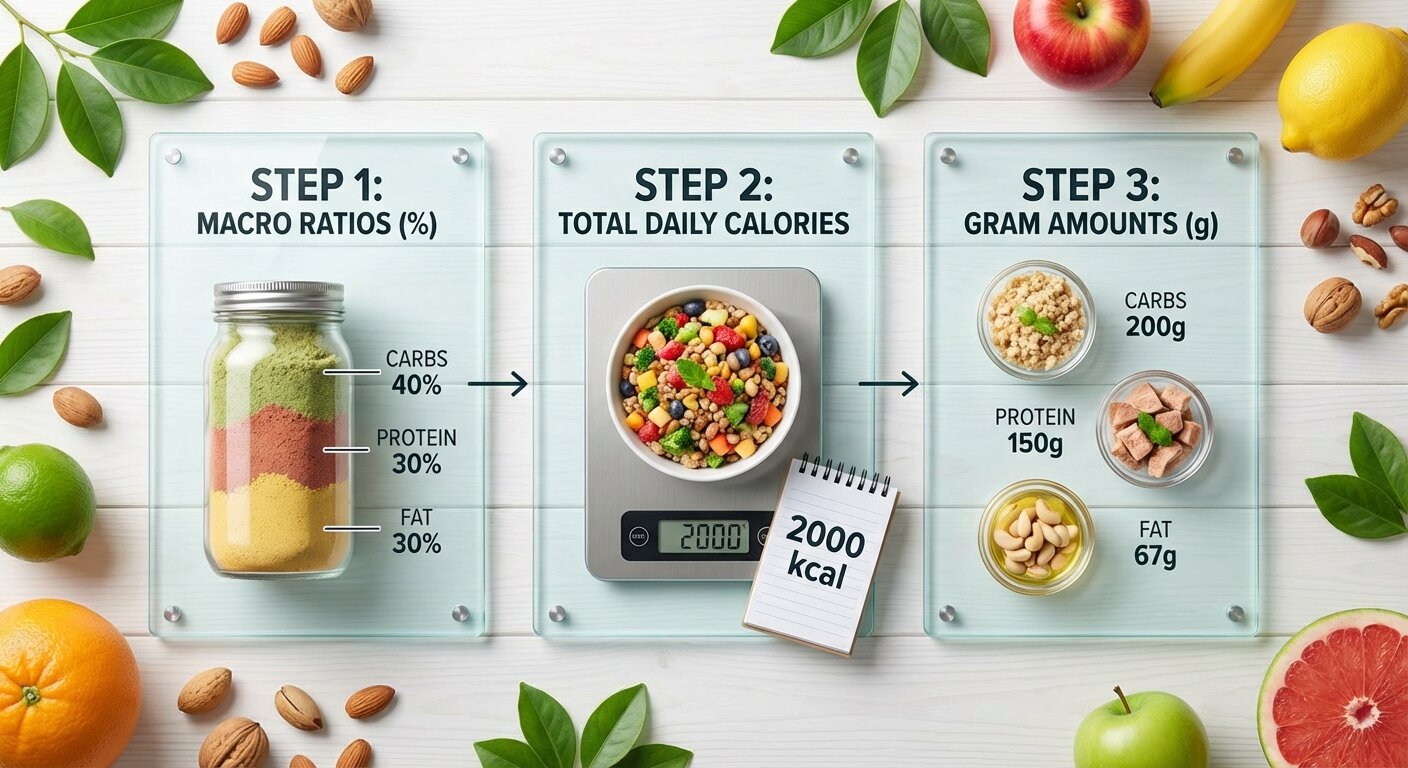
40/30/30: The Balanced “Zone Diet” Split
40% carbs | 30% protein | 30% fat
Origin: Popularized by Dr. Barry Sears’ Zone Diet in the 1990s.
Who it’s for:
- Maintenance and general fitness
- People new to macro tracking
- Those who want balanced energy and satiety
Pros:
- Well-rounded and sustainable
- Adequate protein for muscle preservation
- Enough carbs for activity
- Sufficient fat for hormones
Cons:
- Not optimized for specific goals (fat loss or muscle gain)
- Protein may be low for very active individuals
- Carbs may be low for endurance athletes
Example at 2,000 calories:
- Protein: 150g (600 cal)
- Carbs: 200g (800 cal)
- Fat: 67g (600 cal)
This split works well for maintenance but isn’t ideal for body recomposition.
40/40/20: High Protein for Fat Loss
40% carbs | 40% protein | 20% fat
Who it’s for:
- Aggressive fat loss (see our complete macros for weight loss guide)
- Preserving muscle during cuts
- People who struggle with hunger
Pros:
- Extremely high satiety from protein
- Maximum muscle preservation
- Works well for athletes cutting weight
Cons:
- Fat is at minimum levels (may affect hormones in women)
- Protein may be unnecessarily high for some people
- Can be expensive (high-quality protein costs more)
Example at 1,800 calories:
- Protein: 180g (720 cal)
- Carbs: 180g (720 cal)
- Fat: 40g (360 cal)
This is aggressive but effective for short-term cuts. Not ideal long-term due to low fat.
30/50/20: High Carb for Muscle Gain
30% protein | 50% carbs | 20% fat
Who it’s for:
- Building muscle (see our macros for muscle gain guide)
- High-volume training
- Athletes needing maximum glycogen
Pros:
- Abundant carbs fuel intense training
- Adequate protein for muscle synthesis
- Low fat keeps more calories for carbs (training fuel)
Cons:
- Fat is at minimum (watch for hormone issues)
- Carb-heavy meals may cause energy crashes in some people
- Not ideal for insulin-resistant individuals
Example at 2,800 calories:
- Protein: 210g (840 cal)
- Carbs: 350g (1,400 cal)
- Fat: 62g (560 cal)
This split maximizes training performance and recovery for muscle building.
50/30/20: Standard Bodybuilding Split
50% carbs | 30% protein | 20% fat
Who it’s for:
- Maintenance with regular training
- Lean bulking
- Athletes with high activity levels
Pros:
- High carb intake supports training volume
- Adequate protein
- Time-tested by bodybuilders
Cons:
- Fat is low (minimum for health)
- Carbs may be excessive for moderate activity levels
Example at 2,200 calories:
- Protein: 165g (660 cal)
- Carbs: 275g (1,100 cal)
- Fat: 49g (440 cal)
Popular among physique competitors during off-season.
20/60/20: Keto/Low-Carb Ratio
20% carbs | 60% fat | 20% protein
Who it’s for:
- Ketogenic dieters
- Low-carb enthusiasts
- People managing insulin resistance
Pros:
- Supports ketosis
- High satiety from fat
- Stable energy (no blood sugar spikes)
Cons:
- Not ideal for high-intensity training
- Protein may be too low for muscle preservation
- Adaptation period can be challenging
Example at 2,000 calories:
- Protein: 100g (400 cal)
- Carbs: 100g (400 cal)
- Fat: 133g (1,200 cal)
This is technically not keto (too many carbs). True keto is <5-10% carbs. Read our keto macro calculator guide for specifics.
Best Macro Ratios by Goal
Now let’s get specific about which ratios work best for different objectives.
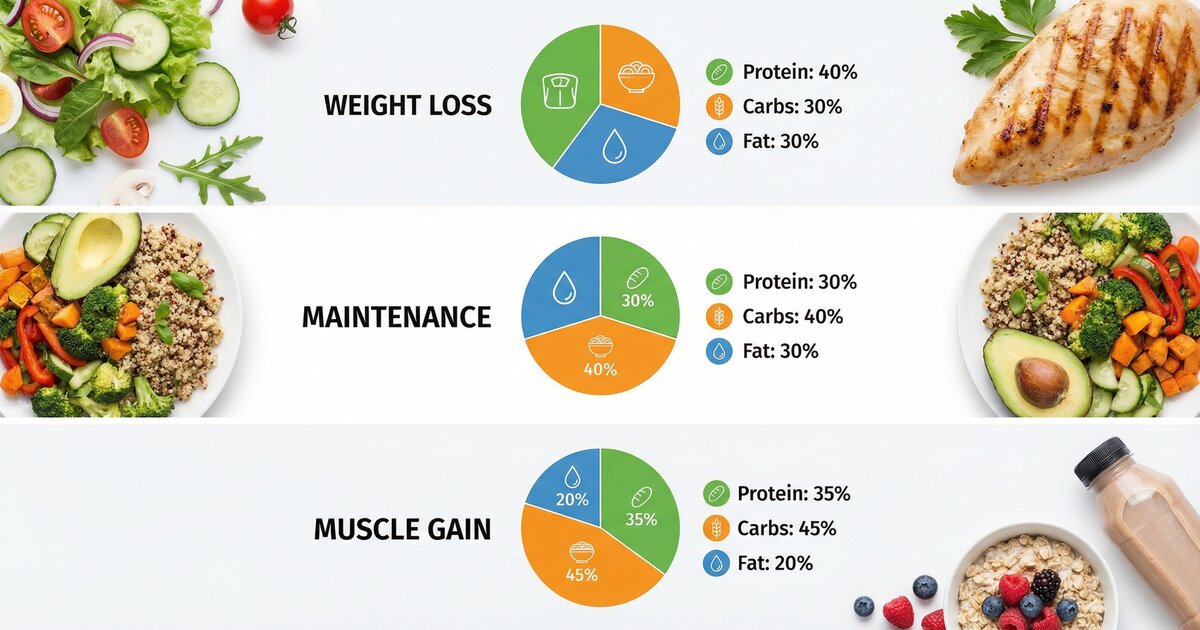
For Fat Loss: 40/35/25 or 40/40/20
Recommended: 40% protein | 35% carbs | 25% fat
Why this works:
- High protein preserves muscle during calorie deficit
- Protein maximizes satiety (easiest way to stick to deficit)
- Moderate carbs support training without excess
- Adequate fat for hormone production
Alternative aggressive split: 40% protein | 40% carbs | 20% fat (if struggling with hunger)
Example for 1,700 calories:
- Protein: 170g (680 cal)
- Carbs: 149g (595 cal)
- Fat: 47g (425 cal)
Or in gram-based terms (better):
- Protein: 0.8-1.0g per pound bodyweight
- Fat: 0.3-0.35g per pound bodyweight
- Carbs: Fill remaining calories
Read our detailed guide on best macro split for weight loss.
For Muscle Gain: 30/50/20 or 25/55/20
Recommended: 30% protein | 50% carbs | 20% fat
Why this works:
- High carbs fuel intense training and recovery
- Adequate protein supports muscle protein synthesis
- Lower fat allows more calories for carbs (training fuel)
Example for 2,800 calories:
- Protein: 210g (840 cal)
- Carbs: 350g (1,400 cal)
- Fat: 62g (560 cal)
Or in gram-based terms (better):
- Protein: 0.8-1.0g per pound bodyweight
- Fat: 0.3-0.4g per pound bodyweight
- Carbs: Fill remaining surplus calories
Check out our complete bulking macros guide for muscle-building nutrition.
For Maintenance: 40/30/30 or 35/35/30
Recommended: 40% carbs | 30% protein | 30% fat
Why this works:
- Balanced and sustainable long-term
- Adequate protein maintains muscle
- Moderate carbs and fats support daily activity
- Flexible for lifestyle
Example for 2,200 calories:
- Protein: 165g (660 cal)
- Carbs: 220g (880 cal)
- Fat: 73g (660 cal)
This split is the “default” for general health and fitness without specific goals.
For Endurance Athletes: 25/60/15
Recommended: 25% protein | 60% carbs | 15% fat
Why this works:
- Very high carbs for glycogen replenishment
- Adequate protein for recovery
- Lower fat to maximize carb intake
Example for 3,000 calories:
- Protein: 188g (750 cal)
- Carbs: 450g (1,800 cal)
- Fat: 50g (450 cal)
Marathon runners, cyclists, and triathletes benefit from high carb ratios.
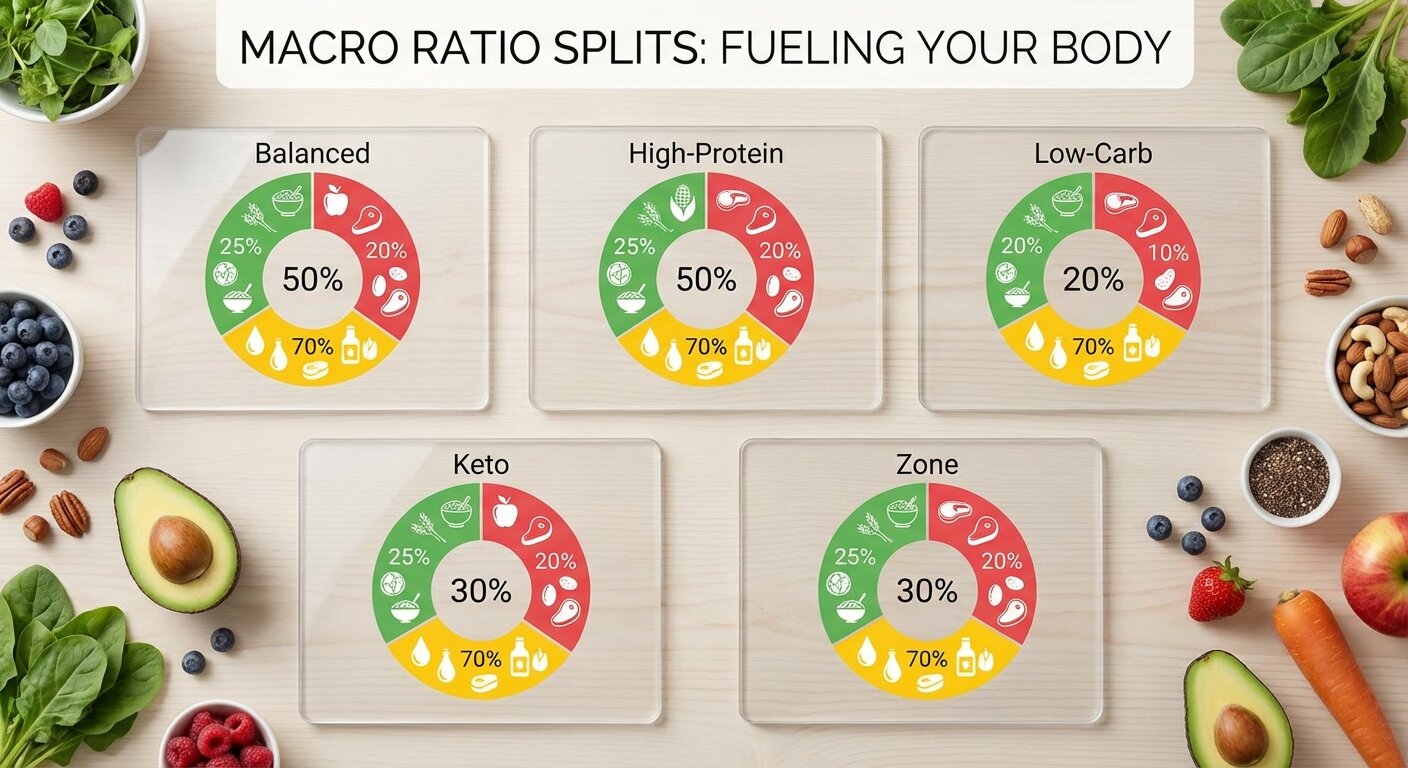
For Keto/Low-Carb: 20/10/70 or 25/5/70
True ketogenic: 10% carbs | 20% protein | 70% fat
Why this works:
- Very low carbs induce ketosis
- High fat provides energy in absence of carbs
- Moderate protein prevents gluconeogenesis
Example for 2,000 calories:
- Protein: 100g (400 cal)
- Carbs: 50g (200 cal)
- Fat: 156g (1,400 cal)
This requires strict adherence to maintain ketosis. Read our keto macro calculator for specifics.
How to Convert Ratios to Gram-Based Targets
Let’s walk through converting a ratio to actual grams—the better tracking method.
Step 1: Know Your Calorie Target
Example: 2,000 calories for fat loss
Step 2: Choose Your Ratio
Let’s use 40/35/25 (protein/carbs/fat)
Step 3: Calculate Each Macro
Protein: 2,000 cal × 40% = 800 calories from protein 800 cal ÷ 4 cal/g = 200g protein
Carbs: 2,000 cal × 35% = 700 calories from carbs 700 cal ÷ 4 cal/g = 175g carbs
Fat: 2,000 cal × 25% = 500 calories from fat 500 cal ÷ 9 cal/g = 56g fat
Final targets: 2,000 cal | 200P | 175C | 56F
Step 4: Verify
(200 × 4) + (175 × 4) + (56 × 9) = 800 + 700 + 504 = 2,004 calories ✓
Now track grams, not percentages.
Better Method: Start with Protein and Fat
Instead of using ratios, calculate protein and fat based on bodyweight, then fill remaining calories with carbs:
For a 160-pound person cutting:
- Protein: 160 × 0.9 = 144g (576 cal)
- Fat: 160 × 0.35 = 56g (504 cal)
- Remaining for carbs: 2,000 - 1,080 = 920 cal → 230g carbs
Final targets: 2,000 cal | 144P | 230C | 56F
This is more accurate than ratio-based calculations. Learn the complete process in how to calculate your macros.
How to Adjust Ratios Based on Your Response
Your initial ratio is a starting point. Here’s how to fine-tune.
If You’re Constantly Hungry
Adjustment: Increase protein and fat, decrease carbs
Why: Protein and fat are more satiating than carbs.
Example: Change 40/35/25 → 45/30/25 (increase protein 5%)
This adds ~25g protein and removes ~25g carbs, dramatically improving satiety.
If You Have Low Energy in the Gym
Adjustment: Increase carbs, decrease fat
Why: Carbs fuel high-intensity training.
Example: Change 30/50/20 → 30/55/15 (add carbs, reduce fat)
This adds ~30g carbs, improving workout performance.
If You’re Not Losing Weight
Adjustment: Reduce total calories (usually from carbs or fat, not protein)
Why: You’re not in a sufficient deficit.
Example: Drop 200 calories by removing 50g carbs or 22g fat
Keep protein high to preserve muscle.
If Fat Loss Is Too Fast (>2 lbs/week)
Adjustment: Add calories, primarily from carbs
Why: Prevents excessive muscle loss and metabolic slowdown.
Example: Add 200 calories (50g carbs)
Sustainable fat loss is 0.5-1% bodyweight per week.
If You’re Not Gaining Muscle
Adjustment: Increase total calories (primarily carbs)
Why: You’re not in sufficient surplus for growth.
Example: Add 300 calories (75g carbs)
Lean bulking requires +200-300 calories above maintenance.
Macro Ratio Myths Debunked
Let’s address common misconceptions.
Myth 1: “You Must Follow X/Y/Z Ratio Exactly”
Truth: Individual variation is huge. Some people thrive on higher carbs, others on higher fats. The “perfect” ratio is the one you can sustain while making progress.
Myth 2: “Changing Your Ratio Will Unlock Fat Loss”
Truth: Calories drive fat loss, not macro ratios. A 40/30/30 split at 2,500 calories won’t cause fat loss if your maintenance is 2,200 calories.
Ratios optimize results within a calorie target—they don’t override energy balance.
Myth 3: “High Carb Makes You Fat”
Truth: Excess calories make you fat, not carbs specifically. Bodybuilders eat 400+ grams of carbs daily and stay lean.
What matters: total calorie intake and protein adequacy.
Myth 4: “Low Fat is Unhealthy”
Truth: Fat below 0.25g per pound can disrupt hormones. But 20-25% of calories (0.3-0.4g per pound) is perfectly healthy.
Myth 5: “You Need the Same Ratio Every Day”
Truth: Advanced lifters use carb cycling—higher carbs on training days, lower on rest days. Total weekly intake matters more than daily ratios.
However, beginners benefit from consistency.
Sample Meal Plans for Different Ratios
Let’s see what these ratios look like in real food.
40/35/25 Split (Fat Loss) - 1,800 Calories
Macros: 180g protein | 158g carbs | 50g fat
Meals:
- Breakfast: Egg white omelet (6 whites + veggies) with oatmeal (30P | 35C | 5F)
- Snack: Greek yogurt with berries (20P | 20C | 2F)
- Lunch: Grilled chicken breast, quinoa, steamed broccoli (45P | 50C | 10F)
- Snack: Protein shake (25P | 5C | 2F)
- Dinner: Baked salmon, sweet potato, asparagus (48P | 48C | 18F)
- Snack: Cottage cheese (12P | 5C | 3F)
Total: 180P | 163C | 40F (close enough)
30/50/20 Split (Muscle Gain) - 2,800 Calories
Macros: 210g protein | 350g carbs | 62g fat
Meals:
- Breakfast: Protein pancakes with syrup (35P | 60C | 8F)
- Snack: Banana with peanut butter (5P | 35C | 8F)
- Lunch: Double chicken burrito bowl with rice (50P | 90C | 15F)
- Pre-workout: Rice cakes with jam (3P | 40C | 1F)
- Post-workout: Protein shake with dextrose (30P | 50C | 2F)
- Dinner: Lean steak, massive pasta serving, vegetables (50P | 110C | 18F)
- Snack: Protein bar (20P | 25C | 8F)
Total: 193P | 410C | 60F (carbs slightly high, still works)
40/30/30 Split (Maintenance) - 2,200 Calories
Macros: 165g protein | 165g carbs | 73g fat
Meals:
- Breakfast: Eggs with avocado toast (25P | 30C | 20F)
- Snack: Apple with almond butter (2P | 25C | 10F)
- Lunch: Turkey sandwich, side salad with dressing (30P | 40C | 15F)
- Snack: Greek yogurt (20P | 15C | 5F)
- Dinner: Chicken thighs, rice, roasted vegetables (50P | 55C | 22F)
- Dessert: Dark chocolate (2P | 10C | 8F)
Total: 129P | 175C | 80F (adjust portions to dial in)
For more meal planning ideas, read our macro meal prep guide.
FAQ: Macro Ratios
Can I use different ratios on training vs rest days?
Yes, this is called carb cycling. Higher carbs on training days fuel workouts; lower carbs on rest days reduce overall calories. Keep protein consistent daily.
What’s better for fat loss: low carb or low fat?
Both work if calories are equal. Low carb works well for insulin-resistant individuals. Low fat allows more carbs for training. Choose based on preference and adherence.
Should women use different ratios than men?
Women generally do better with slightly higher fat (25-30% vs 20-25% for men) for hormone health. Otherwise, ratios are similar.
Do I change my ratios as I lose weight?
Not necessarily. You’ll reduce total calories as you lose weight, which automatically reduces macro gram amounts. Ratios can stay the same.
What ratio is best for abs?
Abs are revealed through fat loss, which requires a calorie deficit. A high-protein ratio (40/35/25) helps preserve muscle while cutting fat. Ratios don’t create abs—low body fat does.
Can I build muscle on low carb?
Yes, but it’s harder. Carbs fuel high-intensity training. Most people build muscle more effectively with moderate-high carbs (45-55% of calories).
The Bottom Line
There is no single “best” macro ratio. The optimal split depends on:
- Your goal (fat loss, muscle gain, maintenance)
- Your activity level
- Your food preferences
- How your body responds
General guidelines:
- Fat loss: 40/35/25 (high protein, moderate carbs/fat)
- Muscle gain: 30/50/20 (high carbs, adequate protein, minimum fat)
- Maintenance: 40/30/30 (balanced split)
- Endurance: 25/60/15 (very high carbs)
- Keto: 20/10/70 (very low carbs, high fat)
Better approach: Set protein based on bodyweight (0.8-1.0g per pound), set minimum fat (0.3-0.4g per pound), fill remaining calories with carbs. This automatically creates the right ratio for your body size.
Ready to get your personalized macros calculated? Use our free macro calculator to get gram-based targets customized to your weight, activity level, and goal.
Then read how to calculate your macros step-by-step for a complete breakdown of the process.
Start with recommended ratios, track consistently for 2-3 weeks, then adjust based on your results. The perfect macro ratio is the one that gets you results while being sustainable long-term.
Related Resources
Related Articles
Travel Macros: How to Track Nutrition While Traveling
Complete guide to managing macros while traveling. Learn meal planning strategies,...
Read guide →
Macros for Shift Workers: Complete Guide to Nutrition on Rotating Schedules
Master macro tracking on night shifts and rotating schedules. Learn meal timing, sleep...
Read guide →
Macros During Ramadan: Complete Nutrition Guide for Fasting
Learn how to track macros during Ramadan fasting. Expert guide covering meal timing,...
Read guide →Disclaimer: This content is for informational purposes only. Consult a healthcare provider before making changes to your diet.