Bulking Macros: The Complete Guide to Clean Bulking (2025)
Reviewed by Sarah Chen, MS, RD
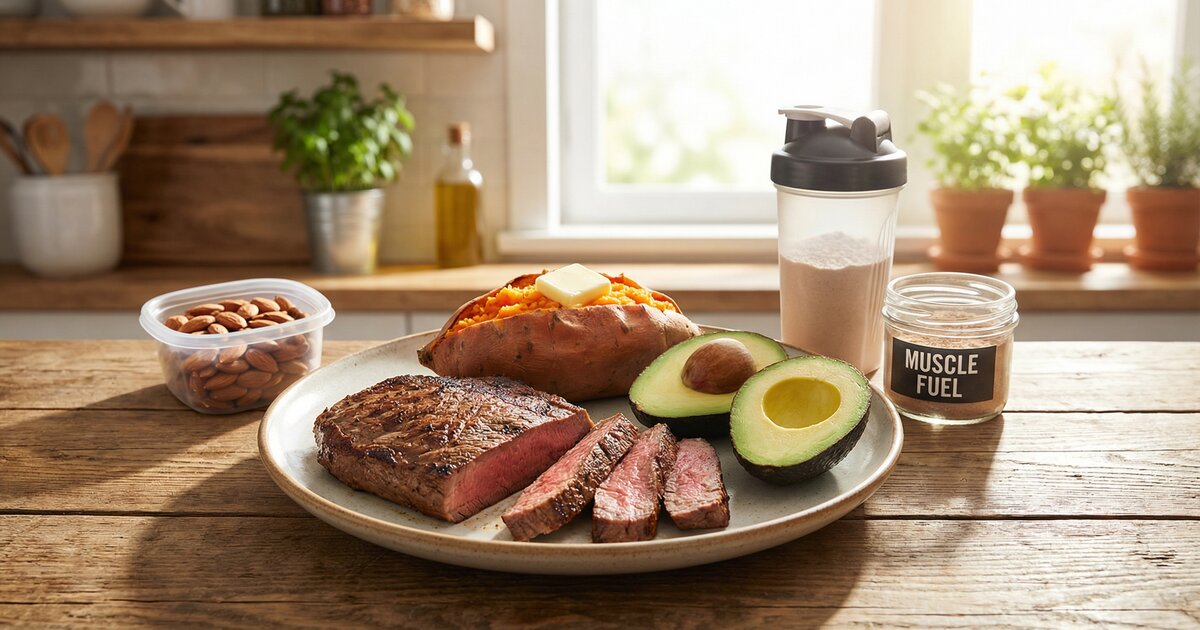
You want to build muscle. You know you need to eat more. But how much more? And what should those extra calories look like?
Here’s the problem: bulk too aggressively and you’ll gain 2-3 pounds per month—but half of it will be fat. You’ll look fluffy and spend months cutting later. Bulk too conservatively and you’ll spin your wheels for months, barely gaining any muscle at all.
The solution? A strategic clean bulk with precisely calculated macros.
This guide teaches you how to set up bulking macros for maximum muscle gain with minimal fat accumulation. You’ll learn the exact formulas, optimal surplus sizes, macro splits for different experience levels, and how to adjust based on progress.
By the end, you’ll have a personalized bulking plan that builds lean muscle efficiently—without getting fat in the process.
Want instant bulking macro calculations? Our free macro calculator generates personalized targets in 60 seconds.
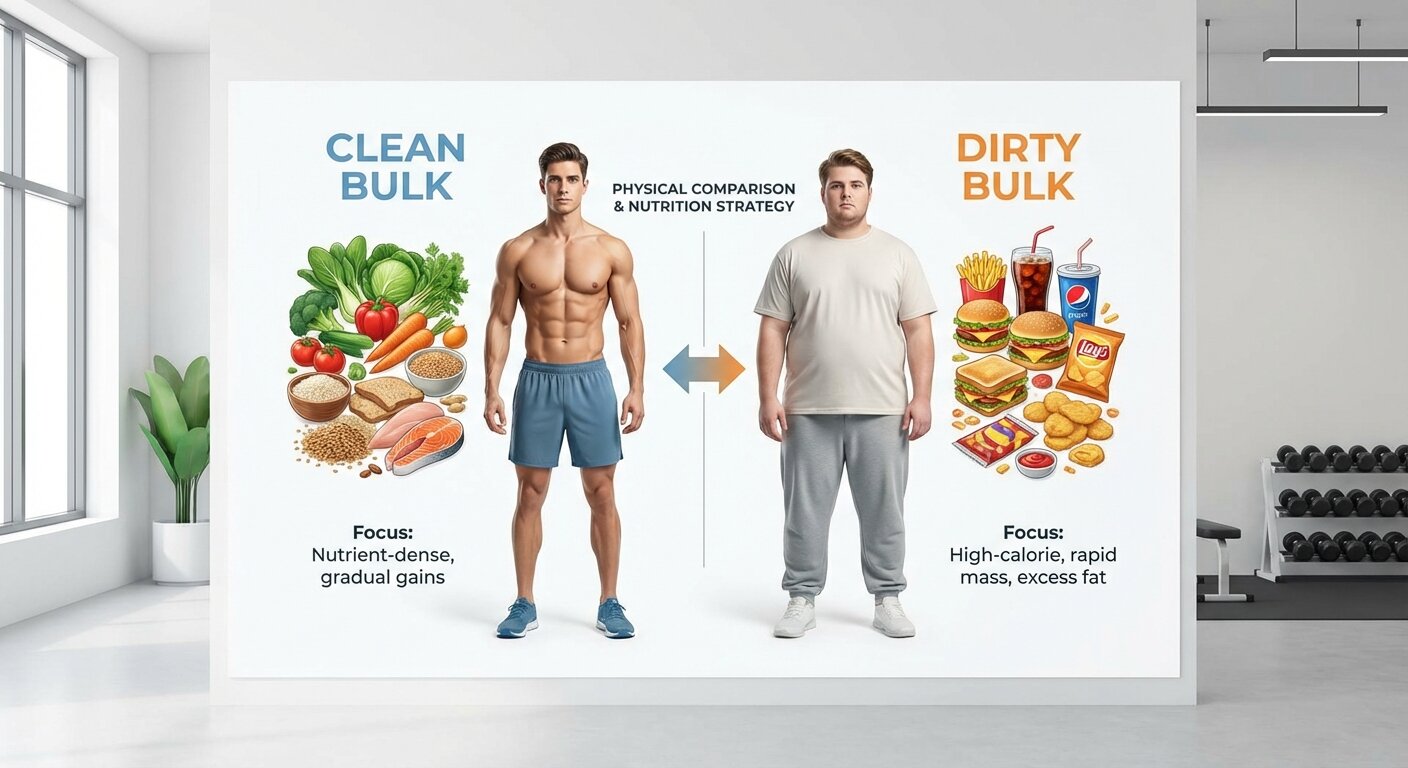
Clean Bulk vs Dirty Bulk: Why the Approach Matters
Before calculating macros, understand the two main bulking philosophies.
The Dirty Bulk Approach
Philosophy: “Eat everything, lift heavy, muscle will come”
Characteristics:
- Large calorie surplus (500-1,000+)
- Any foods (fast food, junk food, “whatever fits”)
- Rapid weight gain (2-4+ lbs/month)
- Minimal tracking
Results:
- Muscle gain: Good (maybe 1-1.5 lbs/month)
- Fat gain: Excessive (1-3+ lbs/month)
- Body fat increases dramatically
- Requires long, aggressive cuts
Who it works for: Extreme hardgainers with very fast metabolisms, young lifters with excellent recovery
The Clean Bulk Approach
Philosophy: “Controlled surplus, quality foods, optimize muscle-to-fat ratio”
Characteristics:
- Moderate surplus (10-20% above maintenance, 200-500 calories)
- Mostly whole, nutrient-dense foods
- Steady weight gain (0.5-1 lb/week)
- Macro tracking
Results:
- Muscle gain: Excellent (1-2 lbs/month for intermediates)
- Fat gain: Minimal (0.5-1 lb/month)
- Maintain visible abs or definition
- Short mini-cuts maintain leanness
Who it works for: Most people, especially those who’ve been training 1+ years
Why Clean Bulking Is Superior
1. Better Muscle-to-Fat Ratio
Your body can only synthesize ~1-2 pounds of muscle per month (for intermediates; less for advanced). Extra calories beyond what’s needed for muscle growth just become fat.
2. Easier to Cut Later
Going from 12% → 15% body fat requires a 4-6 week mini-cut. Going from 12% → 20% requires 12-16 weeks of aggressive cutting—losing some muscle in the process.
3. Better Insulin Sensitivity
Staying leaner maintains insulin sensitivity, which improves nutrient partitioning (more calories go to muscle, less to fat).
4. You Look Better Year-Round
Maintaining definition means you’re always photo-ready and feel confident without a shirt.
Exception: Absolute beginners and extreme ectomorphs can get away with slightly more aggressive surpluses initially.
Calculating Your Bulking Macros (Step-by-Step)
Follow this systematic formula to dial in optimal bulking macros.
Step 1: Calculate Your Maintenance Calories (TDEE)
First, determine how many calories you burn daily.
Quick Estimate Formula
TDEE = Bodyweight (lbs) × Activity Multiplier
Activity multipliers for bulking:
- Moderate training (3-4 workouts/week): 15-16
- High training volume (4-6 workouts/week): 16-17
- Very high volume (6+ workouts/week): 17-18
Most people bulking fall in the 15-17 range.
Examples:
Person A: 165 lbs, training 4x/week
- TDEE = 165 × 15.5 = 2,558 calories
Person B: 145 lbs, training 5x/week
- TDEE = 145 × 16 = 2,320 calories
Person C: 190 lbs, training 6x/week (high volume)
- TDEE = 190 × 16.5 = 3,135 calories
Confirmation Method
The best way to find true maintenance:
- Eat at your estimated TDEE for 2-3 weeks
- Weigh daily, calculate weekly average
- If weight is stable (±1 lb), that’s your maintenance
- If gaining/losing, adjust by 100-200 calories and retest
Step 2: Add Your Calorie Surplus
Create a controlled surplus to fuel muscle growth without excessive fat gain.
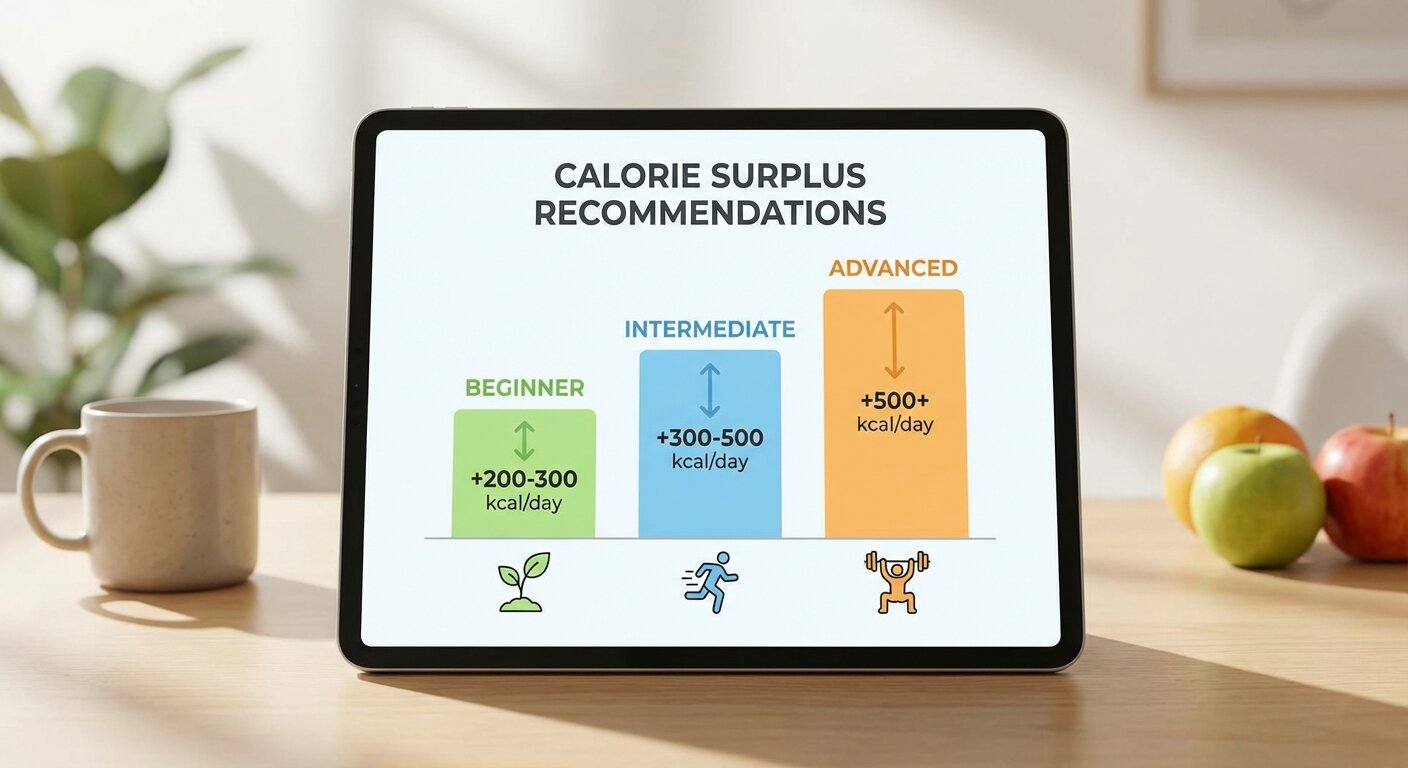
Surplus Guidelines by Experience Level
Beginners (0-1 year training):
- Surplus: 15-20% or 300-500 calories
- Expected gain: 1-2 lbs/month (more muscle, less fat than advanced)
- Higher surpluses work because newbies build muscle faster
Intermediates (1-3 years training):
- Surplus: 10-15% or 200-400 calories
- Expected gain: 0.5-1.5 lbs/month
- Balanced approach, most people fall here
Advanced (3+ years training):
- Surplus: 5-10% or 100-300 calories
- Expected gain: 0.25-0.75 lbs/month
- Muscle grows slowly; small surplus minimizes fat
Example Calculations
Beginner (165 lbs, 2,558 TDEE):
- 15% surplus: 2,558 × 1.15 = 2,942 calories
- Or: 2,558 + 400 = 2,958 calories
- Target: ~2,950 calories
Intermediate (165 lbs, 2,558 TDEE):
- 12% surplus: 2,558 × 1.12 = 2,865 calories
- Or: 2,558 + 300 = 2,858 calories
- Target: ~2,860 calories
Advanced (165 lbs, 2,558 TDEE):
- 8% surplus: 2,558 × 1.08 = 2,763 calories
- Or: 2,558 + 200 = 2,758 calories
- Target: ~2,760 calories
Rule of thumb: Start conservative. You can always add calories later.
Step 3: Set Protein (Optimal for Muscle Growth)
Contrary to bro-science, you don’t need massive protein on a bulk.
Protein Targets for Bulking
Optimal range: 0.8-1.0g per pound bodyweight
Why not higher?
- Beyond 1.0g/lb provides minimal additional benefit
- Extra protein displaces carbs (which fuel training better)
- Protein is expensive and less calorie-dense
Adjust based on training style:
| Training Focus | Protein Target (g/lb) | Reasoning |
|---|---|---|
| Bodybuilding (high volume) | 0.8-0.9 | More carbs fuel volume |
| Powerlifting (lower volume) | 0.9-1.0 | Moderate protein adequate |
| General strength training | 0.8-1.0 | Balanced approach |
Example: 165 lbs person bulking
- Target: 165 × 0.9 = 149g protein
- Calories: 149g × 4 = 596 calories
For more detail, read how many grams of protein per day.
Step 4: Set Fat (Support Hormones and Calories)
Fat supports testosterone production and provides calorie-dense fuel.
Fat Targets for Bulking
Optimal range: 0.3-0.5g per pound bodyweight (20-30% of calories)
Why this range?
- Minimum 0.3g/lb maintains hormone health
- Up to 0.5g/lb provides extra calories without excessive bulk
- Fat is 9 cal/g (helps hit surplus without excessive food volume)
Adjust based on preference:
- Lower fat (0.3-0.35g/lb): If you love carbs and train with high volume
- Moderate fat (0.35-0.4g/lb): Balanced approach for most
- Higher fat (0.4-0.5g/lb): If you prefer fattier foods or lower carb eating
Example: 165 lbs person bulking
- Target: 165 × 0.35 = 58g fat
- Calories: 58g × 9 = 522 calories
Sanity check: Is fat 20-30% of calories?
- Total calories: 2,860
- Fat calories: 522
- Percentage: 522 ÷ 2,860 = 18.2%
This is slightly low. Increase to 65g fat (585 cal = 20.5%) for better balance.
Step 5: Fill Remaining Calories with Carbs
After protein and fat, carbs fill the rest.
Carb Calculation
Remaining calories = Total - (Protein + Fat calories)
Carbs = Remaining calories ÷ 4
Example: 165 lbs, 2,860 calorie bulk
- Total: 2,860
- Protein: 149g (596 cal)
- Fat: 65g (585 cal)
- Remaining: 2,860 - 596 - 585 = 1,679 calories
- Carbs: 1,679 ÷ 4 = 420g
Why High Carbs for Bulking?
Carbs are anabolic:
- Fuel high-volume training
- Replenish glycogen rapidly
- Spike insulin (the body’s main anabolic hormone)
- Protein-sparing (body burns carbs, preserves protein for muscle)
- Support recovery and adaptation
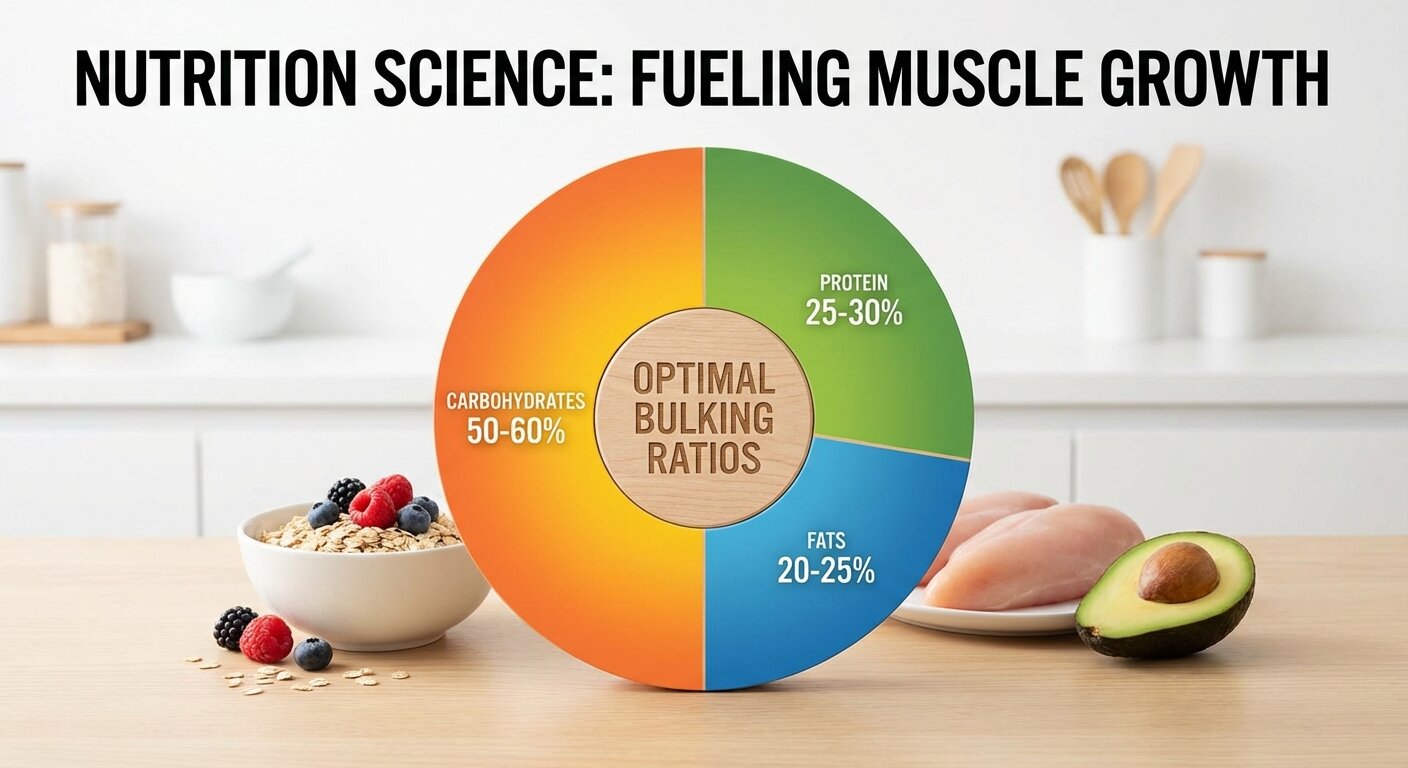
Most successful bulks are 50-60% carbohydrate.
Step 6: Verify Your Macro Split
Check percentages to ensure balance.
Example from above (165 lbs, 2,860 cal):
- Protein: 596 cal ÷ 2,860 = 21%
- Carbs: 1,679 cal ÷ 2,860 = 59%
- Fat: 585 cal ÷ 2,860 = 20%
Final split: 21/59/20 (P/C/F)
Ideal Bulking Macro Percentages
| Macro | Minimum | Optimal Range | Maximum |
|---|---|---|---|
| Protein | 15% | 20-30% | 35% |
| Carbs | 40% | 50-60% | 65% |
| Fat | 15% | 20-30% | 35% |
If your split falls outside these ranges:
- Protein over 30%? Reduce protein, add carbs (you’re eating too much protein)
- Fat under 20%? Increase fat, reduce carbs (hormones need support)
- Carbs under 45%? Increase carbs for better training fuel
Complete Bulking Macro Examples
Let’s walk through three complete calculations.
Example 1: Jake - Beginner Lifter
Stats:
- Male, 22 years old
- 155 lbs, 5’10”, ~12% body fat
- Training 4x/week (beginner program)
- Goal: Build first 15-20 lbs of muscle
Step 1: TDEE
- 155 × 15.5 = 2,403
- Maintenance: ~2,400 calories
Step 2: Surplus
- Beginner: 18% surplus
- 2,400 × 1.18 = 2,832 calories
Step 3: Protein
- 0.9g/lb: 155 × 0.9 = 140g
- 140g = 560 calories
Step 4: Fat
- 0.35g/lb: 155 × 0.35 = 54g
- 54g = 486 calories
Step 5: Carbs
- Remaining: 2,832 - 560 - 486 = 1,786
- 1,786 ÷ 4 = 447g
Jake’s Bulking Macros:
- Protein: 140g (20%)
- Carbs: 447g (63%)
- Fat: 54g (17%)
- Total: 2,832 calories
Expected progress: 1.5-2 lbs/month for first 6 months
Example 2: Maria - Intermediate Lifter
Stats:
- Female, 27 years old
- 125 lbs, 5’5”, ~22% body fat
- Training 4x/week (2 years experience)
- Goal: Lean bulk, add muscle to glutes and shoulders
Step 1: TDEE
- 125 × 15 = 1,875
- Maintenance: ~1,875 calories
Step 2: Surplus
- Intermediate: 12% surplus
- 1,875 × 1.12 = 2,100 calories
Step 3: Protein
- 0.9g/lb: 125 × 0.9 = 113g
- 113g = 452 calories
Step 4: Fat
- 0.4g/lb (slightly higher for female hormones): 125 × 0.4 = 50g
- 50g = 450 calories
Step 5: Carbs
- Remaining: 2,100 - 452 - 450 = 1,198
- 1,198 ÷ 4 = 300g
Maria’s Bulking Macros:
- Protein: 113g (22%)
- Carbs: 300g (57%)
- Fat: 50g (21%)
- Total: 2,100 calories
Expected progress: 0.5-1 lb/month
Example 3: David - Advanced Lifter
Stats:
- Male, 32 years old
- 180 lbs, 5’11”, ~10% body fat
- Training 5-6x/week (6 years experience)
- Goal: Add 5-8 lbs lean mass over 6 months
Step 1: TDEE
- 180 × 16.5 = 2,970
- Maintenance: ~2,970 calories
Step 2: Surplus
- Advanced: 8% surplus
- 2,970 × 1.08 = 3,208 calories
Step 3: Protein
- 0.85g/lb: 180 × 0.85 = 153g
- 153g = 612 calories
Step 4: Fat
- 0.35g/lb: 180 × 0.35 = 63g
- 63g = 567 calories
Step 5: Carbs
- Remaining: 3,208 - 612 - 567 = 2,029
- 2,029 ÷ 4 = 507g
David’s Bulking Macros:
- Protein: 153g (19%)
- Carbs: 507g (63%)
- Fat: 63g (18%)
- Total: 3,208 calories
Expected progress: 0.25-0.5 lbs/month
Adjusting Bulking Macros Based on Progress
Your initial macros are a starting point. Adjust monthly based on results.
What to Track Weekly
- Bodyweight - Weigh daily, calculate weekly average
- Waist measurement - Track fat accumulation
- Strength progress - Are lifts increasing?
- Visual changes - Progress photos monthly
- Subjective factors - Energy, recovery, digestion
Rate of Gain Targets
| Experience Level | Target Gain Per Week | Target Gain Per Month | |---|---|
From our Macros for Muscle Gain pillar.
---| | Beginner (0-1 year) | 0.5-1.0% bodyweight | 2-4 lbs | | Intermediate (1-3 years) | 0.25-0.5% bodyweight | 1-2 lbs | | Advanced (3+ years) | 0.1-0.3% bodyweight | 0.5-1.5 lbs |
Adjustment Scenarios
Scenario 1: Not Gaining Weight (2+ Weeks)
Diagnosis: Surplus is too small or you’re more active than calculated
Fix:
- Increase total calories by 100-200
- Add mostly to carbs (25-50g)
- Retest for 2-3 weeks
- Repeat if still not gaining
Example:
- Current: 2,860 calories (420C)
- New: 2,960 calories (+25g carbs = 445C)
Scenario 2: Gaining Too Fast (>1 lb/Week as Intermediate)
Diagnosis: Surplus is too large, fat accumulation risk
Fix:
- Reduce calories by 100-200
- Take mostly from carbs (25-50g)
- Retest for 2-3 weeks
Example:
- Current: 2,860 calories (420C)
- New: 2,760 calories (-25g carbs = 395C)
Scenario 3: Waist Growing Faster Than Bodyweight
Diagnosis: Too much fat gain, surplus too large or poor food choices
Fix:
- Reduce surplus by 200 calories
- Ensure 80%+ whole foods
- Add 1-2 cardio sessions weekly
- Consider mini-cut if waist up 2+ inches
Scenario 4: Strength Not Increasing
Diagnosis: Training issue or inadequate carbs around workouts
Fix:
- Review training program (progressive overload?)
- Add 30-50g carbs pre/post workout
- Ensure adequate sleep (7-9 hours)
- Consider deload week
Scenario 5: Digestion Issues, Feeling Sluggish
Diagnosis: Eating too much volume, not enough fiber, or poor food quality
Fix:
- Increase meal frequency (5-6 smaller meals)
- Choose easier-to-digest carbs (white rice, potatoes)
- Add digestive enzymes if needed
- Ensure adequate fiber (25-35g daily)
When to Recalculate Completely
Recalculate macros:
- Every 10-15 pounds gained
- Every 2-3 months
- When gain rate stalls or accelerates significantly
- When changing training split or volume

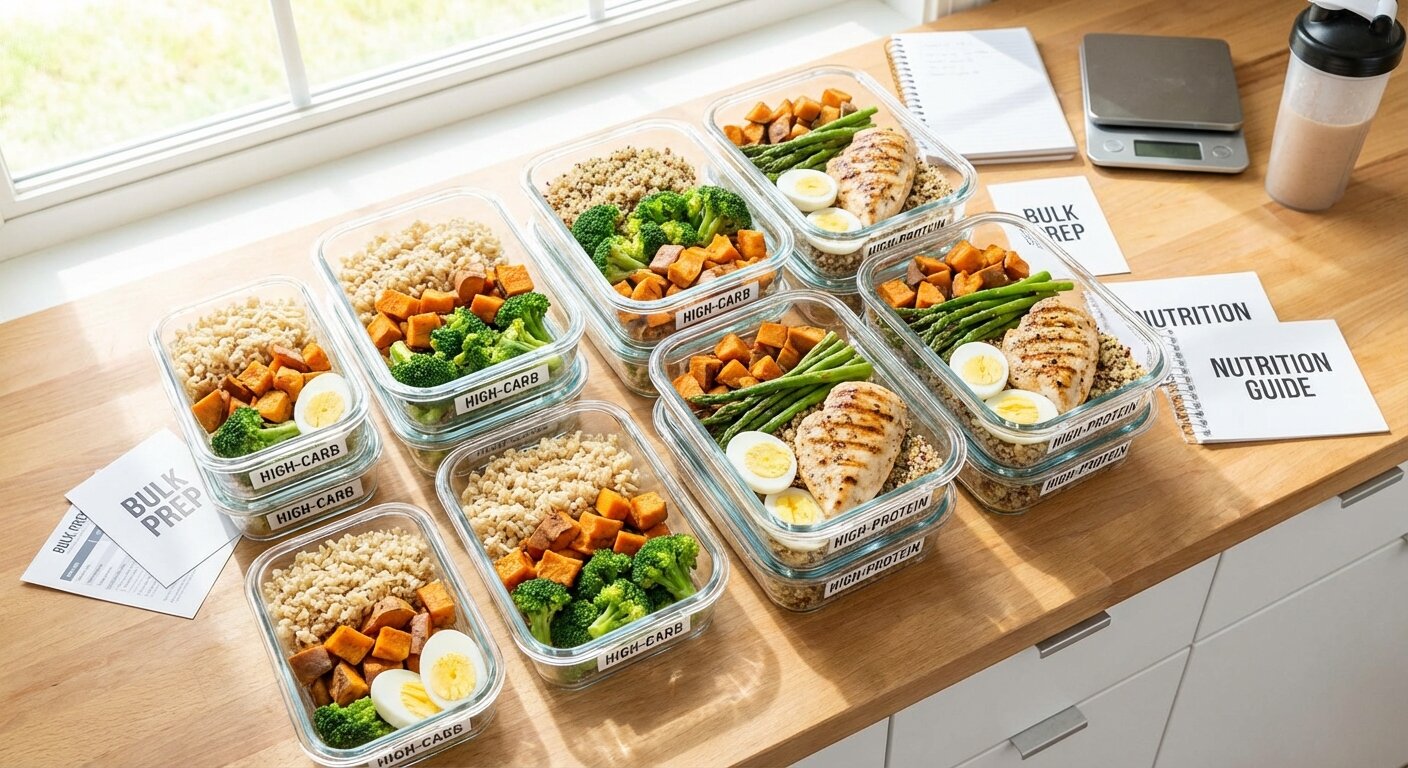
Sample Bulking Meal Plans
Here are three example days of eating at different calorie levels.
Sample Day 1: 2,400 Calorie Bulk (Beginner)
Breakfast:
- 3 whole eggs + 2 egg whites
- 1.5 cups oatmeal with banana
- 1 tbsp peanut butter
- Macros: 38g P / 85g C / 22g F (650 cal)
Mid-Morning Snack:
- Protein shake (whey + whole milk)
- 1 medium apple
- Macros: 32g P / 45g C / 8g F (380 cal)
Lunch:
- 6 oz chicken breast
- 2 cups white rice
- Mixed vegetables with 1 tsp olive oil
- Macros: 50g P / 90g C / 8g F (632 cal)
Pre-Workout:
- 2 rice cakes with honey
- 1 banana
- Macros: 3g P / 55g C / 1g F (242 cal)
Post-Workout:
- Protein shake (whey + dextrose)
- Macros: 25g P / 50g C / 2g F (318 cal)
Dinner:
- 5 oz lean ground beef (93/7)
- 10 oz sweet potato
- Green beans with 1 tbsp butter
- Macros: 40g P / 65g C / 18g F (574 cal)
Evening Snack:
- Greek yogurt with granola and berries
- Macros: 20g P / 50g C / 6g F (332 cal)
Total: 208g P / 440g C / 65g F (3,128 cal)
Sample Day 2: 2,800 Calorie Bulk (Intermediate)
Meal 1:
- 4 whole eggs scrambled
- 2 slices whole wheat toast
- 1 avocado
- Macros: 32g P / 40g C / 34g F (580 cal)
Meal 2:
- Protein smoothie: whey, banana, oats, peanut butter, milk
- Macros: 40g P / 80g C / 16g F (616 cal)
Meal 3:
- 7 oz turkey breast
- 1.5 cups quinoa
- Large salad with olive oil dressing
- Macros: 55g P / 70g C / 15g F (638 cal)
Pre-Workout:
- Rice cakes with jam
- Macros: 4g P / 45g C / 0g F (196 cal)
Post-Workout:
- Protein shake with waxy maize
- Macros: 30g P / 60g C / 2g F (378 cal)
Meal 4:
- 6 oz salmon
- 12 oz baked potato
- Asparagus with butter
- Macros: 45g P / 75g C / 20g F (660 cal)
Meal 5:
- Casein protein shake
- 1 cup blueberries
- 1 oz almonds
- Macros: 30g P / 35g C / 18g F (430 cal)
Total: 236g P / 405g C / 105g F (3,498 cal)
Sample Day 3: 3,200 Calorie Bulk (Advanced)
Meal 1:
- 5 whole eggs
- 2 cups oatmeal with berries and honey
- Macros: 40g P / 95g C / 28g F (780 cal)
Meal 2:
- 8 oz chicken breast
- 2 cups white rice
- Vegetables
- Macros: 65g P / 100g C / 5g F (705 cal)
Meal 3:
- Mass gainer shake (whey, oats, banana, peanut butter, milk)
- Macros: 50g P / 110g C / 20g F (800 cal)
Pre-Workout:
- 3 rice cakes with honey
- 1 banana
- Macros: 4g P / 70g C / 1g F (305 cal)
Intra-Workout:
- Carb powder + BCAAs
- Macros: 5g P / 40g C / 0g F (180 cal)
Post-Workout:
- Protein shake with dextrose
- Macros: 40g P / 80g C / 3g F (503 cal)
Meal 4:
- 8 oz lean steak
- 12 oz sweet potato
- Side salad with avocado
- Macros: 60g P / 80g C / 22g F (746 cal)
Meal 5:
- Greek yogurt parfait with granola, honey, nuts
- Macros: 30g P / 60g C / 15g F (495 cal)
Total: 294g P / 635g C / 94g F (4,514 cal)
Advanced Bulking Strategies
Once you’ve mastered basic bulking, try these tactics.
1. Intra-Workout Nutrition
For long, intense sessions (90+ minutes):
- 30-50g fast-acting carbs (dextrose, waxy maize, Gatorade)
- 5-10g BCAAs or EAAs
- Sipped throughout workout
Benefits: Preserves glycogen, reduces muscle breakdown, enhances performance
2. Carb Timing and Cycling
Focus carbs around training:
- Pre-workout (1-2 hours): 30-50g carbs
- Post-workout (within 2 hours): 80-120g carbs
- Other meals: 40-60g carbs
Or try carb cycling:
- Training days: +50-100g carbs
- Rest days: -50-100g carbs
- Weekly total stays the same
3. Calorie Cycling
Vary daily calories while maintaining weekly average:
- Training days: +200-300 calories
- Rest days: -200-300 calories
Example:
- 4 training days: 3,000 cal
- 3 rest days: 2,600 cal
- Weekly average: 2,829 cal
Benefits: May improve nutrient partitioning and adherence
4. Mini-Cuts
After 8-12 weeks of bulking:
- 2-3 week mini-cut (15-20% deficit)
- Restore insulin sensitivity
- Shed any excess fat gained
- Return to bulk leaner
Then resume bulk with slightly higher surplus
5. Refeed Days
Once weekly:
- Increase calories to maintenance or higher
- Add 100-150g carbs
- Keep protein same, reduce fat
Purpose: Psychological relief, replenish glycogen fully, boost leptin
Common Bulking Mistakes to Avoid
Mistake 1: Surplus Too Large
Problem: Gaining 3-4 lbs/month as intermediate/advanced lifter
Result: Excessive fat gain, insulin resistance, long cutting phase needed
Fix: Reduce to 200-300 calorie surplus, aim for 0.5-1 lb/week gain max
Mistake 2: Dirty Bulking
Problem: “I can eat whatever I want as long as I hit macros”
Result: Poor nutrient intake, digestive issues, excessive fat gain
Fix: 80-90% whole, nutrient-dense foods; save 10-20% for treats
Mistake 3: Bulking While Too Fat
Problem: Starting bulk at 18-20% body fat (men) or 28-30% (women)
Result: Poor nutrient partitioning, mostly fat gain, insulin resistance
Fix: Cut to 10-15% (men) or 20-25% (women) first, then bulk
Mistake 4: Not Tracking Progress
Problem: “I’m bulking” but not weighing or measuring anything
Result: No idea if you’re in surplus, gaining muscle, or spinning wheels
Fix: Weigh daily, calculate weekly averages, track measurements monthly
Mistake 5: Too Much Protein
Problem: Eating 1.5-2.0g/lb protein “just to be safe”
Result: Displaces carbs (hurts training), expensive, no additional benefit
Fix: 0.8-1.0g/lb is optimal; focus on carbs and training intensity instead
Mistake 6: Bulking Too Long
Problem: Bulking for 9-12 months straight
Result: Excessive fat gain (from 12% → 22%), insulin resistance, metabolic issues
Fix: Bulk for 3-6 months max, take mini-cuts or maintenance breaks
Mistake 7: Ignoring Cardio Completely
Problem: “Cardio kills gains”
Result: Poor cardiovascular health, reduced work capacity, harder to cut later
Fix: 2-3 cardio sessions weekly (20-30 min) maintains conditioning without interfering with gains
When to Stop Bulking and Start Cutting
Don’t bulk indefinitely. Here’s when to stop:
Body Fat Percentage Thresholds
Men:
- Stop bulking at 15-17% body fat
- Transition to maintenance or mini-cut
- Resume bulking once back to 10-12%
Women:
- Stop bulking at 27-30% body fat
- Transition to maintenance or mini-cut
- Resume bulking once back to 20-23%
Other Stop Signals
- Waist measurement increased 2-3 inches
- Visible loss of definition (abs, vascularity disappearing)
- Strength gains plateaued for 4+ weeks despite surplus
- Feeling sluggish, low energy despite adequate calories
- Hit your time goal (3-6 month bulk complete)
Transitioning Off Bulk
Option 1: Mini-Cut (2-4 Weeks)
- Drop to 15-20% deficit
- High protein (1.0-1.2g/lb)
- Maintain training intensity
- Shed 4-8 lbs quickly
- Resume bulk
Option 2: Maintenance Phase (2-4 Weeks)
- Eat at TDEE
- Let body adjust
- Restore metabolic capacity
- Then decide: resume bulk or cut?
Option 3: Full Cut
- If you overshot body fat goals
- 8-16 week aggressive cut
- Return to lean baseline before next bulk
Frequently Asked Questions
Can I bulk if I’m not lean yet?
Ideally start at 10-15% BF (men) or 20-25% (women). Higher body fat reduces nutrient partitioning—more calories go to fat instead of muscle. If you’re above these ranges, cut first or do a slow recomp.
How much muscle can I realistically gain?
Year 1: 15-25 lbs (beginners gain fastest) Year 2: 10-15 lbs Year 3: 5-10 lbs Year 4+: 2-5 lbs per year
These are upper limits with perfect training, nutrition, and genetics. Most people gain 50-75% of these amounts.
Do I need to eat more on training days vs rest days?
Not required but can be beneficial. Same weekly total matters most. If cycling, add 200-300 calories on training days (mostly carbs), subtract on rest days.
Should I take creatine while bulking?
Yes. Creatine monohydrate (5g daily) improves strength, power, and muscle gain. It causes 2-4 lbs water retention initially—don’t confuse this with fat gain.
Can women bulk the same way as men?
Yes, same principles apply. Women may prefer slightly higher fat (0.4-0.5g/lb) for hormonal health and slightly smaller surpluses (150-250 cal). Muscle gain potential is lower but process is identical.
What if I’m gaining weight but not getting stronger?
You’re likely gaining mostly fat, not muscle. Common causes:
- Surplus too large
- Training program inadequate (no progressive overload)
- Not enough protein
- Poor recovery (sleep, stress)
Fix training first, then reassess macros.
Your Bulking Macro Action Plan
You now have everything needed to set up a successful clean bulk.
Here’s your implementation plan:
Week 1:
- Calculate TDEE using formulas above
- Add appropriate surplus (10-20% based on experience)
- Set macros: 0.8-1.0g/lb protein, 0.3-0.5g/lb fat, rest carbs
- Download tracking app, start logging
- Weigh yourself daily, establish baseline average
Weeks 2-4:
- Track macros consistently (hit targets 6-7 days/week)
- Follow structured training program with progressive overload
- Weigh daily, calculate weekly averages
- Take progress photos and measurements
Month 2+:
- Assess weekly weight trend: gaining 0.25-0.5% bodyweight/week?
- Check waist measurement monthly
- Monitor strength progression
- Adjust macros if not gaining, gaining too fast, or waist expanding rapidly
- Recalculate fully every 10-15 lbs gained
Months 3-6:
- Continue tracking and progressive training
- Consider mini-cut if waist increased 2+ inches
- Stop bulk when reaching 15-17% BF (men) or 27-30% (women)
- Transition to maintenance or cut
Remember: Bulking is a marathon, not a sprint. Slow, controlled gains with minimal fat accumulation beat aggressive dirty bulks every time.
Ready to calculate your personalized bulking macros instantly? Use our free macro calculator to get started now.
Related guides:
- How to Calculate Macros for Muscle Gain
- Macros for Muscle Gain (Pillar Guide)
- Best Macro Ratios for Different Goals
- Lean Bulk vs Dirty Bulk Comparison
- How Much Protein to Build Muscle
Now go fuel those gains—the right way.
Related Articles
Travel Macros: How to Track Nutrition While Traveling
Complete guide to managing macros while traveling. Learn meal planning strategies,...
Read guide →
Macros for Shift Workers: Complete Guide to Nutrition on Rotating Schedules
Master macro tracking on night shifts and rotating schedules. Learn meal timing, sleep...
Read guide →
Macros During Ramadan: Complete Nutrition Guide for Fasting
Learn how to track macros during Ramadan fasting. Expert guide covering meal timing,...
Read guide →Disclaimer: This content is for informational purposes only. Consult a healthcare provider before making changes to your diet.