How to Calculate Macros for Fat Loss (Not Just Weight Loss)
Reviewed by Sarah Chen, MS, RD
You want to lose fat. Not just weight—fat specifically. You want to see muscle definition, drop body fat percentage, and look lean and athletic.
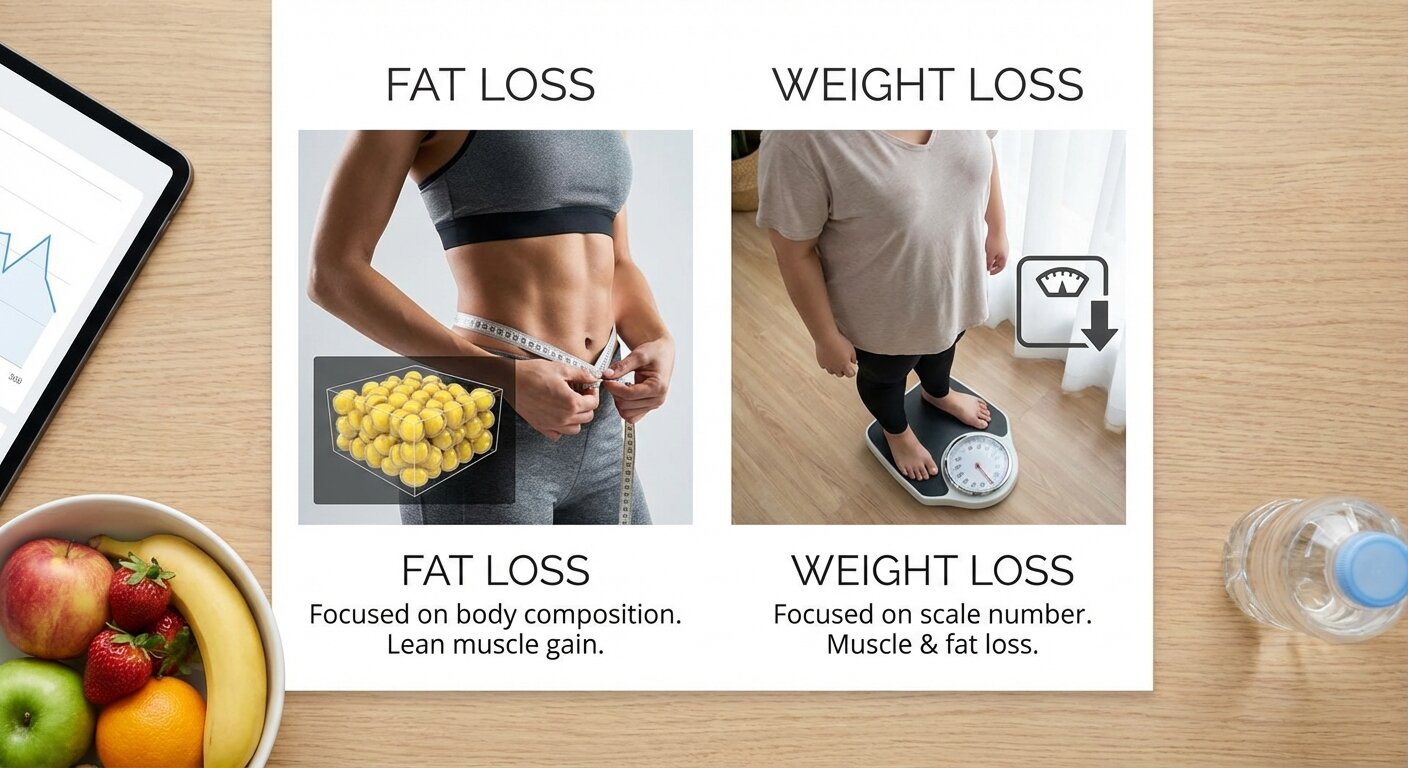
But here’s the problem: most “weight loss” approaches make you smaller but still soft. You lose 20 pounds, but 8 of those pounds are muscle. You end up “skinny-fat”—lighter on the scale but still lacking definition.
The solution? Calculate your macros for fat loss, not just weight loss.
This guide walks you through the exact formulas, step-by-step calculations, and adjustment strategies to maximize fat loss while preserving (or even building) muscle. You’ll learn how to set precise protein, carb, and fat targets based on your bodyweight, body composition, activity level, and training goals.
By the end, you’ll have personalized macro targets that prioritize body composition over scale weight—so you look better, perform better, and keep your results long-term.
Want instant calculations? Our free macro calculator does the math in 60 seconds.
Fat Loss vs Weight Loss: Why the Distinction Matters
Before calculating anything, understand the critical difference.
Weight Loss = Losing Total Bodyweight
When you create a calorie deficit without strategic macros:
You lose:
- Fat (good)
- Muscle (bad)
- Water (neutral)
- Glycogen stores (neutral)
Result: You get smaller but maintain similar body composition. If you’re 30% body fat at 180 pounds and lose 20 pounds without preserving muscle, you might end up 28% body fat at 160 pounds. Lighter, but still soft.
Fat Loss = Reducing Body Fat While Preserving Muscle
When you combine a calorie deficit with high protein and strength training:
You lose:
- Fat (good)
You maintain or gain:
- Muscle (great)
Result: Your body composition dramatically improves. That same 180-pound person could drop to 165 pounds at 18% body fat—lean, defined, and athletic-looking.
Why Macros Matter for Fat Loss
Without macro tracking:
- Low protein = muscle loss
- Unstructured eating = inconsistent deficit
- Random carb/fat distribution = suboptimal energy and performance
With macro tracking:
- High protein = muscle preservation
- Consistent calorie targets = predictable progress
- Strategic carb/fat distribution = training performance maintained
For more on this distinction, read macro counting vs calorie counting.
The 6-Step Formula for Calculating Fat Loss Macros
Follow this systematic approach to dial in your targets.
Step 1: Calculate Your Maintenance Calories (TDEE)
TDEE = Total Daily Energy Expenditure, or how many calories you burn per day.
Method 1: Quick Estimate Formula
TDEE = Bodyweight (lbs) × Activity Multiplier
Activity multipliers:
- Sedentary (desk job, little exercise): 13-14
- Lightly active (1-3 workouts/week): 14-15
- Moderately active (3-5 workouts/week): 15-16
- Very active (5-7 workouts/week): 16-17
- Extremely active (athlete, physical job + training): 17-19
Examples:
Person A: 160 lbs, moderately active (trains 4x/week)
- TDEE = 160 × 15.5 = 2,480 calories
Person B: 140 lbs, lightly active (trains 2x/week)
- TDEE = 140 × 14.5 = 2,030 calories
Person C: 200 lbs, very active (trains 6x/week)
- TDEE = 200 × 16.5 = 3,300 calories
Method 2: Component Calculation (More Accurate)
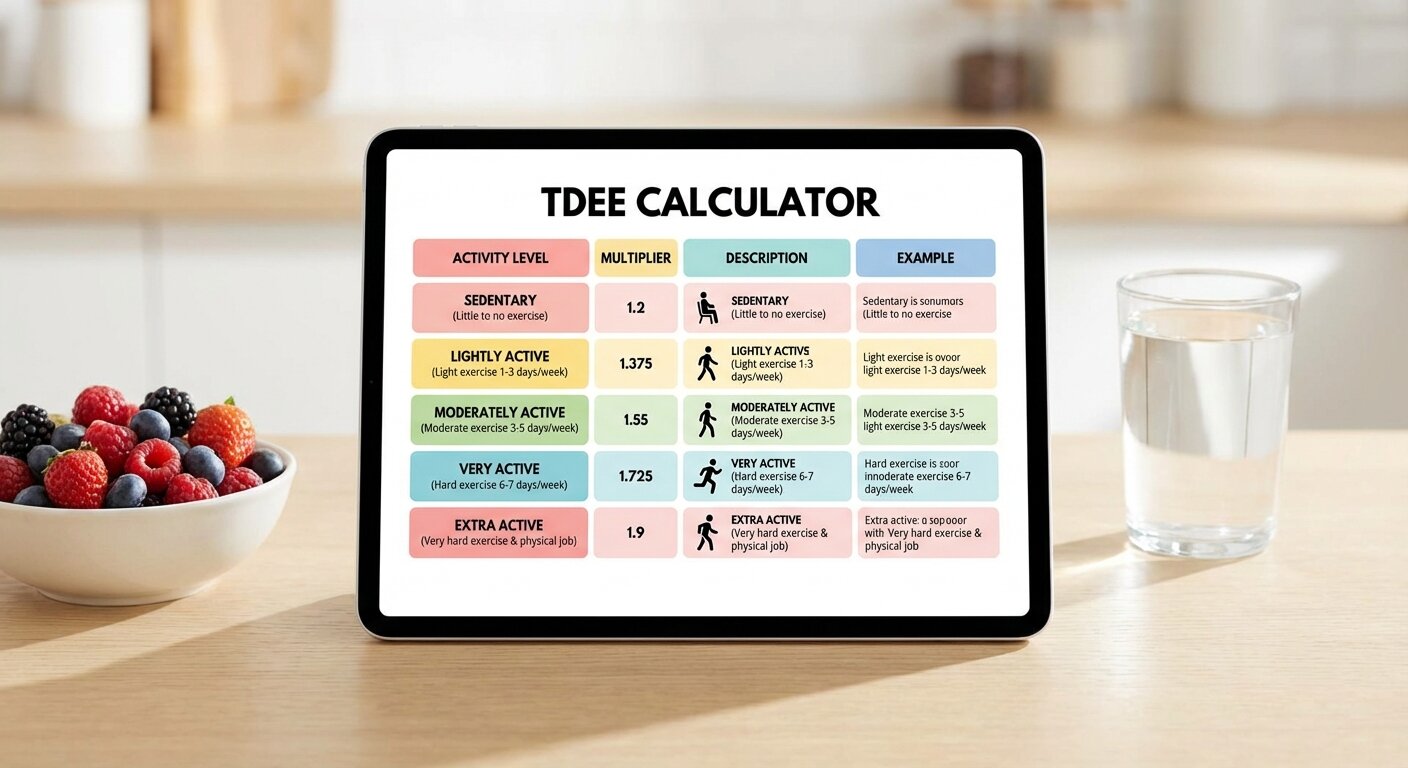
TDEE = BMR × Activity Factor
BMR (Basal Metabolic Rate) formulas:
Mifflin-St Jeor (most accurate):
- Men: BMR = (10 × weight in kg) + (6.25 × height in cm) - (5 × age) + 5
- Women: BMR = (10 × weight in kg) + (6.25 × height in cm) - (5 × age) - 161
Activity factors:
- Sedentary: BMR × 1.2
- Lightly active: BMR × 1.375
- Moderately active: BMR × 1.55
- Very active: BMR × 1.725
- Extremely active: BMR × 1.9
Example:
Woman, 150 lbs (68 kg), 5’6” (168 cm), 30 years old, moderately active
- BMR = (10 × 68) + (6.25 × 168) - (5 × 30) - 161
- BMR = 680 + 1,050 - 150 - 161 = 1,419 calories
- TDEE = 1,419 × 1.55 = 2,199 calories
Method 3: Track and Adjust (Most Accurate)
The best way to determine your true TDEE:
- Eat at your estimated TDEE for 1-2 weeks
- Weigh yourself daily and calculate weekly average
- If weight stays stable, that’s your true maintenance
- If weight changes, adjust calories by 100-200 and test again
This accounts for individual metabolic variations that formulas can’t predict.
For detailed TDEE guidance, see TDEE explained.
Step 2: Create Your Calorie Deficit
Once you know maintenance, create a deficit to drive fat loss.
Deficit Guidelines
Small deficit (10-15%):
- Fat loss: 0.5-0.7% bodyweight per week
- Muscle preservation: Excellent
- Training performance: Minimal impact
- Hunger/adherence: Easiest
- Best for: Lean individuals (men <15% BF, women <25% BF), beginners
Moderate deficit (15-20%):
- Fat loss: 0.7-1% bodyweight per week
- Muscle preservation: Good if protein is high
- Training performance: Slight reduction
- Hunger/adherence: Moderate
- Best for: Most people, balanced approach
Aggressive deficit (20-25%):
- Fat loss: 1-1.5% bodyweight per week
- Muscle preservation: Challenging, requires perfect execution
- Training performance: Noticeable reduction
- Hunger/adherence: Difficult
- Best for: Short-term cuts, higher body fat individuals, experienced dieters
Example calculations:
Person with 2,480 TDEE:
- Small (15%): 2,480 × 0.85 = 2,108 calories
- Moderate (20%): 2,480 × 0.80 = 1,984 calories
- Aggressive (25%): 2,480 × 0.75 = 1,860 calories
Recommendation: Start with a 15-20% deficit. You can always increase the deficit later if needed, but starting too aggressive risks muscle loss and metabolic adaptation.
Step 3: Set Protein (Non-Negotiable Priority)
Protein is the most important macro for fat loss. Set this first.
Protein Targets by Goal and Body Composition
Standard recommendation: 0.8-1.0g per pound bodyweight
Adjust based on leanness:
| Body Fat Percentage | Protein Target (g/lb) | Reasoning |
|---|---|---|
| Men >20% / Women >30% | 0.8-1.0 | Higher fat provides energy buffer |
| Men 15-20% / Women 25-30% | 1.0-1.1 | Balanced approach |
| Men 10-15% / Women 20-25% | 1.1-1.2 | Higher risk of muscle loss |
| Men <10% / Women <20% | 1.2-1.4 | Maximum muscle preservation needed |
Special considerations:
If very overweight (35%+ body fat): Use adjusted bodyweight to avoid overestimating:
- Adjusted BW = (Total BW - Lean Mass) × 0.25 + Lean Mass
- Or simply: Total BW × 0.75 for rough estimate
Example: 250 lbs at 35% body fat
- Lean mass = 250 × 0.65 = 162.5 lbs
- Adjusted BW = (250 - 162.5) × 0.25 + 162.5 = 184 lbs
- Protein target = 184 × 0.9 = 166g protein
If very active or training hard: Go toward higher end (1.0-1.2g/lb) even if not super lean
Converting Protein to Calories
Protein = 4 calories per gram
Example: 160 lbs person targeting 1.0g/lb
- Protein: 160g
- Calories from protein: 160g × 4 = 640 calories
For more on protein needs, read how many grams of protein per day.
Step 4: Set Fat (Essential for Hormones)
Fat supports testosterone, estrogen, thyroid hormones, and overall health. Don’t go too low.
Fat Targets
Standard recommendation: 0.3-0.4g per pound bodyweight
Minimum threshold: Never go below 20% of total calories or 0.25g/lb
Adjust based on preferences:
- Lower fat (0.3g/lb): If you prefer more carbs, train with high intensity
- Moderate fat (0.35g/lb): Balanced approach for most people
- Higher fat (0.4-0.5g/lb): If you respond well to lower carbs, less active
Converting Fat to Calories
Fat = 9 calories per gram
Example: 160 lbs person targeting 0.35g/lb
- Fat: 160 × 0.35 = 56g
- Calories from fat: 56g × 9 = 504 calories
Sanity check: Is fat at least 20% of total calories?
- Total calories: 2,000
- Fat calories: 504
- Percentage: 504 ÷ 2,000 = 25.2% ✓
Step 5: Fill Remaining Calories with Carbs
After protein and fat, everything left goes to carbohydrates.
Carb Calculation
Remaining calories = Total - (Protein calories + Fat calories)
Carbs = Remaining calories ÷ 4
Example: 160 lbs person, 2,000 calorie target
- Total calories: 2,000
- Protein: 160g (640 cal)
- Fat: 56g (504 cal)
- Remaining: 2,000 - 640 - 504 = 856 calories
- Carbs: 856 ÷ 4 = 214g
Carb Adjustments Based on Activity
Your carb target should reflect training volume:
Low activity (<3 workouts/week):
- Reduce carbs by 20-30g
- Increase fat slightly to compensate
High activity (6+ workouts/week):
- Keep carbs high or even increase 20-30g
- Reduce fat slightly if needed
Endurance training:
- Significantly higher carbs (250-350g+)
- Keep protein adequate, reduce fat
Step 6: Verify and Adjust Your Macro Split
Check that your calculated macros make sense.
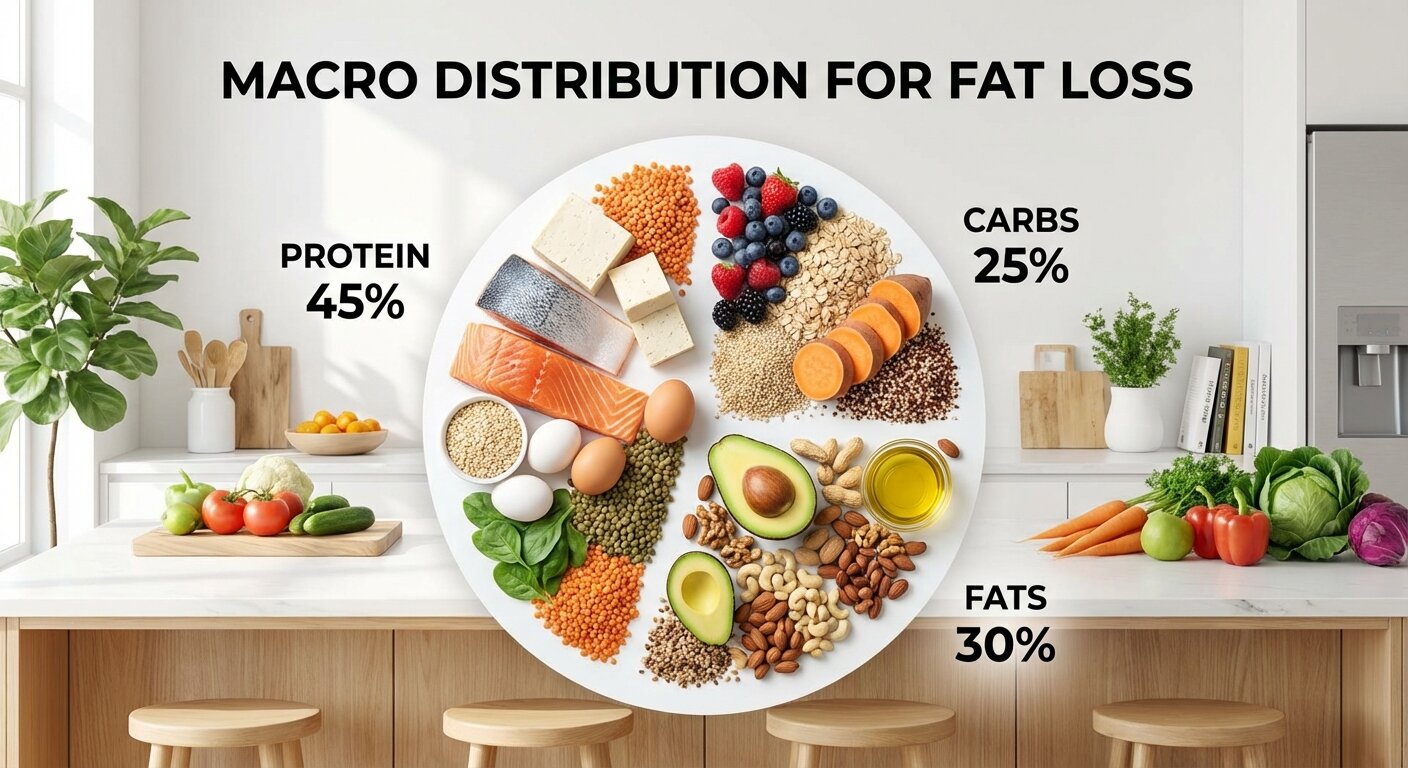
Final Macro Percentages
Calculate what percentage each macro represents:
Example from above (160 lbs, 2,000 cal):
- Protein: 640 cal ÷ 2,000 = 32%
- Carbs: 856 cal ÷ 2,000 = 43%
- Fat: 504 cal ÷ 2,000 = 25%
Final split: 32/43/25 (P/C/F)
This is a solid fat loss split—high protein, moderate carbs, adequate fat.
Ideal Percentage Ranges for Fat Loss
| Macro | Minimum | Optimal Range | Maximum |
|---|---|---|---|
| Protein | 25% | 30-40% | 45% |
| Carbs | 20% | 30-45% | 55% |
| Fat | 20% | 20-30% | 35% |
If your percentages fall outside these ranges, adjust:
- Protein below 30%? Increase protein, reduce carbs/fat
- Fat below 20%? Increase fat, reduce carbs
- Carbs below 25%? Ensure this is intentional (low-carb approach)
Complete Worked Examples
Let’s walk through full calculations for three different people.
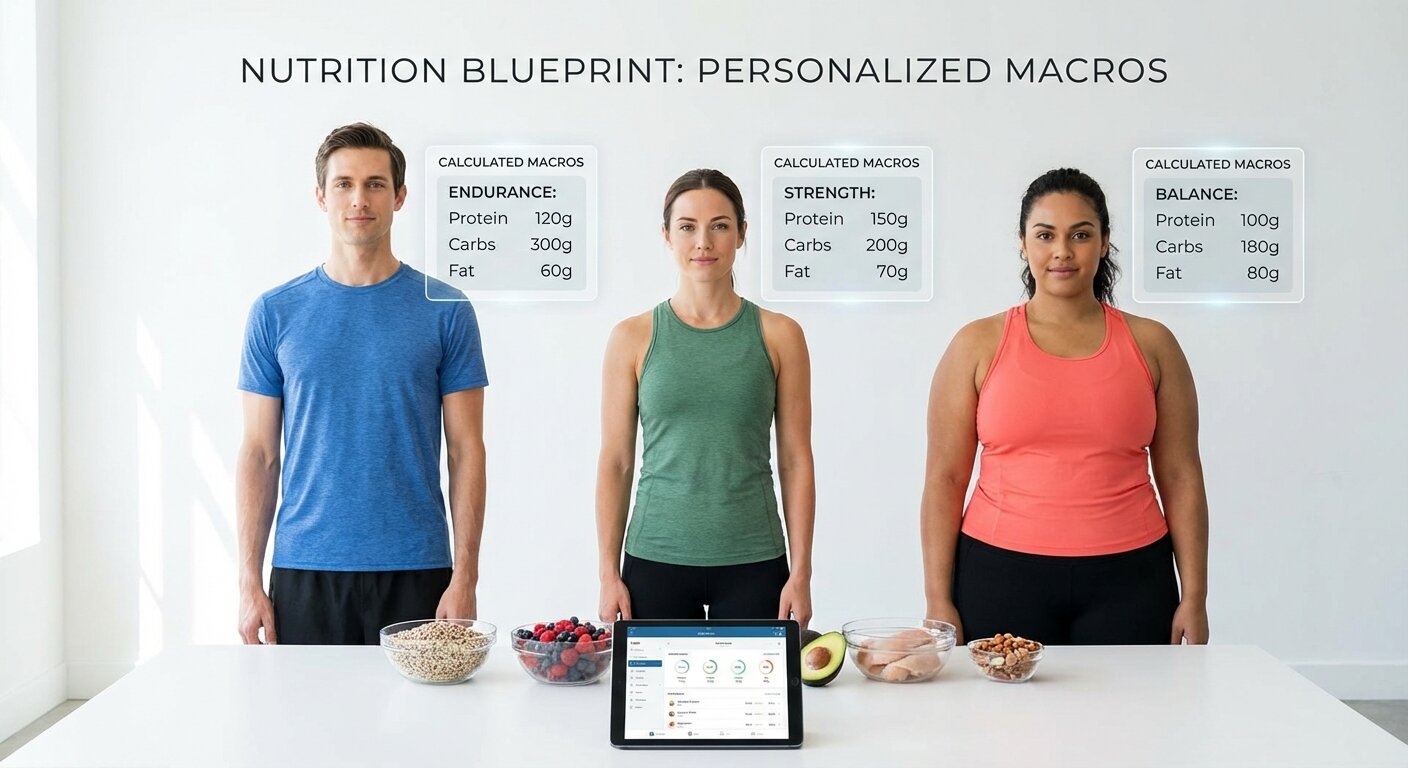
Example 1: Sarah - Beginner, Moderate Body Fat
Stats:
- Female, 28 years old
- 145 lbs, 5’5”, ~28% body fat
- Lightly active (trains 3x/week)
- Goal: Fat loss while building strength
Step 1: Calculate TDEE
- Quick method: 145 × 14.5 = 2,103 calories
- Maintenance: ~2,100 calories
Step 2: Create deficit
- Moderate approach: 2,100 × 0.80 = 1,680 calories
- Target: 1,680 calories
Step 3: Set protein
- Target: 1.0g/lb (she’s training consistently)
- 145 × 1.0 = 145g protein
- 145g = 580 calories
Step 4: Set fat
- Target: 0.35g/lb
- 145 × 0.35 = 51g fat
- 51g = 459 calories
Step 5: Calculate carbs
- Remaining: 1,680 - 580 - 459 = 641 calories
- Carbs: 641 ÷ 4 = 160g
Sarah’s Fat Loss Macros:
- Protein: 145g (35%)
- Carbs: 160g (38%)
- Fat: 51g (27%)
- Total: 1,680 calories
Example 2: Mike - Intermediate, Already Lean
Stats:
- Male, 32 years old
- 175 lbs, 5’10”, ~12% body fat
- Very active (trains 5x/week, walks daily)
- Goal: Get to 10% BF for competition
Step 1: Calculate TDEE
- Quick method: 175 × 16.5 = 2,888 calories
- Maintenance: ~2,900 calories
Step 2: Create deficit
- Conservative (he’s already lean): 2,900 × 0.85 = 2,465 calories
- Target: 2,465 calories
Step 3: Set protein
- Target: 1.2g/lb (he’s lean, needs muscle preservation)
- 175 × 1.2 = 210g protein
- 210g = 840 calories
Step 4: Set fat
- Target: 0.3g/lb (lower to allow more carbs for training)
- 175 × 0.3 = 53g fat
- 53g = 477 calories
Step 5: Calculate carbs
- Remaining: 2,465 - 840 - 477 = 1,148 calories
- Carbs: 1,148 ÷ 4 = 287g
Mike’s Fat Loss Macros:
- Protein: 210g (34%)
- Carbs: 287g (47%)
- Fat: 53g (19%)
- Total: 2,465 calories
Note: Fat is borderline low at 19%. Mike should monitor energy and libido. If issues arise, add 10g fat (reduce 20g carbs).
Example 3: Jason - Higher Body Fat, Focused on Fat Loss
Stats:
- Male, 40 years old
- 230 lbs, 6’0”, ~32% body fat
- Sedentary job, trains 2x/week
- Goal: Lose significant fat, improve health markers
Step 1: Calculate TDEE
- Use adjusted bodyweight for protein calculation
- Maintenance: 230 × 14 = 3,220 calories
- Maintenance: ~3,200 calories
Step 2: Create deficit
- Aggressive (has fat to lose): 3,200 × 0.75 = 2,400 calories
- Target: 2,400 calories
Step 3: Set protein (using adjusted BW)
- Lean mass estimate: 230 × 0.68 = 156 lbs
- Adjusted BW: (230 - 156) × 0.25 + 156 = 175 lbs
- Target: 1.0g/lb adjusted = 175g
- 175g = 700 calories
Step 4: Set fat
- Target: 0.35g/lb adjusted
- 175 × 0.35 = 61g fat
- 61g = 549 calories
Step 5: Calculate carbs
- Remaining: 2,400 - 700 - 549 = 1,151 calories
- Carbs: 1,151 ÷ 4 = 288g
Jason’s Fat Loss Macros:
- Protein: 175g (29%)
- Carbs: 288g (48%)
- Fat: 61g (23%)
- Total: 2,400 calories
Adjusting Macros Based on Progress and Feedback
Your initial macros are a starting point. Adjust based on real-world results.
When to Adjust: Progress Indicators
Track these weekly:
- Scale weight (daily, calculate weekly average)
- Body measurements (waist, hips, chest, arms)
- Progress photos (same lighting, same time of day)
- Training performance (strength, reps, endurance)
- Subjective feedback (hunger, energy, mood, sleep)
Adjustment Scenarios
Scenario 1: Fat Loss Too Slow (<0.5% BW/Week)
Diagnosis: Deficit is too small
Fix:
- Reduce total calories by 100-200
- Take mostly from carbs (25-50g reduction)
- Or add 1-2 cardio sessions while keeping food the same
- Retest for 2 weeks
Scenario 2: Fat Loss Too Fast (>1.5% BW/Week)
Diagnosis: Deficit is too aggressive, muscle loss risk
Fix:
- Increase total calories by 100-200
- Add mostly to carbs (25-50g increase)
- Consider adding a refeed day weekly
- Monitor strength closely
Scenario 3: Losing Strength Rapidly
Diagnosis: Protein too low, deficit too large, or inadequate carbs around training
Fix:
- Increase protein by 20-30g (if below 1.0g/lb)
- Add 30-50g carbs pre/post-workout
- Reduce deficit slightly (100 calories)
- Ensure you’re sleeping 7-8+ hours
Scenario 4: Constant Hunger, Hard to Adhere
Diagnosis: Protein or fat too low, food choices not satiating
Fix:
- Increase protein by 20-30g
- Increase fat by 10-15g (improves satiety)
- Reduce carbs to compensate
- Choose high-volume, low-calorie foods (vegetables, lean proteins)
- Ensure adequate fiber (25-35g daily)
Scenario 5: Weight Plateaus (2+ Weeks)
Diagnosis: Your smaller body now burns fewer calories, maintenance has decreased
Fix:
- Recalculate TDEE based on new bodyweight
- Create a new 15-20% deficit
- Adjust macros accordingly
- Or add 1-2 cardio sessions without changing food
When to Recalculate Completely
Recalculate every:
- 10-15 pounds lost
- 8-12 weeks on a cut
- Significant change in activity level
- Progress stalls for 2-3 weeks
For plateau-busting strategies, read adjusting macros when you plateau.
Advanced Strategies for Optimizing Fat Loss
Once you’ve mastered the basics, try these tactics.
1. Carb Cycling
Vary carb intake based on training days vs rest days.
Training days: Higher carbs (add 30-50g), lower fat Rest days: Lower carbs (reduce 30-50g), higher fat
Example:
- Training day: 160P / 230C / 50F
- Rest day: 160P / 150C / 68F
- Weekly average remains the same
Benefits: Optimizes performance and recovery while maximizing fat oxidation on rest days
2. Refeed Days
Once weekly, eat at maintenance calories (extra carbs mostly).
Purpose:
- Replenishes glycogen stores
- Provides psychological relief
- May boost leptin temporarily (hunger hormone)
Example:
- 6 days: 2,000 calories (deficit)
- 1 day: 2,400 calories (maintenance, +100g carbs)
3. Protein Front-Loading
Eat more protein earlier in the day for appetite control.
Example:
- Breakfast: 50g protein
- Lunch: 50g protein
- Dinner: 40g protein
- Snacks: 20g protein
Research shows higher protein breakfasts improve satiety and reduce total daily intake.
4. Strategic Meal Timing
Pre-workout (1-2 hours): 30-50g carbs + 20-30g protein Post-workout (within 2 hours): 50-80g carbs + 30-40g protein
This optimizes training performance and recovery while allowing lower carbs at other meals.
5. Diet Breaks
After 8-12 weeks of aggressive cutting, take 1-2 weeks at maintenance.
Benefits:
- Restores leptin and metabolic hormones
- Replenishes glycogen fully
- Provides mental break
- May improve long-term fat loss
Then: Resume deficit with recalculated macros
Common Calculation Mistakes to Avoid
Mistake 1: Using Total Bodyweight When Very Overweight
Problem: 300-pound person at 40% BF calculates 300g protein (way too much)
Solution: Use adjusted bodyweight or lean mass for protein calculation
Mistake 2: Creating Too Large a Deficit
Problem: Jumping to 1,200 calories when maintenance is 2,400
Solution: Start with 15-20% deficit max. You can always increase later.
Mistake 3: Setting Fat Too Low
Problem: Going to 30-40g fat daily to “maximize fat loss”
Solution: Keep fat at minimum 0.3g/lb or 20% of calories for hormone health
Mistake 4: Not Adjusting as Weight Drops
Problem: Using the same macros at 180 lbs as at 160 lbs
Solution: Recalculate every 10-15 pounds lost
Mistake 5: Obsessing Over Exact Percentages
Problem: Stressing that today was 38/35/27 instead of 40/35/25
Solution: Focus on hitting gram targets. Percentages are just guidelines.
Mistake 6: Forgetting to Track Liquid Calories
Problem: Logging solid food but not accounting for milk, juice, alcohol, protein shakes
Solution: Track everything that contains calories, including drinks
Mistake 7: Not Eating Enough Protein
Problem: Calculating 0.6g/lb protein because “I read that’s enough”
Solution: During a deficit, go higher. 0.8-1.2g/lb is ideal for preserving muscle.
Tracking and Monitoring Your Fat Loss Macros
Best Tracking Apps
- MyFitnessPal – Largest food database, free
- MacroFactor – Auto-adjusts based on progress (paid, worth it)
- Cronometer – Best for micronutrient tracking
- Carbon Diet Coach – AI-powered adjustments
For detailed comparisons, see best apps for tracking macros.
How to Weigh and Measure
Weighing foods:
- Use a digital food scale (accurate to 1g)
- Weigh raw whenever possible (cooked weights vary)
- Log by grams, not volume (cups/tbsp are inaccurate)
Common logging errors:
- Logging “1 chicken breast” instead of “150g chicken breast”
- Measuring peanut butter by tablespoon (off by 30%+)
- Not counting cooking oils, dressings, condiments
Accuracy matters: A 20% logging error can eliminate your entire deficit.
Weekly Assessment Protocol
Every week:
- Calculate average weight (7 daily weigh-ins)
- Compare to previous week average
- Expected loss: 0.5-1% of bodyweight
- Take measurements (waist minimum)
- Assess training performance (strength maintained?)
- Check hunger and energy (manageable?)
If progress is on track: Keep macros the same If stalled 2+ weeks: Adjust (see scenarios above) If losing too fast: Increase calories slightly
Frequently Asked Questions
Can I eat whatever I want as long as it fits my macros (IIFYM)?
Technically yes—macros drive body composition. But food quality matters for:
- Satiety (whole foods keep you fuller)
- Micronutrients (vitamins, minerals)
- Energy and performance
- Long-term health
Aim for 80-90% whole, minimally processed foods. Save 10-20% for treats that fit your macros.
Should I use my goal weight or current weight for calculations?
Current weight. Your body right now requires X calories. As you lose weight, you’ll recalculate based on new current weight. Using goal weight underfeeds you initially and creates too large a deficit.
What if I don’t know my body fat percentage?
Use total bodyweight for calculations unless you’re clearly over 30% body fat. Visual estimates work:
- See significant belly fat and no muscle definition? Use adjusted BW
- See some abs and muscle? Use total BW
Precision isn’t critical—you’ll adjust based on results anyway.
How long should I stay in a deficit?
Aggressive deficits (20-25%): 8-12 weeks max, then diet break Moderate deficits (15-20%): 12-16 weeks, then diet break Small deficits (10-15%): Can sustain 16-20 weeks
After any extended cut, take 1-2 weeks at maintenance before resuming or transitioning to maintenance/surplus.
Can I build muscle in a deficit?
Yes, if:
- You’re a beginner (first 1-2 years training)
- You’re returning after time off (muscle memory)
- You’re carrying significant body fat (20%+ men, 30%+ women)
- You keep protein very high and train hard
Advanced, lean lifters have a harder time with simultaneous goals. Prioritize one.
Do I need to hit my exact macros every day?
Protein: Hit within ±10g daily (most important) Carbs/Fat: Hit within ±15-20g daily, or balance over the week Calories: Hit within ±50-100 calories daily
Perfect daily adherence isn’t required. Aim for 6/7 days per week hitting targets within reasonable ranges.
Your Fat Loss Macro Action Plan
You now have the complete formula for calculating macros specifically for fat loss.
Here’s your step-by-step action plan:
Today:
- Calculate your TDEE using the formulas above
- Create a 15-20% deficit
- Set protein at 0.8-1.2g per pound bodyweight
- Set fat at 0.3-0.4g per pound bodyweight
- Fill remaining calories with carbs
- Download a tracking app
Week 1:
- Track everything you eat (weigh and measure)
- Aim to hit macros 6/7 days
- Weigh yourself daily, record all weights
- Take starting photos and measurements
Week 2-4:
- Continue tracking consistently
- Calculate weekly weight averages
- Assess progress: losing 0.5-1% bodyweight/week?
- Monitor training performance and hunger
- Make small adjustments if needed
Week 5+:
- Continue process
- Recalculate macros every 10-15 pounds lost
- Add diet breaks every 8-12 weeks
- Adjust based on individual response
Remember: These calculations are your starting point. Your body’s response is the ultimate feedback. Track diligently, assess honestly, and adjust intelligently.
Ready to calculate your personalized fat loss macros instantly? Use our free macro calculator to get started now.
Related guides:
- Best Macro Split for Weight Loss
- How to Calculate Your Macros Step-by-Step
- Best Macro Ratios for Different Goals
- How to Track Your Macros
Now go calculate those macros, hit them consistently, and watch your body composition transform.
Part of our complete Macros for Weight Loss guide.
Related Resources
Related Articles
Travel Macros: How to Track Nutrition While Traveling
Complete guide to managing macros while traveling. Learn meal planning strategies,...
Read guide →
Macros for Shift Workers: Complete Guide to Nutrition on Rotating Schedules
Master macro tracking on night shifts and rotating schedules. Learn meal timing, sleep...
Read guide →
Macros During Ramadan: Complete Nutrition Guide for Fasting
Learn how to track macros during Ramadan fasting. Expert guide covering meal timing,...
Read guide →Disclaimer: This content is for informational purposes only. Consult a healthcare provider before making changes to your diet.