How to Calculate Your Macros: Step-by-Step Guide (2025)
Reviewed by Sarah Chen, MS, RD
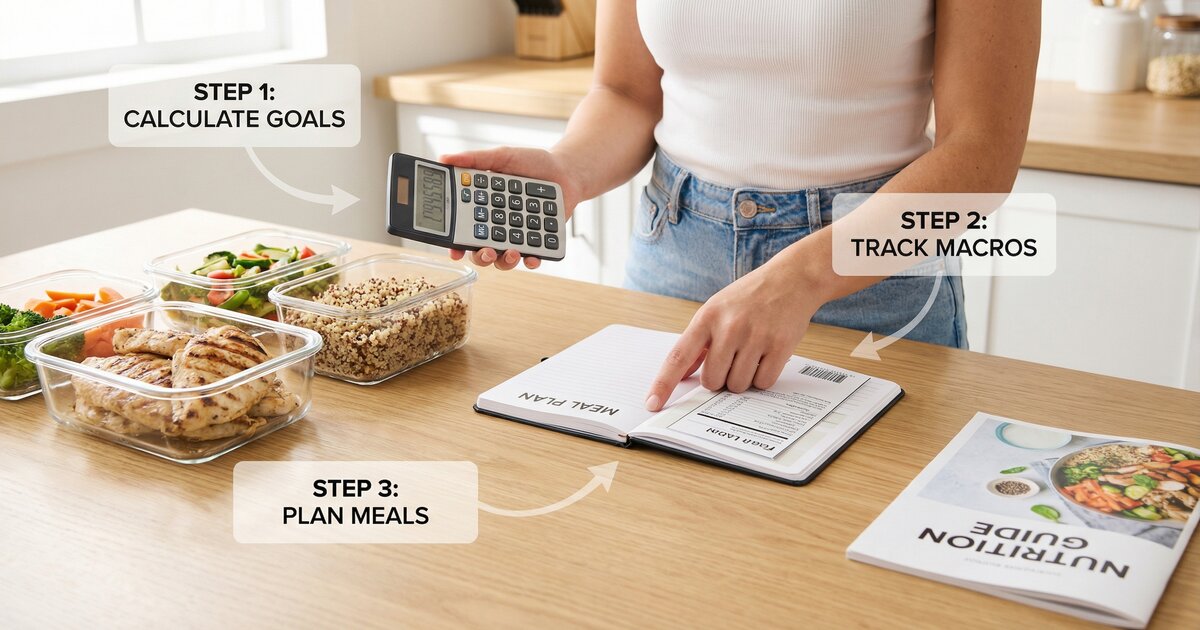
You want to start tracking macros. You’ve heard it works. You know you need protein, carbs, and fat targets.
But when you actually sit down to figure out your numbers? The internet throws 15 different formulas at you, half the advice contradicts itself, and you’re left wondering if you need a nutrition degree just to eat lunch.
Here’s the reality: calculating macros is straightforward once someone walks you through it step-by-step. No complicated math. No guessing. Just a clear process that takes about 5 minutes.
This guide gives you exactly that—a simple, proven method for calculating your personalized macro targets. We’ll use real examples, explain why each step matters, and show you how to adjust based on your specific goal.
By the end, you’ll have your numbers and know exactly what to do with them.
Want to skip the manual work? Our free macro calculator does all the math instantly and gives you personalized targets in 60 seconds.
Why Macro Calculations Matter
Before we dive into the how, let’s talk about why this matters.
Macros vs Calories: What’s the Difference?
Calories tell you how much energy you’re eating. Macros tell you what kind of energy you’re eating.
Both matter, but here’s why macros give you better results:
Example: Two people eat 1,800 calories per day.
Person A: 50g protein, 250g carbs, 60g fat Person B: 140g protein, 180g carbs, 60g fat
Same calories. Completely different outcomes.
Person A loses muscle, feels hungry constantly, struggles to maintain results. Person B preserves muscle, feels satisfied, achieves lasting body composition changes.
The difference? Macro balance.
Calculating your macros ensures you’re eating the right types of food to support your goal—not just the right amount of food. For a deeper understanding, read our guide on macro counting vs calorie counting.
Who Needs to Calculate Macros?
You’ll benefit from macro tracking if you:
- Want to lose fat while preserving muscle
- Struggle with hunger on traditional diets
- Work out and want to optimize performance
- Have hit a weight loss plateau
- Want visible body composition changes (not just scale weight)
You might not need macros if:
- You’re happy with intuitive eating results
- You’re completely new to nutrition (start with what are macros first)
- You have a history of disordered eating (consult a professional)
Most people who lift weights, play sports, or care about how their body looks (not just the number on the scale) benefit enormously from macro tracking.
Step 1: Calculate Your TDEE (Total Daily Energy Expenditure)
TDEE is the total calories you burn in a day—your baseline metabolism plus all movement and activity.
This is your starting point. Get this right, and everything else falls into place.
Method 1: Use a Calculator (Easiest)
The fastest, most accurate way: Use our macro calculator.
Input your stats, get your TDEE in seconds. Done.
Method 2: Calculate Manually (For Understanding)
If you want to understand the math:
Step 1: Calculate BMR (Basal Metabolic Rate) using Mifflin-St Jeor equation:
For men: BMR = (10 × weight in kg) + (6.25 × height in cm) - (5 × age) + 5
For women: BMR = (10 × weight in kg) + (6.25 × height in cm) - (5 × age) - 161
Step 2: Multiply BMR by your activity factor:
- Sedentary (desk job, little exercise): BMR × 1.2
- Lightly active (exercise 1-3 days/week): BMR × 1.375
- Moderately active (exercise 3-5 days/week): BMR × 1.55
- Very active (exercise 6-7 days/week): BMR × 1.725
- Extremely active (athlete, physical job): BMR × 1.9
Example: A 30-year-old woman, 150 pounds (68 kg), 5’6” (168 cm), moderately active:
BMR = (10 × 68) + (6.25 × 168) - (5 × 30) - 161 = 1,409 TDEE = 1,409 × 1.55 = 2,184 calories
This is her maintenance—the amount she burns daily.
Quick Estimation Method
Don’t want to do math? Use this rough estimate:
- Sedentary: Bodyweight (lbs) × 12-13
- Lightly active: Bodyweight × 13-14
- Moderately active: Bodyweight × 14-15
- Very active: Bodyweight × 15-17
Our 150-pound example: 150 × 14.5 = 2,175 calories (very close to the detailed calculation)
Pro tip: Start conservative with activity level. Most people overestimate how active they are. Learn more about this in our TDEE explained and TDEE calculator guide.

Step 2: Set Your Calorie Goal Based on Your Objective
Now adjust your TDEE based on what you want to achieve.
For Fat Loss: Create a Deficit
Target: 300-500 calories below TDEE
Example: TDEE of 2,184 → eat 1,684-1,884 calories
Why this range?
- Too small (< 300): Progress is painfully slow
- Too large (> 500): Excessive hunger, muscle loss, metabolic adaptation
Start at 400-calorie deficit for most people. This loses about 0.5-1 pound per week—sustainable and effective.
Aggressive option: 500-700 calorie deficit if you have 30+ pounds to lose and want faster results. Not recommended long-term.
For detailed guidance, see our best macro split for weight loss article.
For Maintenance: Stay at TDEE
Target: Exactly at TDEE
Use your calculated TDEE. This maintains your current weight while you recomp (build muscle, lose fat slowly).
For Muscle Gain: Create a Surplus
Target: 200-300 calories above TDEE
Example: TDEE of 2,184 → eat 2,384-2,484 calories
Why this range?
- Too small (< 200): Minimal muscle growth
- Too large (> 300): Unnecessary fat gain
Lean bulk (recommended): +200-250 calories. Slow, clean muscle gain with minimal fat. Traditional bulk: +300-500 calories. Faster muscle gain, more fat gain. Check out our comprehensive bulking macros guide.
Step 3: Calculate Your Protein Target
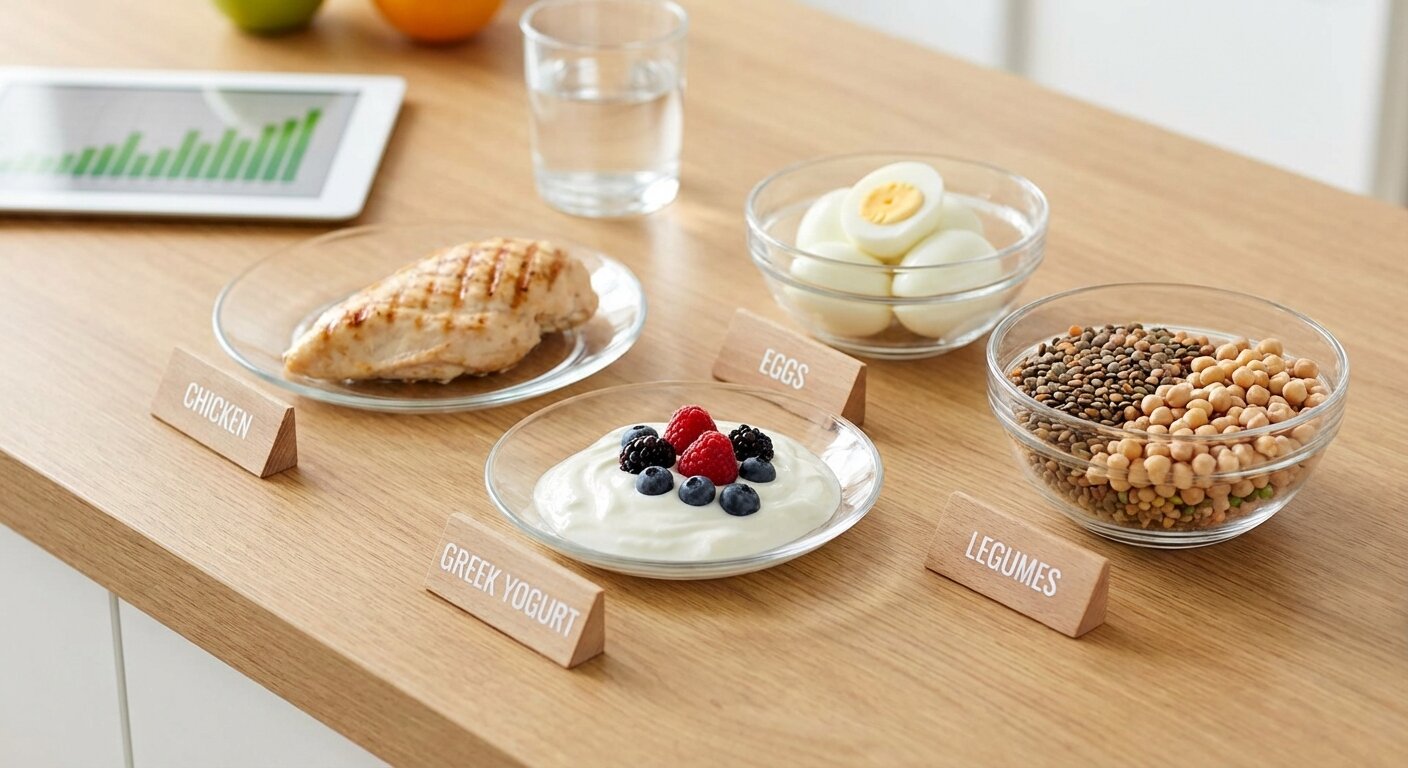
Protein is your most important macro. Set this first.
The Formula
Target: 0.7-1.0g per pound of bodyweight
- Sedentary: 0.7-0.8g per pound
- Active/lifting: 0.8-1.0g per pound
- Aggressive cut: 1.0-1.2g per pound (to preserve muscle)
Example: Our 150-pound woman who lifts 4x/week: 150 × 0.9 = 135g protein daily
Special Cases
If significantly overweight (BMI > 30): Use goal weight or lean body mass instead of current weight. A 250-pound person trying to reach 180 doesn’t need 250g of protein.
If elderly (65+): Aim higher (1.0-1.2g per pound) to combat age-related muscle loss.
If plant-based: Aim toward higher end (0.9-1.0g) since plant proteins are less bioavailable. Read our vegan macro guide for specifics.
For women-specific guidance: Check out our dedicated macro calculator for women which accounts for hormonal cycles and body composition differences.
For keto dieters: See our keto macro calculator for low-carb specific calculations.
Convert Grams to Calories
Protein = 4 calories per gram
135g protein × 4 = 540 calories from protein
Step 4: Calculate Your Fat Target
Fat is essential for hormone production, vitamin absorption, and satiety.
The Formula
Target: 0.3-0.4g per pound of bodyweight
This is your minimum for health. You can go higher (and use fewer carbs) based on preference.
Example: Our 150-pound woman: 150 × 0.35 = 53g fat daily
Round to 50g or 55g for easier tracking.
Why These Amounts?
Below 0.3g per pound: Risk of hormone disruption, poor vitamin absorption, constant hunger. Above 0.5g per pound: Not harmful, but leaves less room for carbs (which fuel training).
Women: Tend to do better with fat at the higher end (0.35-0.4g). Men: Often thrive with fat at the lower end (0.3-0.35g).
Convert Grams to Calories
Fat = 9 calories per gram
53g fat × 9 = 477 calories from fat
Step 5: Calculate Carbs with Remaining Calories
Carbs are your flex macro—they fill the remaining calorie space after protein and fat are set.
The Formula
Step 1: Subtract protein and fat calories from your total goal
Example: Our 150-pound woman aiming for fat loss:
- Goal: 1,784 calories (400-calorie deficit)
- Protein: 540 calories
- Fat: 477 calories
- Remaining: 1,784 - 540 - 477 = 767 calories for carbs
Step 2: Convert carb calories to grams
Carbs = 4 calories per gram
767 ÷ 4 = 192g carbs
Her Final Macros
- Calories: 1,784
- Protein: 135g (540 calories)
- Fat: 53g (477 calories)
- Carbs: 192g (768 calories)
These are her daily targets for fat loss while preserving muscle.
Macro Ratio vs Gram-Based Targets: Which is Better?
You’ll see macro advice given two ways:
Ratio-based: “Try 40/30/30” (40% carbs, 30% protein, 30% fat) Gram-based: “Eat 135g protein, 53g fat, 192g carbs”
Gram-based is always better. Here’s why:
The Problem with Ratios
A 40/30/30 split at 1,200 calories gives you:
- Protein: 90g
- Fat: 40g
- Carbs: 120g
The same 40/30/30 split at 2,800 calories gives you:
- Protein: 210g
- Fat: 93g
- Carbs: 280g
A 130-pound woman and a 220-pound man have wildly different protein needs—but the same ratio gives them vastly different amounts.
Gram-based targets adjust to your body size. That 130-pound woman needs about 100-130g protein whether she eats 1,400 or 1,800 calories.
When Ratios Work
Ratios are fine for:
- Quick mental models
- Ballpark estimates
- Meal planning (e.g., “aim for 30% of my plate to be protein”)
But for calculating your actual targets? Use grams.
Want a detailed comparison? Read the best macro ratios for different goals.
How to Adjust Your Macros for Different Goals
Your initial calculation is a starting point. Here’s how to fine-tune based on your specific goal.
Fat Loss Adjustments
If losing too slowly (< 0.5 lb/week):
- Reduce carbs by 25-50g (-100-200 calories)
- OR reduce fat by 10-15g (-90-135 calories)
- Keep protein high to preserve muscle
If losing too fast (> 1.5 lb/week):
- Add 25-50g carbs
- Prevents excessive hunger and muscle loss
If constantly hungry:
- Increase protein by 20-30g
- Slightly increase fat (+5-10g)
- Reduce carbs to compensate
For troubleshooting, see why you’re not losing weight.
Muscle Gain Adjustments
If not gaining weight:
- Add 50g carbs (+200 calories)
- Assess after 2 weeks
If gaining too much fat:
- Reduce surplus to +200 calories
- Keep protein high (1g per pound)
For enhanced recovery:
- Increase carbs on training days
- Reduce on rest days (carb cycling)
Maintenance Adjustments
If slowly losing weight:
- Add 200 calories (50g carbs or 20g fat)
If slowly gaining weight:
- Reduce 200 calories from carbs or fat
Give adjustments 2-3 weeks before changing again. Your body needs time to respond.
Common Macro Calculation Mistakes
Mistake 1: Using Goal Weight Instead of Current Weight
Wrong: “I want to weigh 140, so I’ll calculate as if I already do.”
Why it fails: You’re not 140 yet. Your current 180-pound body burns more calories than a 140-pound body. Using goal weight puts you in too large a deficit too quickly.
Fix: Use current weight (unless 50+ pounds overweight, then use midpoint).
Mistake 2: Overestimating Activity Level
Wrong: “I go to the gym 3x/week for an hour, so I’m very active.”
Why it fails: 3 hours of exercise + 165 hours of sitting = lightly active at best.
Fix: Be honest. Most people are sedentary or lightly active. You can always increase calories if you’re losing too fast.
Mistake 3: Setting Protein Too Low
Wrong: “I’ll do 0.5g per pound to save calories for carbs.”
Why it fails: Inadequate protein = muscle loss, increased hunger, poor recovery.
Fix: Protein is non-negotiable. Minimum 0.7g per pound, ideally 0.8-1.0g.
Mistake 4: Going Too Aggressive with Deficit
Wrong: “I’ll do a 1,000 calorie deficit to lose weight faster.”
Why it fails: Extreme hunger, muscle loss, metabolic slowdown, rebound weight gain.
Fix: 300-500 calorie deficit for sustainable fat loss. Patience wins.
Mistake 5: Changing Macros Too Frequently
Wrong: “It’s been 5 days and I haven’t lost weight. Let me cut carbs.”
Why it fails: Your body needs 2-3 weeks to respond to changes. Daily fluctuations are water weight, not fat.
Fix: Stick with your macros for at least 2-3 weeks before adjusting. Track weekly averages, not daily weigh-ins.

Sample Macro Calculations for Different People
Let’s walk through 3 complete examples.
Example 1: Woman, Fat Loss
Stats:
- Age: 35
- Weight: 165 lbs
- Height: 5’5”
- Activity: Moderate (workouts 4x/week)
- Goal: Lose fat
TDEE: ~2,150 calories Goal calories: 1,750 (400 deficit)
Macros:
- Protein: 165 × 0.8 = 132g (528 cal)
- Fat: 165 × 0.35 = 58g (522 cal)
- Remaining: 1,750 - 1,050 = 700 cal
- Carbs: 700 ÷ 4 = 175g
Final: 1,750 cal | 132P | 58F | 175C
Example 2: Man, Muscle Gain
Stats:
- Age: 28
- Weight: 175 lbs
- Height: 5’11”
- Activity: Very active (lifts 5x/week)
- Goal: Build muscle
TDEE: ~2,800 calories Goal calories: 3,050 (250 surplus)
Macros:
- Protein: 175 × 1.0 = 175g (700 cal)
- Fat: 175 × 0.3 = 53g (477 cal)
- Remaining: 3,050 - 1,177 = 1,873 cal
- Carbs: 1,873 ÷ 4 = 468g
Final: 3,050 cal | 175P | 53F | 468C
Example 3: Man, Maintenance
Stats:
- Age: 42
- Weight: 190 lbs
- Height: 6’0”
- Activity: Lightly active
- Goal: Maintain, recomp
TDEE: ~2,550 calories Goal calories: 2,550 (maintenance)
Macros:
- Protein: 190 × 0.85 = 162g (648 cal)
- Fat: 190 × 0.35 = 67g (603 cal)
- Remaining: 2,550 - 1,251 = 1,299 cal
- Carbs: 1,299 ÷ 4 = 325g
Final: 2,550 cal | 162P | 67F | 325C
Tools and Resources for Calculating Macros
Best Macro Calculators
-
Macronutrients.com Calculator (Our free tool)
- Mifflin-St Jeor based
- Goal-specific recommendations
- Instant results
-
IIFYM Calculator
- Multiple formula options
- Detailed activity breakdown
-
Legion Athletics Calculator
- Research-backed formulas
- Good explanations
Tracking Apps
Once you have your macros, you need to track them:
- MyFitnessPal: Most popular, huge food database
- Cronometer: Most accurate, great for micronutrients
- MacroFactor: Adaptive coaching, adjusts automatically
- Carbon Diet Coach: Similar to MacroFactor with AI coaching
Read our full comparison in best apps for tracking macros.
Other Helpful Resources
- Food scale: Essential for accurate tracking (we cover this in do you need a food scale)
- Macro meal prep guide: Batch cooking for your targets
- How to read nutrition labels: Understanding packaged foods
FAQ: How to Calculate Macros
How accurate do my macro calculations need to be?
Within 5-10g of your targets is perfectly fine. Don’t stress about hitting exactly 148g when your target is 150g. Consistency over weeks matters more than daily perfection.
Should I calculate macros differently for training vs rest days?
Not necessary when starting. Advanced lifters sometimes use more carbs on training days and fewer on rest days (carb cycling), but beginners benefit more from consistency.
Can I calculate macros if I don’t know my body fat percentage?
Yes. The formulas in this guide don’t require body fat percentage. They work well for most people using total bodyweight.
What if I’m losing weight—do I recalculate every week?
No. Recalculate every 10-15 pounds of weight loss, or when progress stalls for 2-3 weeks. Your calorie needs don’t change dramatically from week to week.
How do I calculate macros for intermittent fasting?
Use the exact same formulas. Meal timing doesn’t change your macro needs—just compress your eating window. Read our intermittent fasting macros guide for specifics.
Is there a difference between calculating macros for men vs women?
The formulas account for sex differences (the BMR equations are different). Women generally do better with slightly higher fat (0.35-0.4g per pound vs 0.3-0.35g for men).
Can I use percentages instead of grams?
You can, but gram-based targets are more accurate. A 40/30/30 split means different protein amounts at different calorie levels. Setting protein at 1g per pound stays consistent regardless of total calories.
The Bottom Line
Calculating macros isn’t complicated—it just seems that way because most guides overcomplicate it.
Here’s the 5-step process:
- Calculate TDEE (maintenance calories)
- Adjust for your goal (+/- 300-500 calories)
- Set protein (0.8-1g per pound)
- Set fat (0.3-0.4g per pound)
- Fill remaining calories with carbs
Give yourself 2-3 weeks on these targets before adjusting. Track consistently. Be honest about your activity level. Start conservative.
Your initial calculation won’t be perfect—and that’s okay. Macro tracking is a feedback loop. You calculate, you track, you assess progress, you adjust. Within a month, you’ll have dialed in your perfect targets.
Ready to get your personalized macros? Use our free macro calculator and get your targets in 60 seconds. No guesswork, no complicated math—just your numbers.
Then read macro tracking for beginners to learn how to actually hit those targets every day.
Learn more in How to Count Macros.
Related Resources
Related Articles
Travel Macros: How to Track Nutrition While Traveling
Complete guide to managing macros while traveling. Learn meal planning strategies,...
Read guide →
Macros for Shift Workers: Complete Guide to Nutrition on Rotating Schedules
Master macro tracking on night shifts and rotating schedules. Learn meal timing, sleep...
Read guide →
Macros During Ramadan: Complete Nutrition Guide for Fasting
Learn how to track macros during Ramadan fasting. Expert guide covering meal timing,...
Read guide →Disclaimer: This content is for informational purposes only. Consult a healthcare provider before making changes to your diet.