Keto Macro Calculator: How to Set Up Keto Macros (2025)
Reviewed by Sarah Chen, MS, RD
You’ve decided to try keto. You’ve heard about bacon, butter, and rapid fat loss. But when you search “keto macros,” you get conflicting advice:
“Eat 80% fat!” “No, 70% fat, 25% protein, 5% carbs!” “Keep it under 20g carbs!” “I eat 50g carbs and I’m in ketosis!”
What the hell are you supposed to do?
Here’s the problem: Most keto macro advice uses percentages, which are confusing and often wrong for your specific body. A 120-pound woman and a 200-pound man shouldn’t eat the same percentages—their actual gram amounts should be vastly different.
The solution? Calculate your keto macros in grams based on your body composition, activity level, and goals.
This guide teaches you the exact formulas to set up ketogenic macros for reliable ketosis, whether you’re trying to lose fat, maintain weight, or even build muscle on keto. You’ll learn how much protein, fat, and carbs your specific body needs—not generic percentages.
By the end, you’ll have personalized keto macro targets that put you in ketosis and keep you there.
Want instant keto macro calculations? Our free macro calculator includes a keto mode with personalized targets.
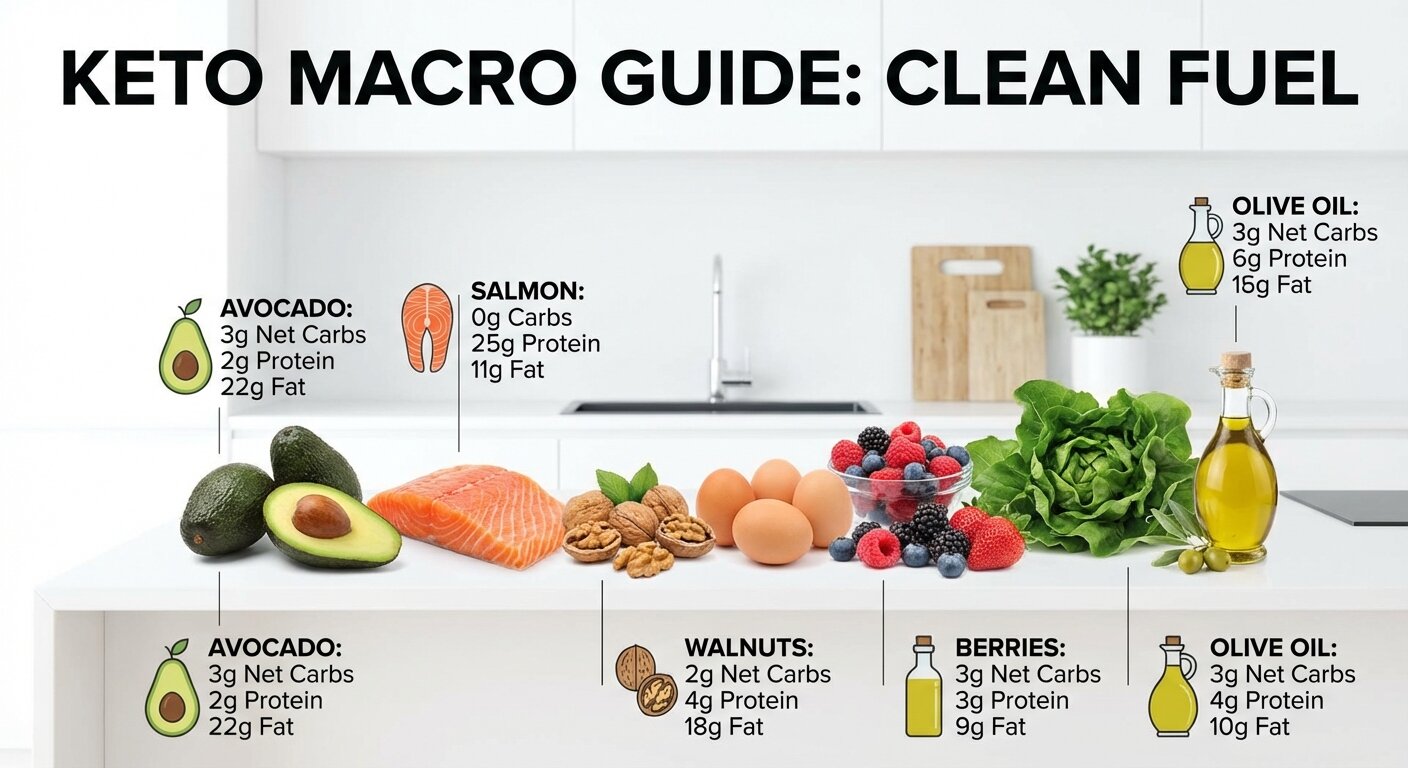
Understanding Keto: Why Macros Matter for Ketosis
Before calculating macros, understand what keto actually is and why specific macro targets matter.
What Is Ketosis?
Ketosis is a metabolic state where your body primarily burns fat for fuel instead of carbohydrates.
Normal metabolism:
- Body converts carbs → glucose → primary energy source
- Fat stored for later use
Ketogenic metabolism:
- Carbs restricted → glucose depleted
- Liver converts fat → ketones → primary energy source
- Fat burned continuously for fuel
Ketones are molecules produced when fat is broken down. Your brain, heart, and muscles can use ketones for energy instead of glucose.
The Three Macros on Keto
Carbohydrates: Restricted to force ketosis
- Keep NET carbs 20-50g daily
- Depletes glycogen stores
- Signals body to produce ketones
Protein: Adequate for muscle preservation
- Too little = muscle loss
- Too much = potential interference with ketosis (overstated concern)
- Target: 0.6-1.0g per pound lean body mass
Fat: Primary energy source
- Replaces carbs as fuel
- Provides satiety
- Adjusted based on goals (higher for maintenance, lower for fat loss)
Common Keto Mistakes
Mistake #1: “I just need to keep carbs under 20g”
Truth: You also need adequate protein and appropriate total calories. Just eating low-carb doesn’t guarantee results.
Mistake #2: “Keto = high fat, so I need to eat tons of fat”
Truth: Dietary fat is a lever. For fat loss, you want your BODY fat to be burned, not just dietary fat. Eat enough fat for satiety, not excess.
Mistake #3: “Protein kicks me out of ketosis”
Truth: Gluconeogenesis (protein → glucose) is demand-driven, not supply-driven. Adequate protein is essential, especially for active people. Don’t under-eat protein.
For more on macro basics, read what are macros.
Step-by-Step: How to Calculate Keto Macros
Follow this systematic process to dial in your targets.
Step 1: Calculate Your Maintenance Calories (TDEE)
First, determine how many calories you burn daily.
Quick Estimate Method
TDEE = Bodyweight (lbs) × Activity Multiplier
Activity multipliers:
- Sedentary (little exercise): 13-14
- Lightly active (1-3 workouts/week): 14-15
- Moderately active (3-5 workouts/week): 15-16
- Very active (5-7 workouts/week): 16-17
Examples:
Person A: 150 lbs, lightly active
- TDEE = 150 × 14.5 = 2,175 calories
Person B: 180 lbs, moderately active
- TDEE = 180 × 15.5 = 2,790 calories
Mifflin-St Jeor Formula (More Accurate)
Men: BMR = (10 × weight kg) + (6.25 × height cm) - (5 × age) + 5 Women: BMR = (10 × weight kg) + (6.25 × height cm) - (5 × age) - 161
Then multiply BMR by activity factor (1.2-1.9).
Example: Woman, 140 lbs (63.5 kg), 5’4” (163 cm), 35 years old
- BMR = (10 × 63.5) + (6.25 × 163) - (5 × 35) - 161 = 1,329
- TDEE = 1,329 × 1.4 (lightly active) = 1,861 calories
Step 2: Adjust Calories for Your Goal
Apply calorie adjustment based on your objective.
For Fat Loss (Most Common)
Create 15-25% deficit:
- Moderate deficit (20%): 2,175 × 0.80 = 1,740 calories
- Aggressive deficit (25%): 2,175 × 0.75 = 1,631 calories
Start with 20% deficit for sustainable fat loss without excessive hunger.
For Maintenance
Eat at TDEE:
- No adjustment needed
- Maintain weight while enjoying keto benefits
For Muscle Gain (Rare on Keto)
Add 10-15% surplus:
- 2,175 × 1.10 = 2,393 calories
Note: Building muscle on keto is challenging. Most use keto for cutting, not bulking.
Step 3: Set Net Carbs (The Non-Negotiable)
Carbs determine whether you achieve ketosis.
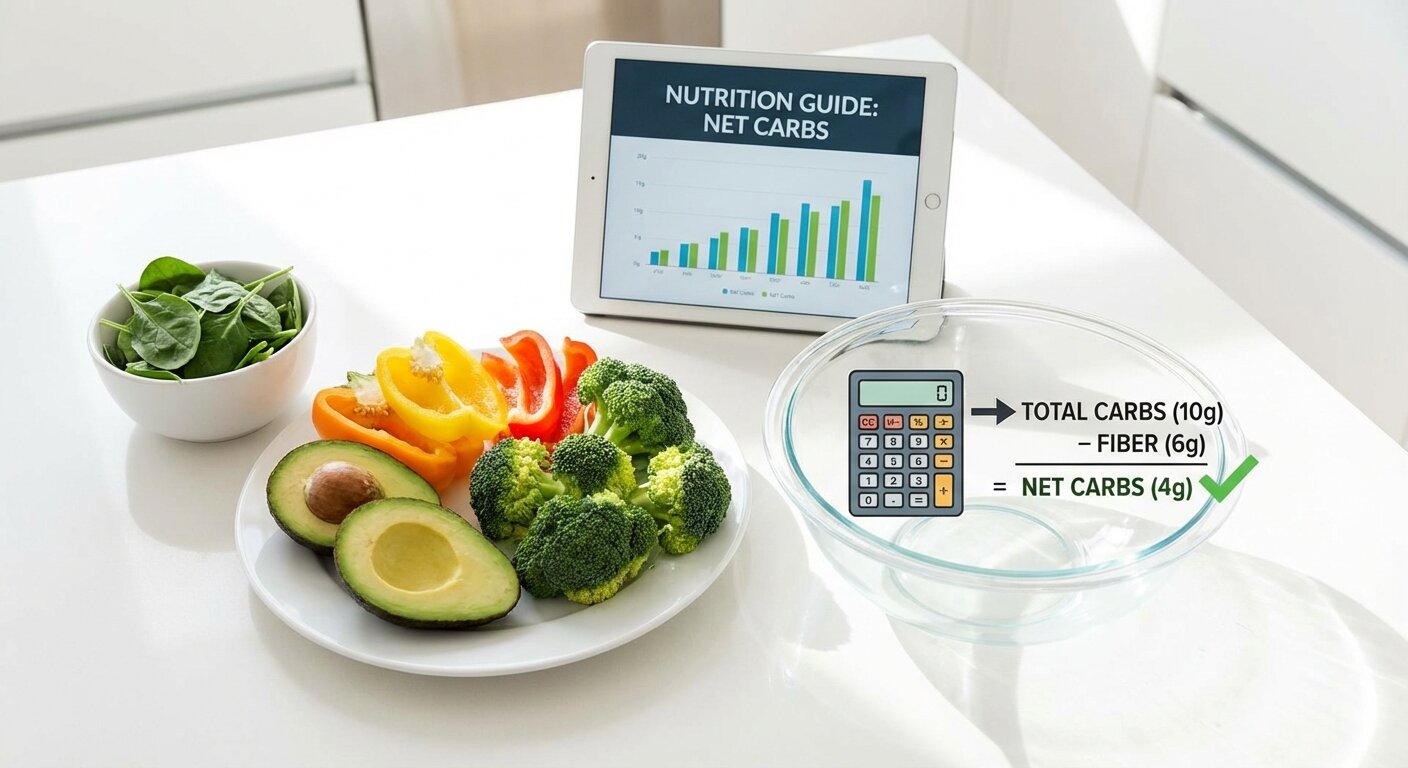
Net Carbs Formula
Net Carbs = Total Carbs - Fiber - (Some Sugar Alcohols)
Why net carbs?
- Fiber doesn’t spike blood sugar or insulin
- Doesn’t interfere with ketosis
- Allows more vegetable intake
Carb Targets by Experience
| Experience Level | Net Carbs | Reasoning |
|---|---|---|
| Keto beginner | 20g | Guarantees ketosis for everyone |
| Fat-adapted (1+ month) | 20-30g | Can tolerate slightly more |
| Very active/athletes | 30-50g | Higher glycogen needs |
| Targeted keto (TKD) | 30-50g (timed around workouts) | Carbs for performance |
Recommendation: Start at 20g net carbs for first 2-3 weeks. Test ketones. Once fat-adapted, experiment with 30-50g if desired.
Converting Carbs to Calories
Carbs = 4 calories per gram
20g net carbs = 80 calories 30g net carbs = 120 calories 50g net carbs = 200 calories
Example: 1,740 calorie fat loss diet with 25g net carbs
- Carb calories: 25 × 4 = 100 calories
Step 4: Set Protein (Essential for Muscle Preservation)
Protein needs on keto are based on LEAN BODY MASS, not total weight.
Calculate Lean Body Mass
Method 1: If you know body fat percentage
Lean Mass = Total Weight × (1 - Body Fat %)
Example: 180 lbs at 25% body fat
- Lean mass = 180 × (1 - 0.25) = 135 lbs
Method 2: Estimate body fat visually
| Description | Men | Women |
|---|---|---|
| Very lean (visible abs) | 10-15% | 18-22% |
| Athletic (some definition) | 15-18% | 22-25% |
| Average (no definition) | 18-25% | 25-30% |
| Overweight | 25-35% | 30-40% |
Protein Targets by Goal
Standard keto: 0.6-0.8g per pound lean mass
Active/lifting: 0.8-1.0g per pound lean mass
Very active/bodybuilding: 1.0-1.2g per pound lean mass (may slightly reduce ketone levels but worth it for muscle preservation)
Example: 180 lbs, 25% body fat (135 lbs lean mass), moderately active
- Target: 0.8g per lb lean mass
- Protein: 135 × 0.8 = 108g protein
- Calories: 108 × 4 = 432 calories
Don’t Fear Protein
Myth: “Too much protein kicks you out of ketosis via gluconeogenesis”
Reality: Gluconeogenesis is demand-driven, not supply-driven. Your body makes glucose as needed regardless of protein intake. Under-eating protein causes muscle loss and metabolic damage.
Better safe than sorry: If unsure, go with higher protein (0.8-1.0g/lb lean mass).
For more on protein needs, read how many grams of protein per day.
Step 5: Fill Remaining Calories with Fat
Fat becomes your primary fuel source on keto.
Fat Calculation
Remaining calories = Total - (Carb calories + Protein calories)
Fat grams = Remaining calories ÷ 9
Example: 1,740 calorie fat loss diet
- Total calories: 1,740
- Carbs: 25g (100 cal)
- Protein: 108g (432 cal)
- Remaining: 1,740 - 100 - 432 = 1,208 calories
- Fat: 1,208 ÷ 9 = 134g fat
Fat as a Lever
For fat loss: Dietary fat is lower because you want body fat to fill the gap
- Example: 100-140g fat
For maintenance: Dietary fat is higher to maintain weight
- Example: 140-180g fat
For muscle gain: Dietary fat is highest to create surplus
- Example: 180-220g+ fat
Key insight: You don’t HAVE to hit fat targets on keto for fat loss. If you’re full eating 120g fat when target is 140g, that’s fine—your body will burn stored fat. Fat is for satiety and meeting calorie goals.
Step 6: Verify Your Macro Percentages
Convert grams to percentages to ensure proper keto ratios.
Example from above (1,740 cal, 25C/108P/134F):
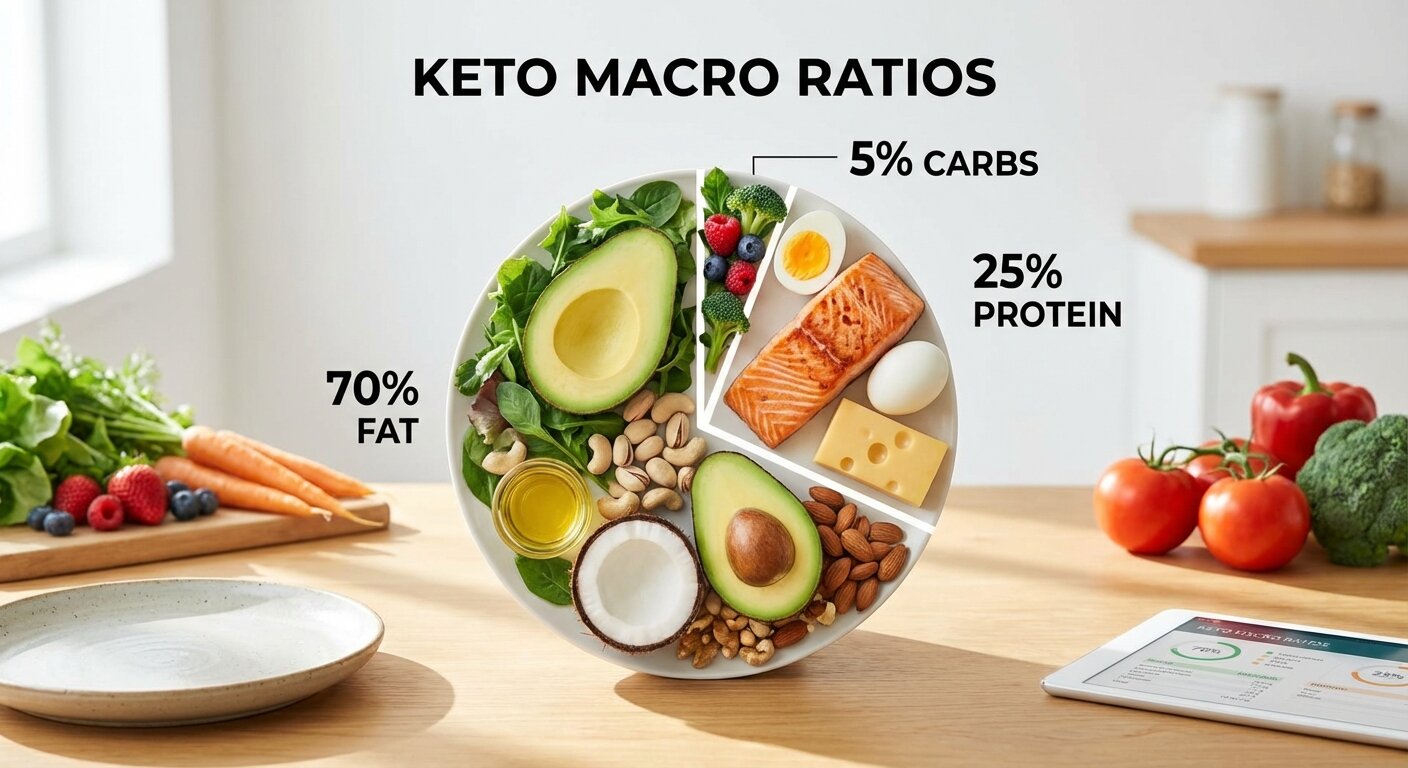
- Carbs: 100 cal ÷ 1,740 = 6%
- Protein: 432 cal ÷ 1,740 = 25%
- Fat: 1,208 cal ÷ 1,740 = 69%
Final ratio: 6/25/69 (C/P/F)
Standard Keto Ranges
| Macro | Minimum | Optimal Range | Maximum |
|---|---|---|---|
| Net Carbs | 5% | 5-10% | 10% |
| Protein | 15% | 20-25% | 30% |
| Fat | 60% | 65-75% | 80% |
If your percentages fall outside these ranges:
- Carbs over 10%? Reduce carbs (you’re eating too many)
- Protein under 20%? Increase protein (muscle loss risk)
- Fat under 60%? Increase calories or reduce carbs/protein slightly
Complete Keto Macro Examples
Let’s walk through three full calculations.
Example 1: Sarah - Fat Loss on Keto
Stats:
- Female, 32 years old
- 160 lbs, 5’6”, ~30% body fat (112 lbs lean mass)
- Lightly active (walks daily, some yoga)
- Goal: Lose 25-30 lbs fat
Step 1: TDEE
- 160 × 14 = 2,240 calories maintenance
Step 2: Deficit
- 20% deficit: 2,240 × 0.80 = 1,792 calories
Step 3: Net carbs
- Starting keto: 20g net carbs (80 cal)
Step 4: Protein
- Target: 0.7g per lb lean mass
- 112 × 0.7 = 78g protein (312 cal)
- Round up: 85g protein (340 cal)
Step 5: Fat
- Remaining: 1,792 - 80 - 340 = 1,372 cal
- Fat: 1,372 ÷ 9 = 152g
Sarah’s Keto Macros:
- Net Carbs: 20g (4%)
- Protein: 85g (19%)
- Fat: 152g (77%)
- Total: 1,792 calories
Expected results: 0.5-1% bodyweight loss per week (0.8-1.6 lbs)
Example 2: Mike - Active Male, Fat Loss
Stats:
- Male, 28 years old
- 200 lbs, 6’0”, ~20% body fat (160 lbs lean mass)
- Very active (lifts 4x/week, plays sports)
- Goal: Get lean while maintaining strength
Step 1: TDEE
- 200 × 16.5 = 3,300 calories maintenance
Step 2: Deficit
- Conservative (he’s fairly lean): 15% deficit
- 3,300 × 0.85 = 2,805 calories
Step 3: Net carbs
- Active, can tolerate slightly more: 30g net carbs (120 cal)
Step 4: Protein
- Target: 1.0g per lb lean mass (higher for strength preservation)
- 160 × 1.0 = 160g protein (640 cal)
Step 5: Fat
- Remaining: 2,805 - 120 - 640 = 2,045 cal
- Fat: 2,045 ÷ 9 = 227g
Mike’s Keto Macros:
- Net Carbs: 30g (4%)
- Protein: 160g (23%)
- Fat: 227g (73%)
- Total: 2,805 calories
Expected results: 0.5-0.75% bodyweight loss per week (1-1.5 lbs)
Example 3: Lisa - Keto for Maintenance
Stats:
- Female, 45 years old
- 135 lbs, 5’4”, ~25% body fat (101 lbs lean mass)
- Moderately active (yoga, hiking, some strength)
- Goal: Maintain weight, mental clarity, stable energy
Step 1: TDEE
- 135 × 15 = 2,025 calories maintenance
Step 2: Maintenance
- No deficit: 2,025 calories
Step 3: Net carbs
- Fat-adapted, tolerates more: 35g net carbs (140 cal)
Step 4: Protein
- Target: 0.75g per lb lean mass
- 101 × 0.75 = 76g
- Round up: 80g protein (320 cal)
Step 5: Fat
- Remaining: 2,025 - 140 - 320 = 1,565 cal
- Fat: 1,565 ÷ 9 = 174g
Lisa’s Keto Macros:
- Net Carbs: 35g (7%)
- Protein: 80g (16%)
- Fat: 174g (77%)
- Total: 2,025 calories
Expected results: Weight maintenance, stable ketosis
Adjusting Keto Macros Based on Progress
Your initial macros are a starting point. Adjust based on results.
Tracking Ketosis
Methods to confirm ketosis:
1. Urine ketone strips
- Cheap ($10-15 for 100 strips)
- Test for acetoacetate in urine
- Accurate for first 2-3 weeks
- Less accurate once fat-adapted (body uses ketones more efficiently)
2. Blood ketone meter
- More accurate ($40-60 meter, $1-2 per strip)
- Test for beta-hydroxybutyrate (BHB) in blood
- Gold standard for measuring ketosis
- Levels: 0.5-3.0 mmol/L = nutritional ketosis
3. Breath ketone meter
- One-time purchase ($100-200)
- Measures acetone in breath
- No recurring costs
- Moderate accuracy
Ketone ranges:
- Below 0.5 mmol/L: Not in ketosis
- 0.5-1.5 mmol/L: Light nutritional ketosis (fine for most)
- 1.5-3.0 mmol/L: Optimal ketosis
- Above 3.0 mmol/L: High ketosis (not necessary, no added benefit)
Adjustment Scenarios
Scenario 1: Not Reaching Ketosis After 1 Week
Diagnosis: Carbs likely too high, or hidden carbs in foods
Fix:
- Drop net carbs to 20g (strict)
- Track everything (sauces, dressings add up)
- Eliminate dairy temporarily (some find it stalls ketosis)
- Test again in 3-4 days
Scenario 2: In Ketosis But Not Losing Weight
Diagnosis: Eating at maintenance despite trying to cut
Fix:
- Reduce calories by 200 (take from fat: reduce 22g fat)
- Ensure you’re tracking accurately (weigh food)
- Check for hidden calories (oil, nuts, cheese)
- Add 1-2 walks daily (increase deficit through activity)
Scenario 3: Losing Weight But Also Losing Strength
Diagnosis: Protein too low or deficit too aggressive
Fix:
- Increase protein by 20-30g (may reduce ketones slightly but worth it)
- Reduce deficit to 15% (increase fat by 20-30g)
- Time carbs pre-workout (targeted ketogenic diet)
- Ensure adequate sleep (7-9 hours)
Scenario 4: Constant Hunger, Hard to Adhere
Diagnosis: Fat too low for satiety or not fat-adapted yet
Fix:
- Increase fat by 15-20g (reduce deficit slightly)
- Eat more protein (highly satiating)
- Give it 2-3 weeks (hunger decreases once fat-adapted)
- Drink more water, eat high-volume low-carb veggies
Scenario 5: Kicked Out of Ketosis
Diagnosis: Ate too many carbs (cheat meal, hidden carbs)
Fix:
- Don’t panic—just return to 20g net carbs
- Consider 24-hour fast to deplete glycogen faster
- May take 2-4 days to return to ketosis
- Test ketones to confirm when back
When to Recalculate
Recalculate keto macros:
- Every 15-20 pounds lost
- Every 2-3 months
- When transitioning from fat loss to maintenance
- When increasing training volume significantly

Keto Macro Variations
Standard keto isn’t the only approach.
Standard Ketogenic Diet (SKD)
What it is: Consistent macros every day
Macros: 20-50g net carbs, adequate protein, high fat
Best for: Most people, beginners, sedentary to moderately active
Targeted Ketogenic Diet (TKD)
What it is: Add 15-30g fast-acting carbs 30-60 minutes before workouts
Macros:
- Non-training days: Standard keto (20g)
- Training days: 35-50g total (added pre-workout)
Best for: Athletes, high-intensity training, those experiencing performance drops
Example: Eat 20g dextrose or fruit before training, stay under 20g rest of day
Cyclical Ketogenic Diet (CKD)
What it is: 5-6 days strict keto, 1-2 days high-carb refeed
Macros:
- Keto days (5-6 days): 20g net carbs
- Refeed days (1-2 days): 300-500g carbs, low fat
Best for: Bodybuilders, advanced athletes, those struggling with long-term keto adherence
Warning: Requires discipline. Easy to turn “refeed” into “binge.”
High-Protein Keto
What it is: Higher protein (30-35% of calories), moderate fat
Macros: 20-30g net carbs, 1.2-1.5g protein per lb lean mass, moderate fat
Best for: Bodybuilders, strength athletes, aggressive fat loss, muscle preservation
Trade-off: May produce lower ketone levels (0.5-1.0 mmol/L) but better body composition
Sample Keto Meal Plans
Here are three example days.
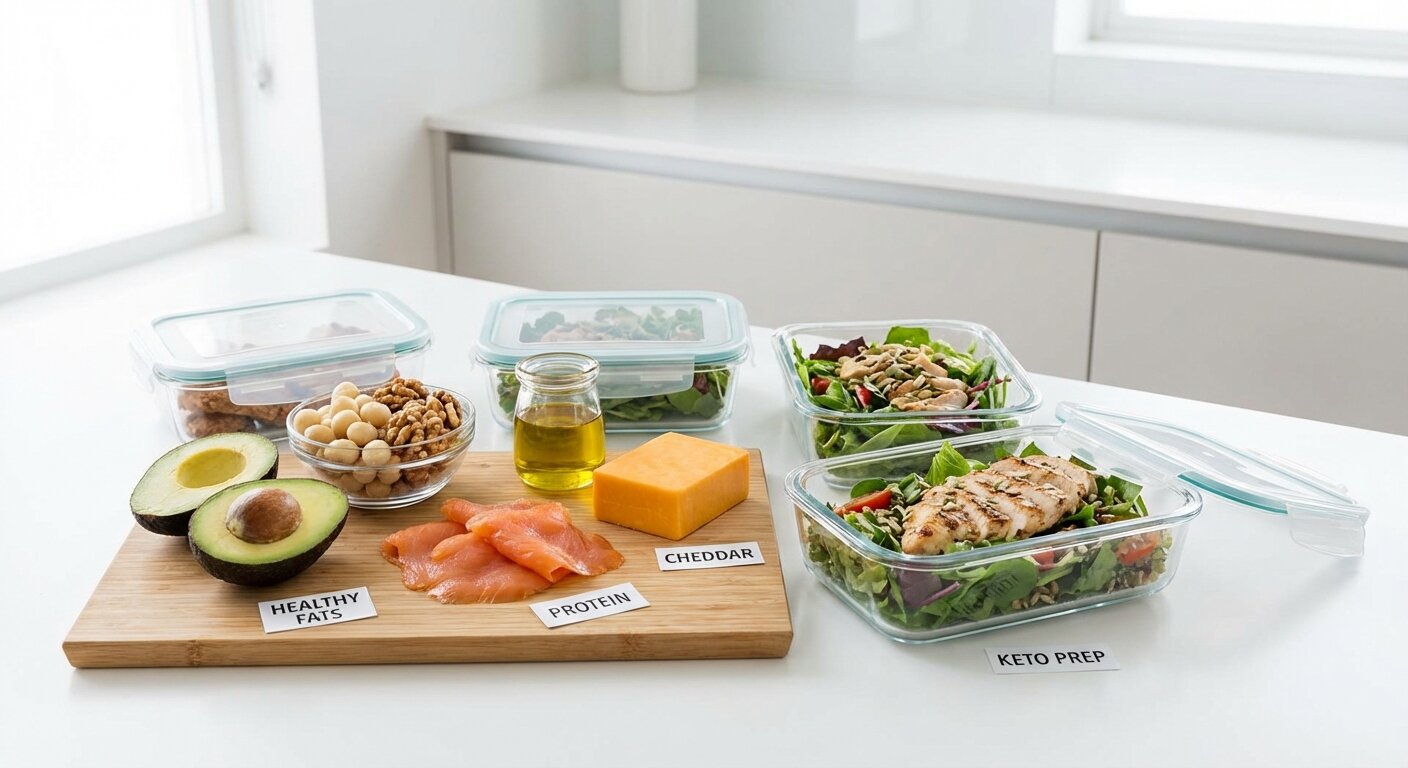
Day 1: Standard Keto Fat Loss (1,800 cal, 20C/85P/152F)
Breakfast:
- 3 eggs scrambled in butter
- 2 strips bacon
- ½ avocado
- Black coffee
- Macros: 24g P / 3g C / 48g F (540 cal)
Lunch:
- 6 oz grilled chicken thigh (skin on)
- Large salad (spinach, cucumber, tomato)
- 2 tbsp olive oil + vinegar dressing
- Macros: 35g P / 8g C / 52g F (632 cal)
Snack:
- 1 oz macadamia nuts
- String cheese
- Macros: 9g P / 3g C / 25g F (272 cal)
Dinner:
- 5 oz salmon (baked with butter)
- Roasted broccoli with olive oil
- Side salad
- Macros: 35g P / 6g C / 32g F (464 cal)
Total: 103g P / 20g C / 157g F (1,908 cal)
Day 2: Active Male Keto (2,800 cal, 30C/160P/227F)
Breakfast:
- 4-egg omelet with cheese and spinach
- 3 sausage links
- ½ avocado
- Macros: 42g P / 4g C / 62g F (748 cal)
Mid-Morning:
- Protein shake (keto protein powder + MCT oil)
- 1 oz almonds
- Macros: 32g P / 6g C / 28g F (420 cal)
Lunch:
- 8 oz ribeye steak
- Cesar salad (no croutons) with dressing
- Macros: 56g P / 5g C / 58g F (788 cal)
Pre-Workout:
- 15g dextrose (for TKD approach)
- Macros: 0g P / 15g C / 0g F (60 cal)
Dinner:
- 7 oz chicken thighs
- Cauliflower mash with butter
- Green beans sautéed in olive oil
- Macros: 48g P / 8g C / 46g F (640 cal)
Evening Snack:
- Keto fat bombs (cream cheese, cocoa, sweetener)
- Macros: 4g P / 3g C / 28g F (276 cal)
Total: 182g P / 41g C / 222g F (2,932 cal)
Day 3: Keto Maintenance (2,000 cal, 35C/80P/174F)
Breakfast:
- 2 eggs + 2 egg whites
- 2 slices bacon
- Sautéed spinach in butter
- Macros: 26g P / 2g C / 28g F (380 cal)
Lunch:
- Bunless burger (6 oz 80/20 beef)
- Avocado, lettuce, tomato, cheese
- Side of cucumber salad
- Macros: 38g P / 10g C / 52g F (648 cal)
Snack:
- Celery sticks with almond butter
- Macros: 4g P / 8g C / 16g F (192 cal)
Dinner:
- 6 oz pork chops
- Roasted Brussels sprouts with bacon
- Small side salad with olive oil
- Macros: 42g P / 12g C / 48g F (624 cal)
Dessert:
- Keto cheesecake (made with almond flour crust)
- Macros: 6g P / 5g C / 28g F (296 cal)
Total: 116g P / 37g C / 172g F (2,140 cal)
Common Keto Macro Mistakes
Mistake 1: Not Tracking Net Carbs Properly
Problem: Counting total carbs instead of net carbs, eating too few vegetables
Solution: Subtract fiber. A food with 10g total carbs and 6g fiber = 4g net carbs. Track net carbs.
Mistake 2: Under-Eating Protein
Problem: “Protein kicks me out of ketosis so I keep it under 60g”
Solution: Eat adequate protein (0.7-1.0g per lb lean mass). Muscle loss is worse than slightly lower ketones.
Mistake 3: Overeating Fat
Problem: “Keto = high fat, so I add butter and oil to everything even when full”
Solution: Fat is for satiety and meeting calories. For fat loss, don’t force extra fat. Let body fat fill the gap.
Mistake 4: Hidden Carbs
Problem: Not tracking sauces, dressings, “low-carb” products with hidden sugars
Solution: Read labels. Track everything. Many sauces have 5-10g carbs per serving.
Mistake 5: Not Supplementing Electrolytes
Problem: “Keto flu” from sodium, potassium, magnesium depletion
Solution:
- 3,000-5,000mg sodium daily
- 1,000-3,500mg potassium
- 300-500mg magnesium
- Use salt, electrolyte supplements, bone broth
Mistake 6: Giving Up Too Soon
Problem: Quitting after 1 week because “it’s too hard” or “not losing weight fast enough”
Solution: Fat adaptation takes 2-4 weeks. Give it at least a month before judging results.
Mistake 7: Using Percentages Instead of Grams
Problem: “I need to eat 75% fat” but not knowing what that means for YOUR body
Solution: Calculate grams based on YOUR bodyweight, lean mass, and TDEE. Percentages are guidelines only.
Frequently Asked Questions
Can I build muscle on keto?
Yes, but it’s harder than on higher-carb diets. Muscle growth is slower. If muscle gain is priority, consider cyclical keto (carb refeeds) or targeted keto (carbs around workouts). High protein (1.0-1.2g/lb lean mass) is essential.
Do I need to hit my fat macro exactly?
No. Fat is a LIMIT, not a goal. If you’re trying to lose fat, eating less dietary fat is fine—your body will burn stored fat. Hit protein and stay under carbs. Fat is for satiety.
How long does it take to get into ketosis?
Typically 2-4 days of eating under 20g net carbs. Blood/breath ketones confirm. Some people reach ketosis in 24 hours (especially with fasting). Full fat-adaptation takes 2-4 weeks.
What if I cheat and eat carbs?
You’ll likely exit ketosis. Glycogen stores refill, ketone production stops. Takes 2-4 days to return to ketosis. Not the end of the world, but frequent cheating defeats the purpose.
Should I do keto if I’m an athlete?
Endurance athletes can thrive on keto once adapted. Strength/power athletes may struggle due to reduced glycogen. Consider targeted keto (carbs pre-workout) if performance suffers.
Can women do keto?
Yes, same principles. Some women experience hormone disruption on very low carb (<20g). If period irregularity occurs, increase to 30-50g net carbs or consider carb cycling.
Do I need to track macros forever?
Initially, yes—to learn portion sizes and ensure ketosis. Once experienced, some people intuitively eat keto without tracking. But for weight loss, tracking significantly improves adherence and results.
Your Keto Macro Action Plan
You now have the complete formula for calculating keto macros.
Here’s your implementation plan:
Week 1 (Setup):
- Calculate TDEE and apply deficit/surplus
- Set net carbs at 20g (strict for guaranteed ketosis)
- Set protein at 0.7-1.0g per pound lean mass
- Fill remaining calories with fat
- Download tracking app (MyFitnessPal, Carb Manager, Cronometer)
- Buy ketone strips or meter
Week 1-2 (Adaptation):
- Track everything you eat
- Aim to hit macros 6-7 days per week
- Test ketones on day 3, 5, and 7
- Expect “keto flu” (fatigue, headaches)—supplement electrolytes
- Weigh daily, record starting weight average
Week 3-4 (Fat-Adapted):
- Energy should improve dramatically
- Hunger decreases
- Ketone levels stabilize (0.5-2.0 mmol/L)
- Assess weight loss: losing 0.5-1% per week?
- If not in ketosis, reduce carbs to 15g and retest
Month 2+:
- Adjust macros if weight loss stalls
- Experiment with carb tolerance (try 30-40g once fat-adapted)
- Consider targeted keto if training performance suffers
- Recalculate macros every 15-20 lbs lost
Remember: Keto requires commitment. Give it at least 4 weeks before judging. Once fat-adapted, many people feel incredible—energy, mental clarity, appetite control, and consistent fat loss.
Ready to calculate your personalized keto macros? Use our free macro calculator with keto mode enabled.
Related guides:
- What Are Macronutrients? (Complete Guide)
- How to Count Macros (Pillar Guide)
- Best Macro Ratios for Different Goals
- How to Calculate Your Macros Step-by-Step
- Best Macro Split for Weight Loss
- How Much Protein Do You Need Per Day
Now go calculate those keto macros and experience what high-fat, low-carb eating can do for your body.
Related Articles
Travel Macros: How to Track Nutrition While Traveling
Complete guide to managing macros while traveling. Learn meal planning strategies,...
Read guide →
Macros for Shift Workers: Complete Guide to Nutrition on Rotating Schedules
Master macro tracking on night shifts and rotating schedules. Learn meal timing, sleep...
Read guide →
Macros During Ramadan: Complete Nutrition Guide for Fasting
Learn how to track macros during Ramadan fasting. Expert guide covering meal timing,...
Read guide →Disclaimer: This content is for informational purposes only. Consult a healthcare provider before making changes to your diet.