TDEE Calculator: Calculate Your Total Daily Energy Expenditure
Reviewed by Sarah Chen, MS, RD
You want to lose fat, build muscle, or simply understand how much you should be eating. But every article throws around different calorie numbers, and you’re not sure where to start.
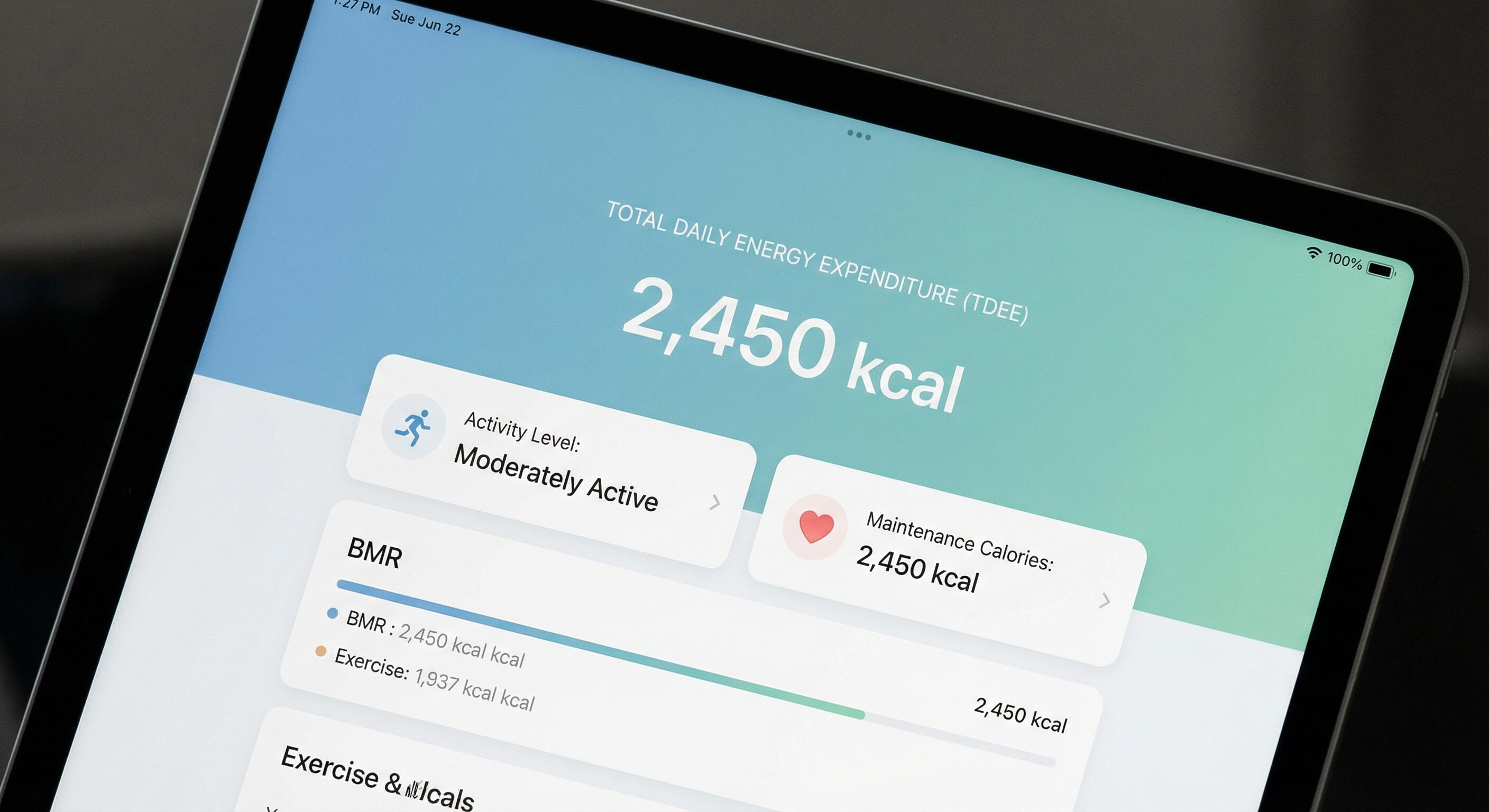
The answer starts with one number: your TDEE (Total Daily Energy Expenditure).
Your TDEE is the total number of calories you burn in a day—from sleeping, walking, thinking, working out, even digesting food. It’s your metabolic baseline, and it’s the foundation for every nutrition goal.
Once you know your TDEE, everything else falls into place. Want to lose weight? Eat below it. Want to gain muscle? Eat above it. Want to maintain? Eat right at it.
This guide explains exactly what TDEE is, how to calculate it accurately, and how to use it to reach your goals.
Ready to get your number? Use our Macro Calculator to calculate your TDEE and personalized macros in under 60 seconds.

What Is TDEE?
TDEE stands for Total Daily Energy Expenditure—the complete number of calories you burn every single day.
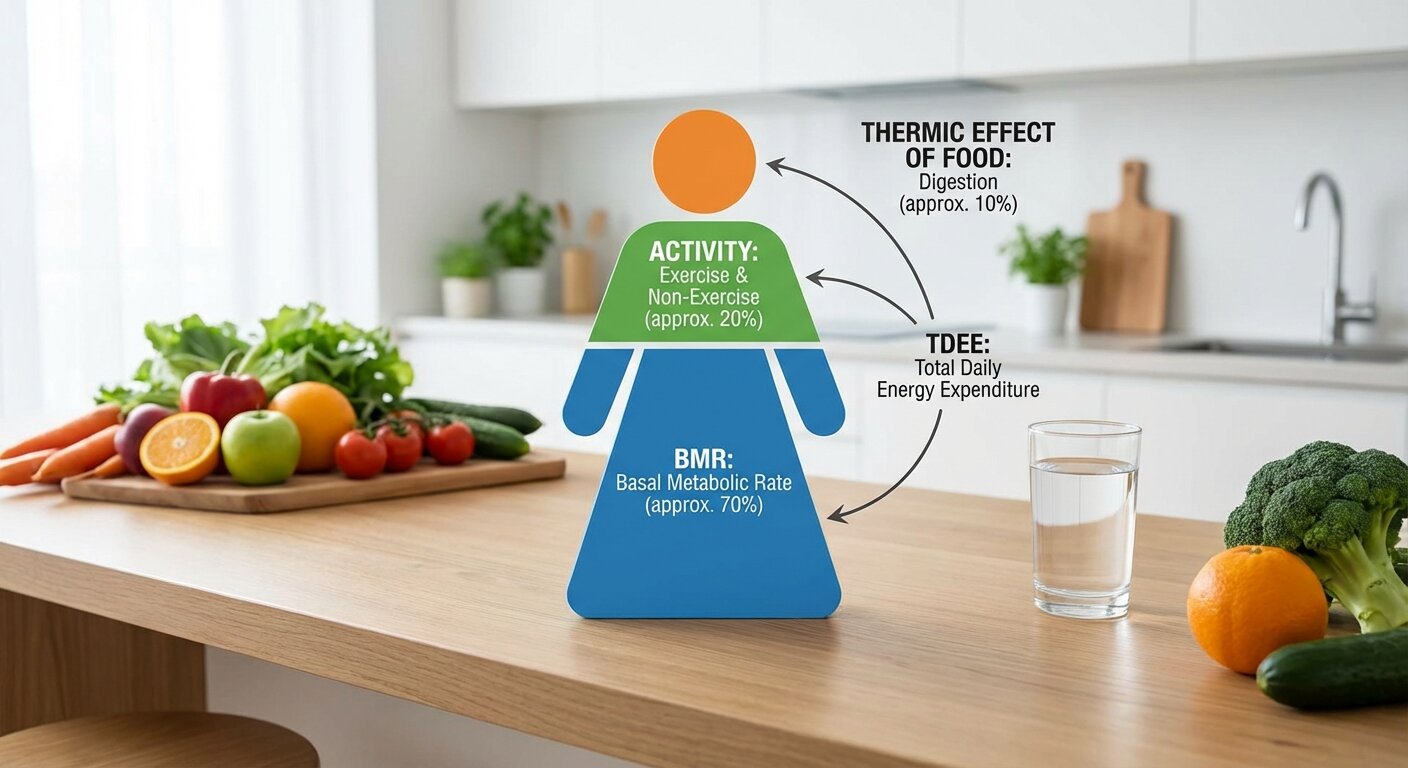
Your TDEE includes four main components:
1. Basal Metabolic Rate (BMR)
The calories you burn just staying alive. Breathing, circulating blood, maintaining body temperature, cell production—all the automatic functions that keep you living.
BMR typically accounts for 60-70% of your TDEE for most people. It’s your baseline—the minimum calories you’d need if you stayed in bed all day.
2. Activity Thermogenesis
The calories burned from all movement:
- Exercise Activity Thermogenesis (EAT): Structured workouts like lifting, running, or sports
- Non-Exercise Activity Thermogenesis (NEAT): Everything else—walking, fidgeting, typing, cleaning
For sedentary people, activity might add 15-30% to BMR. For very active people, it can add 50-100%.
3. Thermic Effect of Food (TEF)
The energy your body uses to digest, absorb, and process food. TEF accounts for about 8-15% of total calories consumed.
Protein has the highest thermic effect (20-30% of calories consumed), followed by carbs (5-10%), and fats (0-3%).
4. Adaptive Thermogenesis
Small metabolic adjustments your body makes in response to overfeeding or underfeeding. This is typically minor but can affect long-term weight changes.
Your TDEE = BMR + Activity + TEF + Adaptive Thermogenesis
Understanding TDEE is the first step toward calculating the right macros for your body. Learn more in our complete guide on what macronutrients are and how they affect your daily energy needs.
How to Calculate Your TDEE
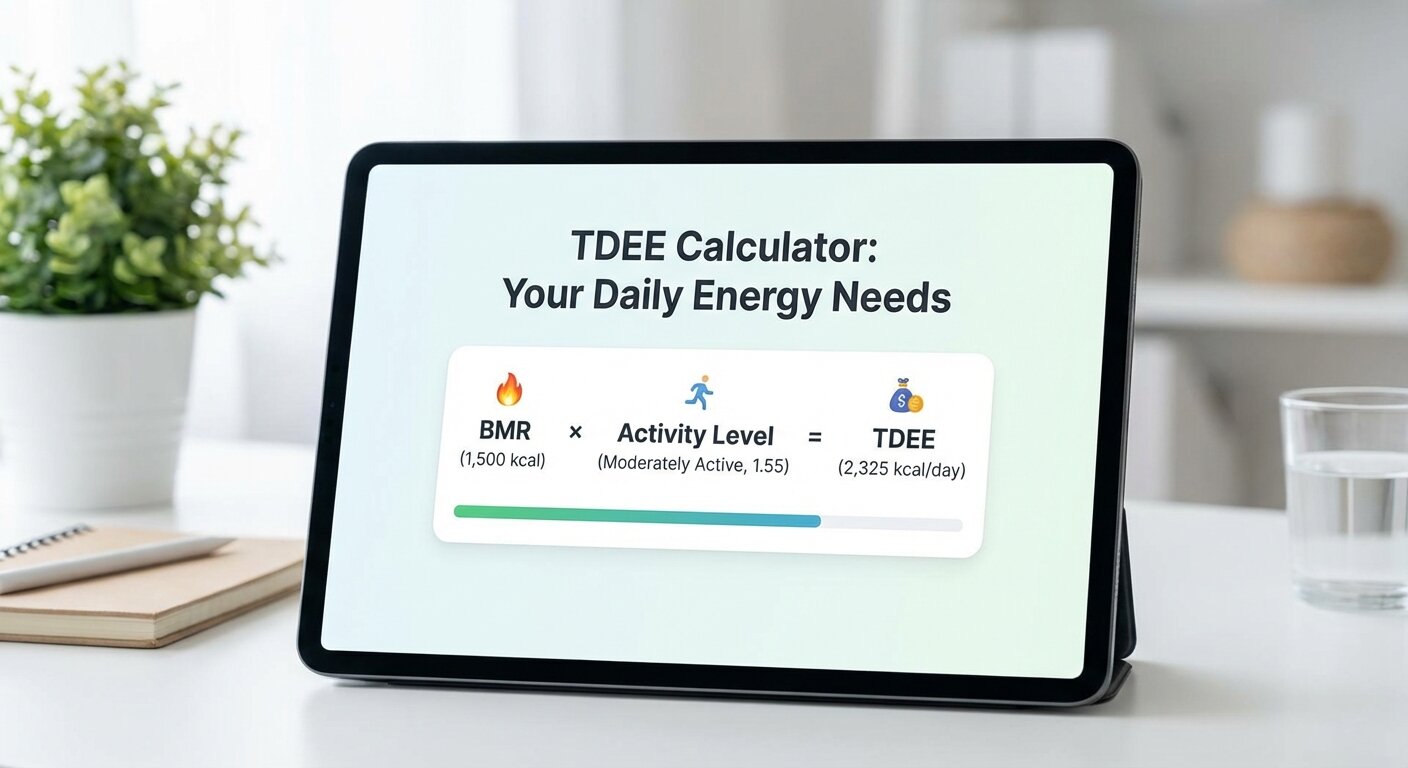
Calculating TDEE involves two steps: finding your BMR, then multiplying by an activity factor.
Step 1: Calculate Your BMR
The most accurate formula for BMR is the Mifflin-St Jeor equation:
For Men: BMR = (10 × weight in kg) + (6.25 × height in cm) - (5 × age) + 5
For Women: BMR = (10 × weight in kg) + (6.25 × height in cm) - (5 × age) - 161
Example (30-year-old woman, 150 lbs / 68 kg, 5’6” / 168 cm):
- BMR = (10 × 68) + (6.25 × 168) - (5 × 30) - 161
- BMR = 680 + 1,050 - 150 - 161
- BMR = 1,419 calories
This is the minimum she burns just being alive.
Step 2: Multiply by Activity Factor
Now multiply your BMR by your activity level:
| Activity Level | Description | Multiplier |
|---|---|---|
| Sedentary | Desk job, minimal/no exercise | BMR × 1.2 |
| Lightly Active | Light exercise 1-3 days/week | BMR × 1.375 |
| Moderately Active | Moderate exercise 3-5 days/week | BMR × 1.55 |
| Very Active | Hard exercise 6-7 days/week | BMR × 1.725 |
| Extremely Active | Physical job + intense daily training | BMR × 1.9 |
Continuing our example (lightly active):
- TDEE = 1,419 × 1.375
- TDEE = 1,951 calories
This woman burns approximately 1,951 calories per day. That’s her maintenance level.
The Easiest Way: Use a Calculator
Rather than doing the math yourself, use our Macro Calculator. It handles the BMR calculation and activity multiplier automatically, then gives you both your TDEE and personalized macro targets.
Choosing Your Activity Level (Be Honest!)
The biggest mistake people make? Overestimating their activity level.
Here’s how to accurately assess yours:
Sedentary (BMR × 1.2)
- Desk job, remote work, driving job
- No structured exercise, or only 1-2 days per week
- Under 5,000 steps per day
- Example: Office worker who goes to the gym once a week
This describes most people. Even if you work out 3x/week but sit the rest of the time, you’re closer to sedentary than you think.
Lightly Active (BMR × 1.375)
- Desk job with intentional daily movement
- Light exercise or walking 3-4 days per week
- 7,000-10,000 steps per day
- Example: Office worker who lifts 3x/week and walks daily
Moderately Active (BMR × 1.55)
- Job involves standing/walking most of the day
- Moderate to intense exercise 4-5 days per week
- 10,000-15,000 steps per day
- Example: Teacher who does CrossFit 4x/week, or construction worker who lifts 3x/week
Very Active (BMR × 1.725)
- Physical job or training for a sport
- Intense exercise 6-7 days per week
- 15,000+ steps per day
- Example: Personal trainer, athlete in-season, or manual laborer who trains daily
Extremely Active (BMR × 1.9)
- Elite athlete or extremely physical job
- Multiple training sessions per day
- Example: Professional athlete, military special forces, competitive bodybuilder during peak training
When in doubt, choose the lower option. It’s easier to add calories than to figure out why you’re not losing weight.
Using Your TDEE for Different Goals
Once you know your TDEE, you can set the right calorie target for your specific goal.
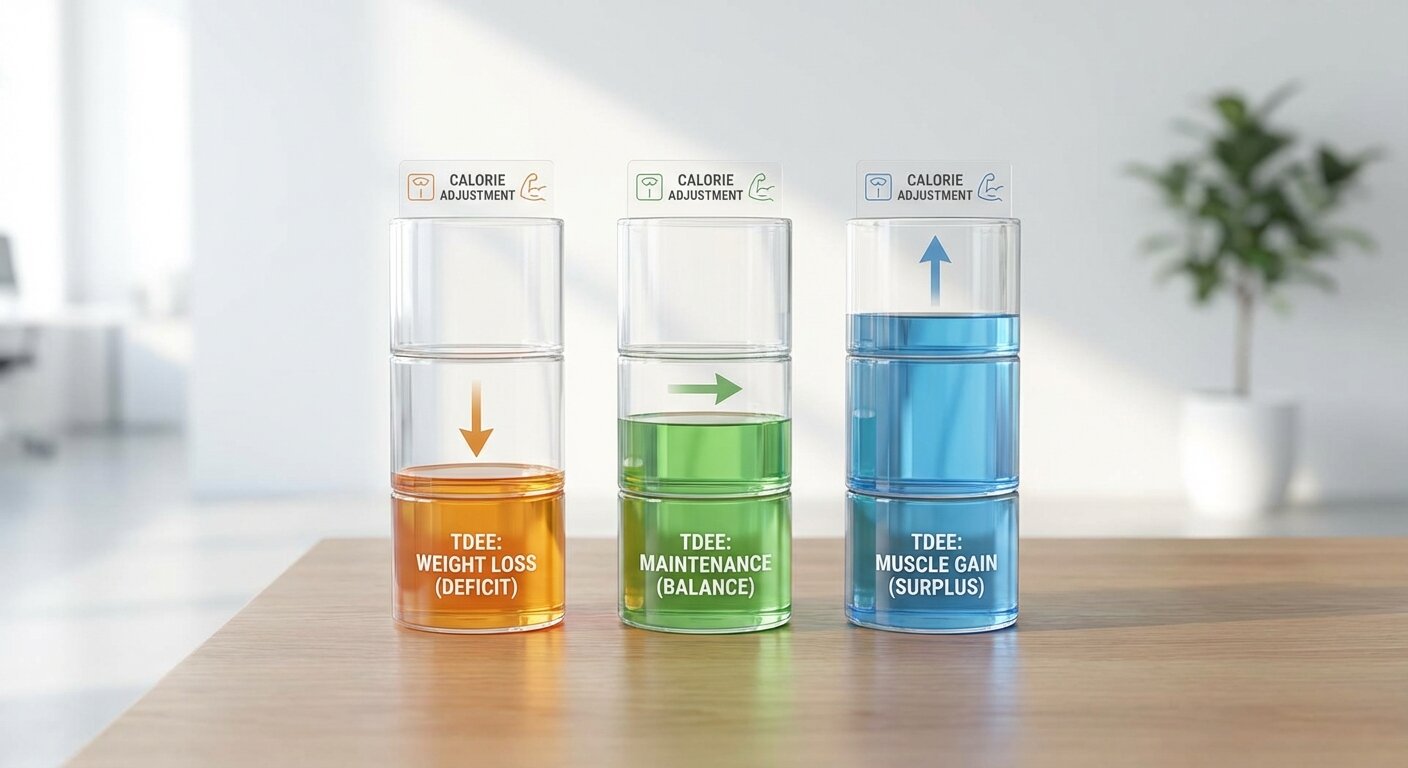
For Weight Maintenance
Eat at your TDEE.
If you want to stay at your current weight, eat the number of calories your TDEE calculator gives you. Your weight should remain stable over several weeks.
For Fat Loss
Eat 300-500 calories below your TDEE.
A moderate deficit leads to 0.5-1 pound of fat loss per week. This rate preserves muscle mass, maintains energy, and is sustainable long-term.
Example (TDEE: 2,000 calories):
- Deficit: 2,000 - 500 = 1,500 calories per day
- Expected loss: 1 pound per week
Aggressive deficits (750-1,000 calories) work short-term but are harder to sustain and risk muscle loss. Learn more about setting the right deficit in our guide to macros for weight loss.
For Muscle Gain (Bulking)
Eat 300-500 calories above your TDEE.
A moderate surplus supports muscle growth without excessive fat gain. Pair this with progressive strength training for best results.
Example (TDEE: 2,200 calories):
- Surplus: 2,200 + 400 = 2,600 calories per day
- Expected gain: 0.5-1 pound per week (mix of muscle and some fat)
For detailed guidance on building muscle, check out our complete guide on macros for muscle gain.
For Body Recomposition
Eat at or slightly below TDEE with high protein.
Body recomposition (building muscle while losing fat) works best for beginners or returning lifters. Eat at maintenance calories with 1.0-1.2g protein per pound of bodyweight and focus on strength training.
Progress is slower but produces dramatic visual changes. Learn more in our body recomposition macros guide.
TDEE vs BMR: What’s the Difference?
People often confuse TDEE and BMR. Here’s the key difference:
| BMR | TDEE | |
|---|---|---|
| Definition | Basal Metabolic Rate | Total Daily Energy Expenditure |
| What it measures | Calories burned at complete rest | Total calories burned including activity |
| Typical percentage | 60-70% of total burn | 100% (includes BMR) |
| What it includes | Only basic bodily functions | BMR + activity + digestion |
| Example value | 1,400 calories | 2,000 calories |
Think of it this way:
- BMR = The calories you’d burn lying in bed all day in a dark room
- TDEE = The calories you actually burn living your normal life
Should You Ever Eat Below Your BMR?
Generally, no.
Your BMR represents the minimum energy your body needs to function. Consistently eating below BMR can lead to:
- Metabolic slowdown
- Muscle loss
- Hormonal disruption
- Extreme fatigue
- Nutrient deficiencies
Short-term aggressive deficits (like a week-long diet break) won’t cause harm, but chronic under-eating below BMR is unsustainable and counterproductive.
Safe approach: Keep your deficit moderate (TDEE minus 300-500), which keeps you well above BMR while still losing fat consistently.
Factors That Affect Your TDEE
Your TDEE isn’t static—it changes based on several factors:
1. Body Weight
Heavier people burn more calories. As you lose weight, your TDEE decreases because you’re moving less mass.
Implication: Recalculate your TDEE every 10-15 pounds lost.
2. Muscle Mass vs Fat Mass
Muscle burns more calories at rest than fat. Someone with 20% body fat at 150 lbs burns more calories than someone with 30% body fat at the same weight.
Implication: Strength training helps maintain TDEE during weight loss.
3. Age
Metabolism slows slightly with age due to muscle loss and hormonal changes. TDEE typically decreases 1-2% per decade after age 30.
Implication: Older adults may need to be more precise with calorie tracking.
4. Sex
Men typically have higher TDEEs than women due to more muscle mass and higher baseline metabolism.
Implication: Direct calorie comparisons between men and women aren’t useful.
5. Genetics
Some people have naturally faster or slower metabolisms. The variation is typically 5-10% between individuals of similar size and composition.
Implication: TDEE calculators give estimates. Your actual TDEE might be slightly higher or lower.
6. Metabolic Adaptation
After prolonged calorie restriction, your body adapts by reducing NEAT (spontaneous movement) and becoming more efficient. This can lower your TDEE by 5-15%.
Implication: Take diet breaks every 8-12 weeks to restore metabolic rate.
7. Hormonal Factors
Thyroid function, sleep quality, stress, and hormonal health affect metabolism.
Implication: If your TDEE seems unusually low despite accurate tracking, consult a doctor to rule out thyroid issues.
How to Adjust Your TDEE Over Time
Your TDEE isn’t a fixed number. You’ll need to adjust it as your body and circumstances change.
When to Recalculate:
- Every 10-15 pounds of weight change (loss or gain)
- When you change activity levels (new training program, job change)
- Every 8-12 weeks even if weight is stable (metabolic adaptation)
- When weight loss stalls for 2-3 weeks despite consistent tracking
How to Track Your Real-World TDEE:
The best way to find your actual TDEE is to track your intake and weight for 2-4 weeks:
- Weigh yourself daily (same time, after waking, after using bathroom)
- Calculate your weekly average weight
- Track your daily calorie intake accurately
- Calculate your weekly average intake
If your weight stays stable for 2-3 weeks: Your average intake = your TDEE
If you lose weight: Your TDEE is higher than your intake
- Lost 1 lb/week? Your TDEE is ~500 calories higher
If you gain weight: Your TDEE is lower than your intake
- Gained 1 lb/week? Your TDEE is ~500 calories lower
This real-world data is more accurate than any calculator.
Common TDEE Calculation Mistakes
Mistake 1: Overestimating Activity Level
“I work out 5 days a week, so I’m Very Active!”
Not quite. If you sit 8 hours at work, commute sitting, and relax sitting at home, those 5 hours of weekly exercise don’t outweigh 60+ hours of sitting.
Fix: Be brutally honest. Most people are Sedentary or Lightly Active.
Mistake 2: Not Adjusting as Weight Changes
Your TDEE at 200 lbs is higher than at 170 lbs. If you don’t recalculate, you’ll wonder why weight loss stalled.
Fix: Recalculate every 10-15 lbs.
Mistake 3: Eating Below BMR Long-Term
“I’ll just eat 1,000 calories and lose weight faster!”
This backfires. You’ll lose muscle, crash your metabolism, feel terrible, and likely rebound.
Fix: Keep deficits moderate. Slow and steady wins.
Mistake 4: Ignoring Real-World Results
Calculator says 2,200, but you’re gaining weight eating 2,200? Your actual TDEE is lower.
Fix: Use calculators as starting points. Adjust based on 2-4 weeks of real data.
Mistake 5: Forgetting About Weekends
You eat 1,800 Monday-Friday, then 3,000 Saturday-Sunday. Your weekly average is actually 2,143 calories.
Fix: Track your weekly average, not just weekday intake.

TDEE and Macro Tracking: The Next Step
Knowing your TDEE tells you how much to eat. But for real results—fat loss while preserving muscle, or muscle gain without excessive fat—you need to know what to eat.
That’s where macros come in.
Once you have your TDEE and calorie target, you’ll set your protein, carbs, and fats based on your goals. Protein supports muscle, carbs fuel performance, and fats support hormones.
Quick Macro Guidelines:
- Protein: 0.8-1.2g per pound of bodyweight
- Fat: 0.3-0.5g per pound of bodyweight
- Carbs: Fill the remaining calories
The easy way: Use our Macro Calculator to get your TDEE and personalized macro split in one step.
For a complete guide on setting and tracking macros, read our article on how to count macros.
FAQ: TDEE Calculator
What is TDEE and why does it matter?
TDEE (Total Daily Energy Expenditure) is the total number of calories you burn in a day, including your basal metabolic rate, activity, exercise, and digestion. Knowing your TDEE helps you set accurate calorie targets for weight loss, maintenance, or muscle gain.
How accurate is a TDEE calculator?
TDEE calculators provide estimates within 5-10% accuracy for most people. Your actual TDEE depends on factors like muscle mass, genetics, and metabolic adaptation. Use the calculator as a starting point, then adjust based on your real-world results over 2-4 weeks.
What’s the difference between BMR and TDEE?
BMR (Basal Metabolic Rate) is the calories you burn at complete rest. TDEE includes your BMR plus all activity, exercise, and the energy cost of digesting food. For most people, TDEE is 20-50% higher than BMR depending on activity level.
How do I choose the right activity level?
Be honest about your actual activity. Sedentary means desk job with minimal exercise. Lightly active includes 1-3 days of exercise per week. Moderately active means 3-5 days. Very active is 6-7 days of intense training. Most people overestimate—when in doubt, go with the lower option.
Should I eat my TDEE or eat less?
Eat at your TDEE to maintain your current weight. Create a deficit (TDEE minus 300-500 calories) for fat loss, or a surplus (TDEE plus 300-500 calories) for muscle gain. Never drop below your BMR for extended periods.
Why is my TDEE different from my friend’s?
TDEE varies based on age, sex, height, weight, body composition, and activity level. Men typically have higher TDEEs due to more muscle mass. Taller and heavier people burn more calories. Active individuals burn significantly more than sedentary people.
How often should I recalculate my TDEE?
Recalculate your TDEE every 10-15 pounds of weight change, when you significantly change your activity level, or every 8-12 weeks. As you lose weight, your TDEE decreases because you’re burning fewer calories moving a lighter body.
Can I lose weight by just eating at my TDEE?
No, eating at your TDEE maintains your current weight. To lose weight, you need to eat below your TDEE (a calorie deficit). A deficit of 300-500 calories typically leads to 0.5-1 pound of fat loss per week.
Related Articles

Travel Macros: How to Track Nutrition While Traveling
Complete guide to managing macros while traveling. Learn meal planning strategies,...
Read guide →
Macros for Shift Workers: Complete Guide to Nutrition on Rotating Schedules
Master macro tracking on night shifts and rotating schedules. Learn meal timing, sleep...
Read guide →
Macros During Ramadan: Complete Nutrition Guide for Fasting
Learn how to track macros during Ramadan fasting. Expert guide covering meal timing,...
Read guide →Disclaimer: This content is for informational purposes only. Consult a healthcare provider before making changes to your diet.